Hillary Clinton Honors Madeleine Albright: A Legacy of Pushing Boundaries
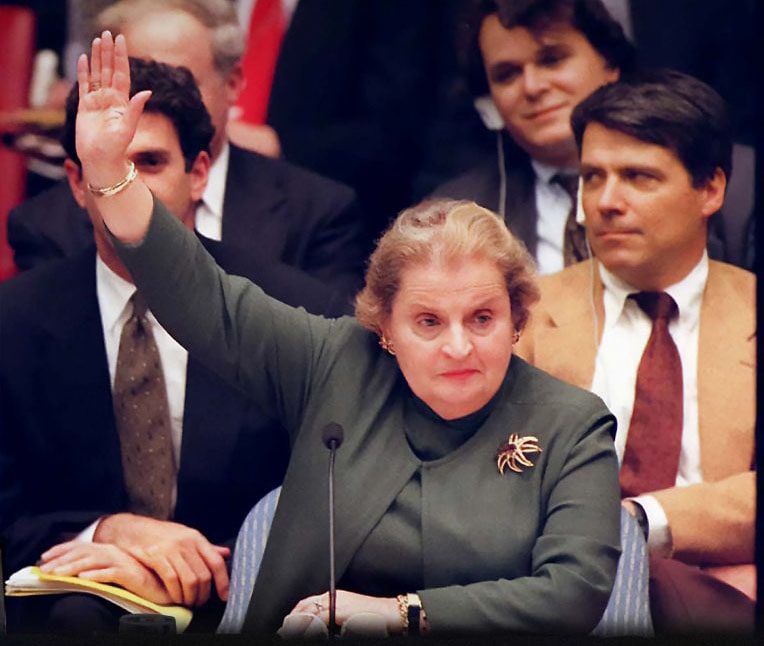
Hillary Clinton Honors Madeleine Albright: A Legacy of Pushing Boundaries
In a heartfelt tribute, Hillary Clinton reflects on the life and legacy of former US Secretary of State Madeleine Albright, who recently passed away. Clinton suggests that we can honor Albright’s memory by embracing her wisdom and continuing her work.
A Night Over the Pacific
Late one night in 1995, aboard a cramped airplane soaring over the Pacific, Madeleine Albright reviewed a draft of a speech Clinton was preparing for the United Nations conference on women in Beijing. With a firm stare that had made even the most fearsome dictators shudder, Albright asked Clinton what she truly aimed to achieve with her address.
Clinton replied, “I want to push the envelope as far as I can.” Albright’s response was simple and direct: “Then do it.” She then guided Clinton on how to refine the speech’s argument that women’s rights are human rights, and human rights are women’s rights.
The Essence of Madeleine
That was Madeleine—always cutting straight to the heart of the matter with clarity and courage. Throughout her life, she pushed boundaries. She did so on behalf of women and girls, shattering the glass ceiling of diplomacy as the first woman to serve as Secretary of State. She called out atrocities against women worldwide and championed the United States as an indispensable nation and the leader of the free world. She never stopped advocating for freedom and democracy, even persuading skeptical generals and diplomats to see human rights as a national security imperative.
A Personal Loss
For Bill and Hillary Clinton, and for Albright’s many friends around the world, her passing is a painful personal loss. She was irrepressible—wickedly funny, stylish, and always ready for adventure and fun. Clinton recalls the excitement Albright showed when walking her through the streets of her native Prague, pointing out the yellow house where she lived as a girl. They couldn’t stop laughing when an unexpected rainstorm turned their umbrellas inside out, and they couldn’t stop smiling when the captivating playwright and dissident-turned-president Václav Havel charmed them over dinner.
Albright was 10 years ahead of Clinton at Wellesley, and for decades, they addressed and signed their notes to each other as “Dear ’59” and “Love, ’69.”
A Woman of Action
In the 1990s, when Bill Clinton appointed Albright as UN Ambassador and then Secretary of State, she confronted the blood-soaked Serbian dictator Slobodan Milošević. She helped rally American power and the NATO alliance to end the brutal war in Bosnia and ethnic cleansing in Kosovo. She saw the chronically underestimated Russian president Vladimir Putin for what he is: a vicious autocrat intent on reclaiming Russia’s lost empire and a committed foe of democracy everywhere.
In a prescient column in the Times published on February 23, Albright warned that an invasion of Ukraine would be “a historic error” that would leave Russia “diplomatically isolated, economically crippled, and strategically vulnerable in the face of a stronger, more united Western alliance.” As often happened, the man with the guns was wrong, and Madeleine was right.
Lessons Worth Remembering
Albright was a woman of action, especially when facing injustice. In 2000, she became the first Secretary of State to travel to North Korea, where she spent 12 hours negotiating with the dictator Kim Jong-il. However, as she often said, her crucial historical frame of reference was Munich, not Vietnam, so she had a deep appreciation for the risks of inaction.
Today, with a rising tide of authoritarianism threatening democracy not just in Ukraine but worldwide, her lessons are worth remembering. Having experienced Europe’s historic traumas firsthand, Albright understood that the security provided by NATO was the key to keeping the continent free, peaceful, and undivided.
A Strong Belief in Alliances
She rejected the criticism that NATO’s expansion needlessly provoked Russia and is to blame for its invasion of Ukraine. If NATO had not expanded, Putin would be menacing not just Ukraine but the Baltic States and likely all of Eastern Europe. As the historian and journalist Anne Applebaum recently argued, “The expansion of NATO was the most successful, if not the only truly successful, piece of American foreign policy of the last 30 years.”
Albright also strongly disagreed with Donald Trump’s approach of treating America’s alliances as a protection racket where partners must pay tribute or fend for themselves. She knew that US alliances—especially with other democracies—are a military, diplomatic, and economic asset that neither Russia nor China can match, despite their best efforts, and crucial for national security.
A Lasting Legacy
Even at the end of her life, Albright treasured her first glimpse of the Statue of Liberty, sailing into New York Harbor in 1948 as an 11-year-old refugee on a ship called the SS America. She would have been thrilled by President Joe Biden’s recent announcement that the United States will welcome up to 100,000 refugees fleeing Ukraine, and she would encourage us to do more to respond to this unfolding humanitarian nightmare.
She would warn, as she did in her book, about the “self-centered moral numbness that allows fascism to thrive,” and urge us to keep pushing the envelope for freedom, human rights, and democracy. We should listen.
This article first appeared in The New York Times. Reproduced under license.