Ekaterina Zinoveva-Provinskaya Shares Insights on Groundbreaking Performance
Ekaterina Zinoveva-Provinskaya Shares Insights on Groundbreaking Performance
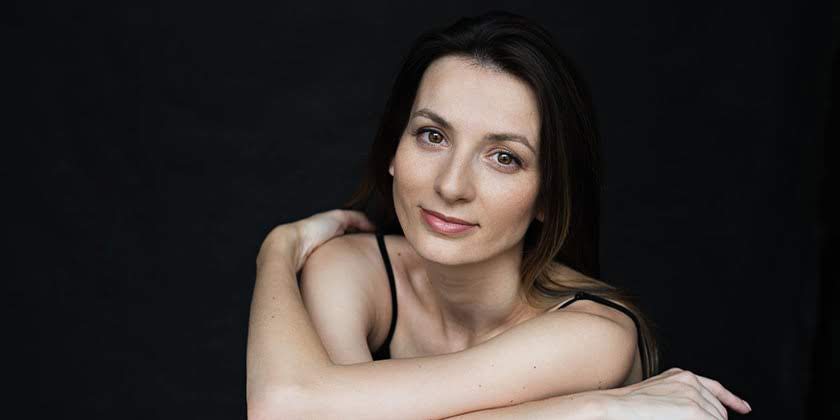
On April 24th, the improvisational plastic performance-parable “Fire and Ice” will take place. Supported by the company A1, the Family Inclusive Theater “i” has produced Belarus’s first virtual production performance to celebrate its fifth anniversary. The lead roles will be performed by artists from the Belarusian State Academic Theater, including Marina Vezhnovets, Yuri Kovalev, Ekaterina Zinoveva-Provinskaya, actor Mikhail Samusenko, directors, teachers, actors from the Family Inclusive Theater “i”, and a quintet of musicians: Alexandra Sandler (keyboards), Karen Karapetyan (violin), Anton Mashkalo (flute), Bogdan Doveryalo (cello), and Daniil Zalesky (percussion). Ekaterina Zinoveva-Provinskaya, a ballerina, drama theater, and film actress, shared her thoughts on the new production and her impressions of working on the performance.
About the Family Inclusive Theater “i”
The Family Inclusive Theater “i” was established in 2016 based on the theater studio of Irina Pushkareva with the general support of the company A1. During the classes, students, including children with autism, learn choreography, plasticity, vocals, acting, and communication. The main task of the theater is to produce professional performances for the whole family, which help demonstrate a model of a society of equal opportunities to the audience.
Interview with Ekaterina Zinoveva-Provinskaya
Ekaterina, how did it all begin?
I was invited to this project by my teacher, Alexandra Sandler, who teaches at the Belarusian State Academy of Arts. I have been in love with this person since my student days and continue to be. As a professional, I completely trust her, so I had no doubts about participating in the performance “Fire and Ice.” Although it should be noted that it was somewhat of an adventure, as initially, she did not tell me anything specific about the project.
Alexandra Israilevna, a musician and composer, is responsible for the music in this performance. I would say that she is its soul, as music is the foundation of the production, the thread that connects all the participants.
What is meant by an “improvisational performance” in this case?
The entire performance is a large improvisation, both musical and plastic. Of course, improvisation is a game, but like any game, it has certain rules and frameworks. We know where the character comes from and where they are going, what they should do, but HOW they do it happens differently each time. Even at the premiere, everything will not be exactly as it was during rehearsals. Moreover, no single rehearsal is like another; each reflects the inner state of the artists here and now. That is why we say that this performance is unique.
All artists know that even the same opera, ballet, or drama performance is never repeated; it is different each time, depending on the mood, the state of the artists, musicians, and even the audience on a particular evening. But in traditional productions, the text is strictly prescribed: choreographic, vocal, etc. Improvisation, whether musical or physical, gives the artist complete freedom. For example, you might initially think of doing one thing, but your body behaves differently than intended. It is essential not to stop yourself but to follow your feeling.
This is what distinguishes classical dance from the art of improvisation because, in ballet, it is necessary to fit into the ballet pattern and perfectly perform the prescribed movement or pose. Here, you can do whatever you want. It is not classical, not contemporary; there is no specific style. You must completely “reset” and make your body obey intuition and musical impulse. Initially, there was a temptation to follow a familiar path, to throw in a few movements to create a beautiful classical variation with which you can tell something, but this is not ballet, and the tasks are different, by the way, very clearly defined.
Our second director, Gennady Fomin, often told me during rehearsals: “Katya, I see that you have started to think tensely; now it is not necessary; you need to completely free yourself and allow yourself to be a little naughty.” The performance is unique in this inner freedom, in the fact that something real and alive happens here and now. This inner freedom helps to exist within the given framework.
What is given to you? Tell us about your role.
My character is the Creation. The Master creates it together with the Muse. The Creation is a blank slate, a child who sees, perceives, and studies everything for the first time. The Creation can do anything on stage because this image is not constrained by any frameworks; it perceives everything that happens around it purely and freely. It is in this role that the “naughtiness” Gennady Fomin spoke about is justified and plays a significant role.
Is there more dance or dramatic play in your role?
First of all, I tried to remove classical dance from my role as much as possible; this was one of my main tasks. But I do not see myself from the side, and perhaps it only seems to me that I am not doing anything “ballet-like”… Initially, the rehearsals were in the form of trainings. We learned to feel a specific part of our body separately—a hand, a shoulder, a head, a chest—and to move, subordinating the whole body to this point. For example, you start concentrating on how your hand moves, what it wants to do, and where it will lead you.
Nevertheless, this looks like a dance story.
Well, of course, it is not a text that needs to be spoken. It is the plasticity of the body. But in any case, classical ballet is rigid frameworks. To do a pirouette, for example, your whole body is involved. Here, the accents are completely different. It is free improvisation.
Based on the libretto text, the Creation falls in love with its Master.
The child grows up and explores the world. Of course, the Creation falls in love with the Master because he is the ideal. For example, I recall my childhood feelings when a friend of my parents comes, young, beautiful, extraordinary—and I am already in love with him.
What role does the Youth play in the performance? Who plays him?
There is a complicated story. It is better to come and see. The Youth is played by the drama theater actor Mikhail Samusenko. He is a unique artist, quite soft, pliable, and sensitive. It is not difficult for him to work with professional ballet dancers Marina Vezhnovets and Yura Kovalev. It is very interesting, by the way, to observe how my colleagues from the theater feel differently in this performance. In this performance, you do not switch off for a second; you cannot work by yourself because there are others, partners whose mood you must guess. You just know that everyone has the task of getting from point A to point B. And that is it. It happens that at the previous rehearsal, the partner is tense, in a more closed state, and today the mood is already completely different, playful, soft, then the “adjustments” to him are different. Your attention is focused here and now. This, on the one hand, is exhausting, but on the other hand, it is fulfilling. This is also the uniqueness of the performance. The interaction of “loop and hook” according to Stanislavsky works here.
There is also another important partner—music. The main themes are written by Alexandra Sandler (she also plays the piano in the performance), and the rest is the improvisation of the musicians. We have a wonderful flutist Anton Mashkalo (it is the flute that reflects my character, so we are in “tight coupling” with him). Also, no less wonderful are Karen Karapetyan—violin, Daniil Zalesky—percussion, and Bogdan Doveryalo—cello.
Connection to Inclusion
The performance “Fire and Ice” is produced by the Family Inclusive Theater “i”. It involves drama actors who work with people with disabilities, demonstrating the importance of inclusion and equal opportunities.