Dresden: A Journey Through German Romance and History
Dresden: A Journey Through German Romance and History
Most travel agencies offer a one-day bus tour to Dresden from Prague, leading many to believe that Dresden’s attractions can be seen in just a few hours. I tried to be thorough and planned for two days, but ended up staying for three, and still had things left on my list. So, to truly experience the “Florence on the Elbe,” you need a week, or at least four days to rush through the main museums.
Day One: The City Center
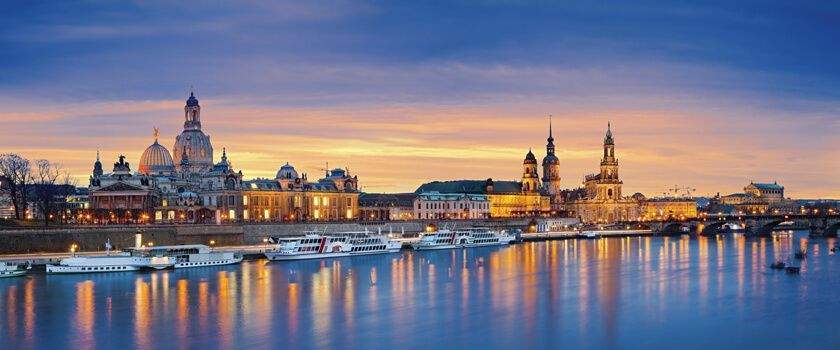
Dresden is considered one of the most beautiful cities in Europe, a title it earned back in the 17th century. In the 19th century, it was known as the center of German romance. Strolling along the Brühl Terrace, a picturesque promenade, was a favorite pastime for nobles from neighboring countries. The city boasts luxurious palaces, castles along the Elbe, magnificent churches, and art treasures, earning it comparisons to Florence.
However, this beauty was destroyed in February 1945 by British bombings. Historian David Irving even wrote a book titled “The Destruction of Dresden,” reflecting the professional community’s view of those tragic events.
Today, the historic city center has been fully restored, but the approach to restoration was unusual. Tourists are often surprised by the blackened stones of the old buildings, a result of using fire-damaged bricks for restoration. Residents collected stones, numbered them, and tried to return them to their original places. The war and fires are impossible to forget.
The Procession of Princes
Surprisingly, the unique “Procession of Princes” mural, a fragile composition of porcelain tiles over 100 meters long on the wall of the Dresden Castle’s stable courtyard, remained almost intact. The 25,000 tiles were made at the Meissen Manufactory, which is still operational and worth a visit. The mural depicts the entire dynasty of Saxon rulers.
In essence, the first day’s itinerary is set: a morning walk through the city center, an afternoon boat ride on the Elbe, an evening promenade along the Brühl Terrace, and visits to Catholic and Lutheran cathedrals, magnificent fountains, and parks.
Day Two: The Zwinger
Although “Zwinger” typically refers to fortifications in Europe, Dresden’s Zwinger is a palace and park complex in the ornate Baroque architectural style. It was not used for defensive purposes. Saxon rulers held tournaments and celebrations here, and also housed impressive collections of paintings, porcelain, and weapons.
The Zwinger’s calling card is the Dresden Art Gallery, considered a symbol of the city. It features works by Titian, Rubens, Velázquez, Dürer, and, of course, Raphael’s “Sistine Madonna.” Tourists often buy tickets to the Zwinger for the art gallery, but those indifferent to painting can explore the pavilions and fountains, missing out on much. The Zwinger also houses a range of themed museums, including:
- Mathematical-Physical Salon: A scientific museum with over two thousand exhibits, including rare astronomical globes from the 13th century.
- Porcelain Pavilion: The largest porcelain museum in Europe, with many exhibits from China, Korea, and Japan.
The Zwinger deserves a separate day for exploration, not just for its museums, but also for its gates, pavilions, flowerbeds, fountains, cascades, grottos, pools, and sculptures. The most famous sculptural complex with fountains on the palace grounds is the “Nymph Bath.” It features 14 nymph statues, seven on each side.
If you have energy left after visiting all the Zwinger museums, the Semper Opera House awaits. You don’t necessarily have to attend a performance. They offer tours of the opera’s backstage world and share theatrical legends, including in Russian. Advance booking is required.
Day Three: The Residential Palace
The Residential Palace, also known as the Castle Residence, is one of Dresden’s oldest buildings, constructed and reconstructed since the late 13th century.
A combined ticket for all palace museums includes the Numismatic Cabinet, the Print Cabinet, the Knight’s and Turkish Halls, the Armory, and the famous “Green Vault,” which competes with the Old Masters Gallery for the title of the city’s symbol. The combined ticket is cheaper than visiting each museum separately, but you must visit all museums in one day. If you don’t start from the moment the palace opens, you might not have enough time.
The Green Vault Museum
The treasury of the Saxon kings, featuring over 4,000 items. It’s the largest collection of treasures in Europe, even surpassing the Armory in Moscow. One of the first European museums, it was established in the early 18th century by Elector Augustus the Strong, who set up rooms to display the most interesting exhibits to guests.
Tourists are often surprised to find that there are two “Green Vault” museums. The collection is divided into two parts and housed on two floors.
The Historic Green Vault is located in the halls used by Augustus the Strong as a museum. The green-colored columns gave the museum its name. Even when the columns were covered with mirrors and the green color disappeared, the name remained. Now, you can only enter this part of the collection through a special airlock due to enhanced security measures.
The New Green Vault is in the regular museum rooms, with less ancient but technologically more advanced items.
The Armory
The most mysterious museum, often confused in guidebooks. Its second name is the Dresden Military History Museum, and it was located in the Zwinger for many years before moving to the Residential Palace. Here, you can see one of the world’s most interesting collections of ceremonial weapons: 10,000 exhibits, from swords, rapiers, and daggers to rifles and pistols. The Armory also houses armor, portraits from the 16th to 18th centuries, and historical textiles.
If time permits, the castle also has halls for thematic exhibitions, usually featuring paintings and sculptures by established and young masters.
Day Four/Five: Museum Hopping
Visiting five museums that I find most interesting in one day is unlikely, even though they are all located in the city center. However, it’s feasible over two days.
The German Hygiene Museum
An anatomical museum dedicated to the structure and function of the human body. To be honest, descriptions from guidebooks and Wikipedia don’t make the Hygiene Museum, also known as the Human Museum, seem particularly interesting, but it’s actually a very curious place.
It’s divided into children’s and adult exhibitions and a constantly changing exhibition section.
The museum has been around since 1911. At that time, Dresden hosted an international hygiene exhibition, and one of the industrialists, the inventor of a mouthwash, thought that the exhibits might interest people on a permanent basis.
The “Transparent Man,” a full-size transparent model with illuminated internal organs, was incredibly popular. It’s still the main attraction of the “adult” part of the museum. The “children’s” rooms are dedicated to the five human senses and are interactive. There are many board games, simple entertainments like a dark maze room, and all exhibits can be touched.
The Albertinum
A museum of fine arts. It houses the New Masters Gallery, which has over 2,000 paintings from the 19th and 20th centuries, and a collection of sculptures.
The easiest way to promote this museum is to quote Ivan Tsvetaev, who, after visiting the Albertinum,…
For more information, visit the official Dresden tourism website.