Belarus in Her Heart: A Tribute to Maya Plisetskaya at the Bolshoi Theatre
Belarus in Her Heart: A Tribute to Maya Plisetskaya at the Bolshoi Theatre
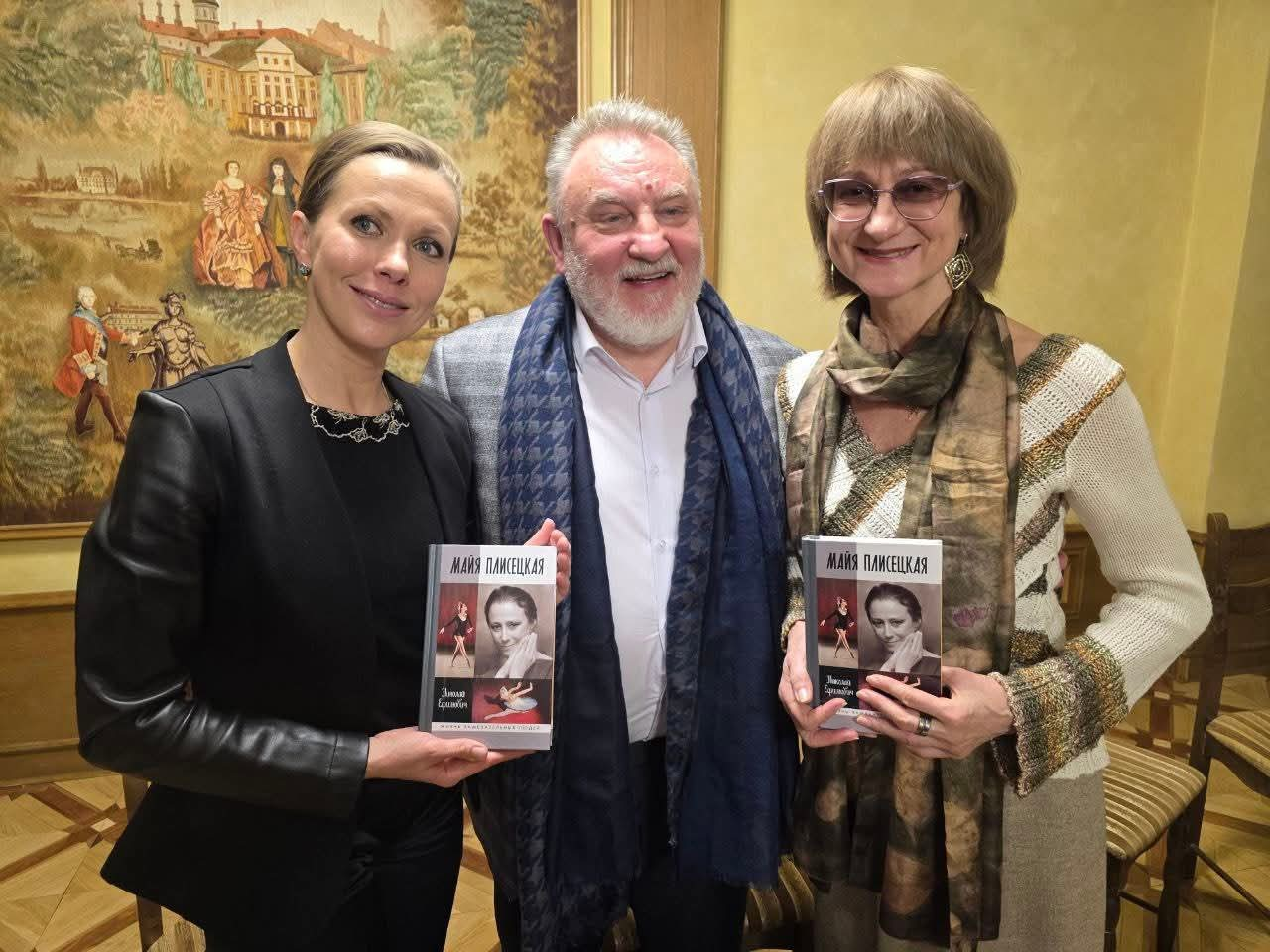
On November 20, 2025, the ballet world celebrated the 100th anniversary of the birth of the legendary Maya Plisetskaya, whose biography is deeply connected to Belarus. On December 5, the Bolshoi Theatre of Belarus hosted the presentation of the first biography in the book series “Lives of Remarkable People” by the publishing house “Molodaya Gvardiya,” dedicated to the iconic ballerina. The book was personally presented by the author, Nikolai Efimovich, a journalist and head of the “BelRos” TV channel who had known Maya Plisetskaya for over twenty years.
Personal Connections to Belarus
“I am originally from Belarus,” Nikolai Efimovich began his speech to the audience, journalists, and honored guests at the presentation in the Gobelin Hall of the Bolshoi Theatre of Belarus. “It was extremely important for me that the presentation of this book and the documentary film ‘Maya Plisetskaya, Whom We Did Not Know’ took place in Belarus. The Belarusian premiere of the film was held at the “Listapad” film festival, where we were awarded a special prize by the Parliamentary Assembly of the Union of Belarus and Russia, which is very symbolic.”
“As it turned out, many people still do not know that Belarus was not a foreign land for Maya Plisetskaya,” the author noted. “Not only because she danced here, loved to visit, and highly appreciated the Minsk audience for their ability to truly appreciate and admire art. She loved our audience, although she traveled the world and was received with incredible enthusiasm everywhere. Remember Argentina, where she was carried in people’s arms… This land was not foreign to her, primarily because her parents were natives of Belarus.”
Family Roots and Early Life
Maya Plisetskaya’s father, Mikhail Plisetsky, was from Gomel, where he was born, raised, and lived until he was about twenty years old. He was later drawn to revolutionary ideas, which Maya did not approve of in her memoirs. She barely remembered her father, as he was repressed when she was still a child, but she loved him dearly. Her mother, Rachel Messerer, was from the city of Vilna, which was part of Belarus during the time of the Russian Empire. Moreover, her mother’s parents, Maya’s grandparents, were from the village of Dolginovo near Vileyka.
A Memorable Film-Ballet
Another significant connection to Belarus is the television film-ballet “Fantasy” based on Ivan Turgenev’s work “Spring Waters.” This film, which Plisetskaya loved dearly, was directed by the young choreographer Valentin Elizariev. When Maya first met him, she exclaimed, “Oh, how young you are!” which helped ease the tension in their relationship. During one of the first rehearsals in a white television studio where everyone wore shoe covers, Elizariev’s shoelace came undone. Despite being a legendary ballerina, Maya Plisetskaya knelt down and tied his shoelace herself. This moment was even captured by a photographer. After this incident, their relationship became warm and trusting.
The Birth of the Book
When asked about how the book came to be, Nikolai Efimovich admitted it was not easy. “I remember sitting at my desk, feeling lost and not knowing where to start or what to write about,” he said. “It was a daunting task because hundreds of books have been written about Maya Plisetskaya, and numerous films have been made about her. Her entire life has become a myth, making it difficult to separate fact from fiction.”
At the time of the proposal from the “Molodaya Gvardiya” publishing house to write a biography of the legendary ballerina, Nikolai Efimovich had already authored several interviews with Plisetskaya, which he compiled into the book “The Red Swan: The Most Candid Interviews with the Great Ballerina,” published in 2015.
A Journey of Sincerity
“Many people ask me if I am a ballet critic,” Nikolai Efimovich shared. “While it is flattering, I must admit that I have never been closely involved with ballet in my life. I was born in a forest village in Belarus and first saw ballet on television, which we only got in 1974-75. Later, while studying in Minsk, I visited the Bolshoi Theatre of Belarus and saw a ballet performance on stage. I remember getting my hands on a photo album about Plisetskaya for the first time… My first meeting with the legendary ballerina happened when I was already working as a correspondent for “Komsomolskaya Pravda” in Nizhny Novgorod, where Maya Plisetskaya came on tour with the “Imperial Russian Ballet” of Gediminas Taranda.
“At that time, she had already left the Bolshoi Theatre. The Moscow editorial office of “KP” gave me the task of conducting an interview that would stand out from the rest. I was late for the meeting with Maya, and she was not in the mood. When I approached her for an interview, she said, ‘Read my book!’ (This was her favorite phrase when she did not want to talk to a journalist). Plisetskaya disliked banal questions like ‘What are your creative plans?’ She found it uninteresting to repeat herself. And this was true in everything she did!”
“When she worked as the director of the National Ballet of Spain (after the Bolshoi Theatre and the Imperial Ballet), she still danced herself. After performing in ‘Carmen,’ she said, ‘This is one of the performances where I finally did what I wanted!’ She worked on her roles throughout her life. When the second cast of ‘Carmen’ was being prepared, a Spanish ballerina who was supposed to dance the lead role could not repeat Plisetskaya’s performance. In frustration, she said, ‘How can I learn the role if she dances it differently every time?’ This was the essence of Maya Plisetskaya: the very idea of dancing her beloved ‘Swan Lake’ the same way for her entire life was impossible for her. And yet, it was one of her most beloved ballets. She performed it more than 800 times: both on the stage of the Bolshoi Theatre and in regional cultural centers. There were even two GAZ trucks whose sides were lowered to create an improvised stage. Once, in Budapest, Plisetskaya danced on the grass in the rain—and such was her life! She always sought to break the mold…”
That first interview with Maya Plisetskaya for “Komsomolskaya Pravda” marked the beginning of a long-term relationship between the journalist and the ballerina. “People often ask me how a boy from a forest village in Belarus managed to find a common language with the great ballerina,” Nikolai Efimovich confessed. “The secret is simple: sincerity! Maya highly valued sincerity in relationships. On my part, there was admiration, love… Before me was a great person, as if from space—and we sat and talked. I remember when I came to her house to proofread the text, I was struck by her apartment: everything was very comfortable and warm, homely.”
When their apartment was being prepared for the future museum, the main request of her husband, Rodion Konstantinovich Shchedrin, was that everything should remain as it was when they lived there… Now, when you enter the Maya Plisetskaya apartment-museum, there is no feeling of sterility and coldness of a museum. It seems as if the owners have just stepped out and will return soon.
At the meeting in Minsk, Nikolai Efimovich admitted that he had hesitated for almost five years to start writing the biography of the great ballerina, realizing that everything or almost everything had already been written about her. Until he found unique, previously unknown documents in the archives: Plisetskaya’s correspondence with her friends, a page from her diary, and more. For more information about Maya Plisetskaya, you can visit the Wikipedia page dedicated to her.