Why Barbie Isn’t Suitable for Kids Under 4: A Psychologist’s Guide to Choosing the Right Doll
Why Barbie Isn’t Suitable for Kids Under 4: A Psychologist’s Guide to Choosing the Right Doll
In our childhood, many girls dreamed of owning a magical and expensive Barbie doll. The first Barbie dolls were simple and unpretentious, with immobile arms and legs, although the head could turn with a bit of effort. Today, the variety of dolls available is staggering, but many of them can be quite frightening. The traditional dolls we knew have given way to unimaginable creations that captivate both children and adults. However, the question remains: what can these dolls teach our children? And should dolls even be expected to teach anything at all?
The Historical Role of Dolls: From Rituals to Playtime
The earliest dolls known to humanity were tied to rituals involving ancestral worship and the creation of the world. Such rituals can still be found in African tribes. Throughout history, people have used dolls to communicate with the gods. Ancient writers described large figures of gods used in ritual processes in Ancient Greece and Rome. In India, puppet theater represents a microcosm of the world, where serious narratives are played out.
Our history is also rich with mysticism. Pagan tribes used dolls as a means to communicate with the gods, such as the Maslenitsa festival where effigies were burned to appease the sun god. With the advent of Christianity, dolls were banned, but the restrictions eased during the Middle Ages. By Christmas in Italy, images of the Virgin Mary with the infant Jesus in the form of dolls appeared. These figures were called “Marion,” from which the word marionette derives. Later, the tradition of setting up Nativity scenes outside churches spread to Eastern Europe.
In Russia, the portable puppet theater, or “vertep,” became popular. This theater typically had two stages, one above the other. The upper stage depicted the Nativity scene, while the lower stage represented the palace of King Herod. These performances were initially for the common people at fairs but later moved to the homes of wealthy townsfolk.
The Evolution of Dolls: From Religious Artifacts to Children’s Toys
The religious connotations of dolls began to fade in the second half of the 18th century, thanks to France. Enterprising fashion designers wanted to showcase their creations not only to the local elite but also to the nobility. They created “pandoras,” medium-sized dolls with the proportions of adult women, dressed in the latest fashion. Potential buyers would bring the pandora and a suitcase full of clothes, perfumes, and other accessories. Today, pandoras have evolved into mannequins, which we see daily in the windows of almost all stores.
It was only in the mid-19th century that Europe began to focus on the needs of children. Toy factories, including those producing dolls, began to spring up everywhere.
Choosing the Right Doll for Different Ages
Mothers have been making dolls for their children since time immemorial. Initially, these dolls were simple, made of plaster, wood, clay, bone, and fur. Although primitive, they resembled humans and were dressed in clothes. However, mass production of toys did not begin until the 19th century.
As mentioned earlier, France introduced the world to porcelain dolls, and the first baby doll appeared. Rubber and plastic dolls became available to children only in the 1940s. The Barbie boom swept across America in the early 1960s and reached us in the 1990s. Interestingly, today, two Barbie dolls are sold every second worldwide!
Modern Dolls: A Guide for Parents
Modern dolls come in a vast array of types, which can be overwhelming for parents. When choosing a doll for your child, consider various factors such as age, the material of the toy, and the child’s interests.
Dolls for Toddlers Under 3
For toddlers under 3, choose dolls that are pleasant to the touch. At this age, children are still learning about the purpose of toys and often just touch and examine them. They explore the world through touch, so soft, cloth dolls that resemble humans are ideal.
Dolls for this age group should have clearly distinguishable facial features. Although soft and pleasant, they should undoubtedly resemble humans. A child’s image of a human is still forming, so it’s important that the doll’s features are also in the right places. Ideally, the mother can sew such a doll herself. This way, it will retain the warmth of the mother’s hands and may become the child’s favorite toy for life.
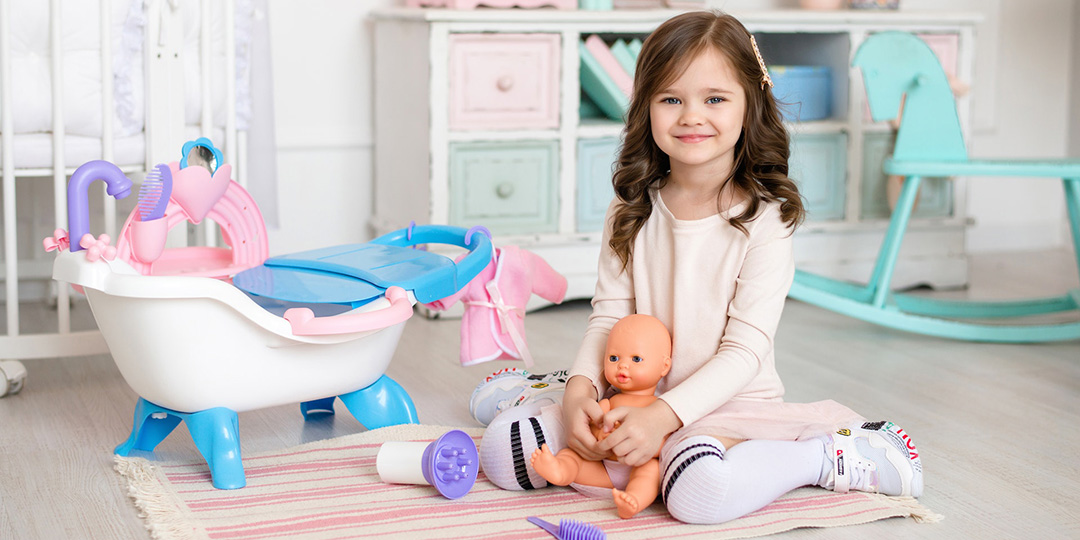
Don’t forget about simple plastic baby dolls. These dolls symbolize a small person and teach children to care for others. Toddlers love to imitate their parents, and they can transfer all their knowledge about care to the doll.
Dolls for Children Aged 3 to 7
After the age of 3, children become interested in role-playing games where they try on different roles. At this age, children enjoy pretending to be adults. A doll is a small copy of the child, so it’s important that it resembles them. For example, if your child is a blonde angel, the doll should also have light hair, not green or purple. Also, ensure that the doll does not represent an adult woman.
From the age of 4, playing with dolls begins to imitate human relationships, lifestyle, and social rules. Girls increasingly take on the role of adult women, so from 4 to 7 years old, Barbie or similar dolls have a place of honor in the toy arsenal.
However, be careful when choosing. Think about the role you want your children to play. Many doll images already carry a certain message. For example, Barbie dolls often resemble capricious ladies with a luxurious home, car, and pool. Seeing this, the child projects the doll’s life onto their own. Imagine what will happen when they face real life.
Also, pay attention to whether the dolls resemble real women. Many doll models have an overly ideal figure that few can boast of in real life, and your daughter may see herself in this way. By the way, psychologists have found that teenagers who played with ideal dolls for a long time subsequently have serious psychological problems: complexes, low self-esteem, and a constant desire to change their appearance.
Try to buy dolls with kind, gentle, sweet, and smiling faces. Playing with such a toy, the child calms down, which is not noticeable when the child holds aggressive and scary dolls in their hands. On the contrary, the baby subconsciously absorbs anger, hatred, and aggression, which they then direct at loved ones and friends.
Psychologists have established that the ratio of the body and head proportions of the toy is of great importance. Some violations of ideal symmetry cause patronizing attitudes. For example, if a person has such dolls or a beast’s face with chubby cheeks, a small nose, and big eyes.
For more insights on the impact of dolls on children’s psychology, you can refer to authoritative sources such as the American Psychological Association.