Why Are Men So Fascinated with Bitcoin?
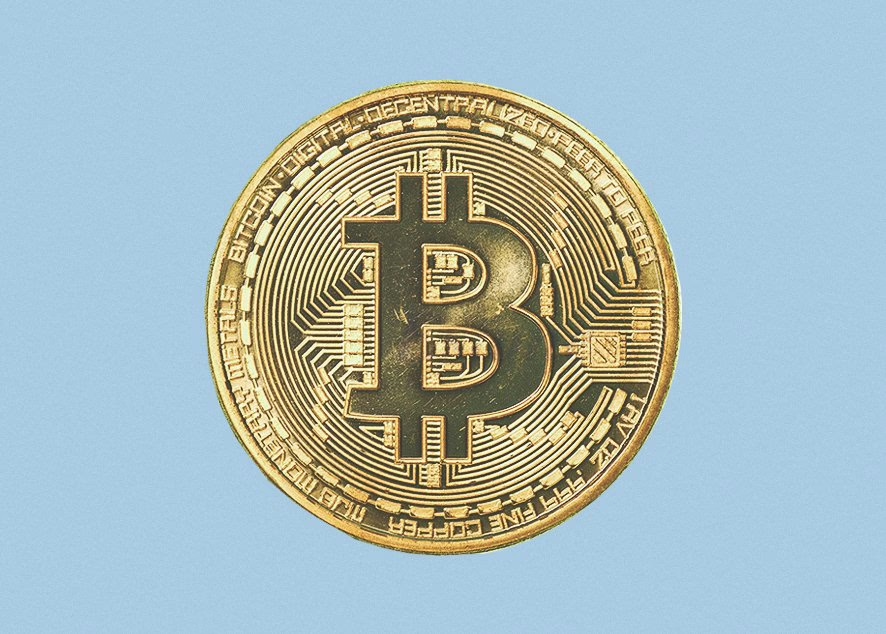
In recent years, Bitcoin has dominated conversations worldwide. From Japanese retirees to high school students in Omsk, it seems everyone is talking about it. The chances are high that a new acquaintance might bring up Bitcoin on your first date. Despite the buzz, the cryptocurrency market is relatively young, and fewer people understand it than you might think. Much of the hype is driven by social media and news outlets reporting daily fluctuations. Try explaining Bitcoin to your mom—it’s money you can’t see or use to buy anything tangible. Even popular TV shows like “The Big Bang Theory” might leave you with more questions than answers.
Bitcoin: The Brand
For most people, Bitcoin has become synonymous with cryptocurrency. It’s the only term from the crypto world that everyone recognizes. Today, all types of coins and chains are often referred to as Bitcoin, even if they are entirely different. According to Google Analytics, slightly more than 4% of women show interest in Bitcoin, meaning the vast majority of enthusiasts are men. Let’s explore what attracts men to this topic and whether we should consider investing in cryptocurrency.
Easy to Start
The modern cryptocurrency market can be compared to the Internet in the 90s. Currently, there are 21 million Bitcoins in circulation, while the Earth’s population is 7 billion people. In 2010, the cost of one “coin” was $0.008, and at the time of writing this article, it has reached $13,782. The higher the numbers on the chart, the more people are willing to take the risk and start investing.
Just half a year ago, anyone could buy an expensive video card and start mining. Mining involves finding a unique code through mathematical operations. Now, to get even one Bitcoin, you need an entire farm—a warehouse filled with computers that burn thousands of Watts around the clock. To understand how cryptocurrencies work, you need to know what blockchain is.
Blockchain: The Backbone
Blockchain is a public, decentralized ledger that records transactions: who bought and who sold. The word “block” refers to the way data is stored—in blocks. A transaction is passed through each link in the chain, which verifies the transaction. Bitcoin, in turn, is a digital currency exchanged on the blockchain.
Bitcoin itself was created as a way to anonymously conduct transactions and transfer money between people. Its initial goal was to allow partners to see transactions without paying an intermediary.
Earning Without Effort
The world is striving to own money, and this is another serious reason to get a few “coins.” With electronic currency, everything seems simpler—choose the right moment, and the money is in your pocket. Bitcoin is not so difficult to buy on the Internet—the question is only in the cost. Most beginners do not understand the technical nuances of obtaining cryptocurrency and the problems that can be encountered in terms of security and scalability.
Bitcoin as a Bank Alternative
People are noticing more and more flaws in the modern financial industry and think that Bitcoin could serve as an excellent alternative to the established system. We trust banks with our finances without expecting a significant interest rate, as banks promise a high level of reliability and liquidity. We perceive our account simply as money that is available in full.
In reality, banks take the money that you think you have access to and direct it to risky lending, such as financing someone else’s 30-year mortgage. In turn, banks receive a high interest rate on these long-term loans. Think about it: they take your money for risking their position but do not pay you anything extra and lie that you can always get your funds back.
Blockchain allows a digital system to transfer reliable units of money without the need for an intermediary. Bitcoin chains are valued for their reliability, as they are a decentralized system designed to resist corruption and be independent of banking structures. In general, people believe that the revolution in the field of cryptocurrencies will allow them to free themselves from the tyranny of banks, and billions of people will be able to become part of the world economy.
Easy Money Transfers
Some families are scattered all over the world, and in such situations, transferring money between banks is simply inefficient. Companies like Western Union charge such high fees for their services that the exchange itself loses all meaning—it’s easier to earn money locally. And in some countries, like China, it is illegal for ordinary people to send large sums of money.
Bitcoin allows you to avoid these problems and makes it possible to transfer any amounts in real-time and without fees.
Making Money with Cryptocurrencies
It is worth noting that the phrase “making money” does not apply to Bitcoin unless a person is selling and investing the profit. Currently, only 21 million Bitcoins have been mined. About 500 thousand of them change hands daily. Since the number of Bitcoins is limited, the price is rising. But do you think all Bitcoin owners will be able to find people willing to pay up to 120 billion dollars for all the Bitcoins in the world? Most likely, the growing bubble will eventually deflate but not burst. The main obsession should not be Bitcoin but the blockchain technology used for it. The more people involved in its development, the more new coins will emerge.
Bitcoin: Power and Protection
At the same time, Bitcoin is a valuable asset that has significant influence. Owners are not yet risking using it, although they could even exert political pressure on some country, so for now, everyone is just keeping their money in their wallets. It is difficult to make predictions: perhaps this will become a revolution in the understanding of the value of money, or perhaps it will become a tool of enslavement.
Bitcoin can protect money from inflation. Countries facing high inflation and currency fluctuations, such as Argentina, suffer from sharp devaluations of their currency, and people lose significant amounts of money in a matter of hours. Yes, the price of Bitcoin is also not stable, but it seems like a lesser evil if your country is shaken by a revolution.