The Misrepresentation of Women in Sci-Fi: A Call for Equality
The Misrepresentation of Women in Sci-Fi: A Call for Equality
In recent years, cinema has made strides in celebrating feminism, presenting audiences with a multitude of films featuring strong, intelligent, and beautiful women who serve as role models for an entire generation. However, despite these advancements, one crucial element has consistently been missing—equality. This issue is particularly prevalent in the science fiction genre, where women are often portrayed in a distorted and sexualized manner.
The ‘Sexual Newborn’ Trope
Science fiction narratives have given cinema countless captivating stories and diverse settings. However, at the heart of these narratives often lies a troubling romantic conflict: an experienced man, lonely due to his personality traits or sheer bad luck, and an inexperienced, virginal being housed in the body of an adult, sexually attractive woman. This archetype is known as the ‘Sexual Newborn.’
Characteristics of the ‘Sexual Newborn’
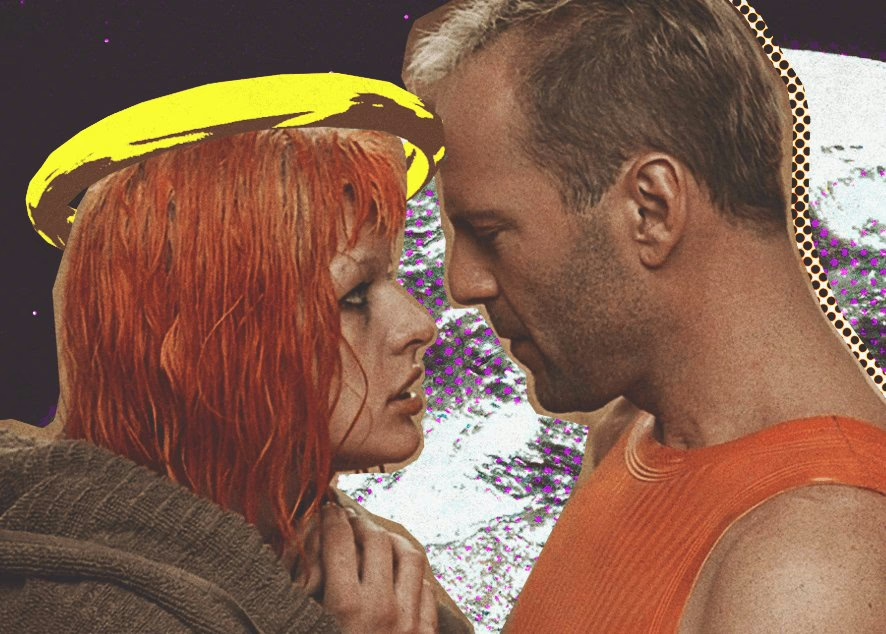
The typical female science fiction character is often described as ‘wide-eyed, naive, and innocent, yet sexual.’ Films like ‘The Fifth Element,’ ‘Tron,’ ‘Splash,’ ‘Cloud Atlas,’ and even ‘Star Trek’ feature such characters. These heroines often lack a basic understanding of the world, behaving like children and ‘accidentally’ ending up naked, simply because no one has taught them the purpose of clothing.
Naivety as a Plot Device
This naivety is often explained by the plot as the heroine having grown up in a completely different environment or being a ‘perfect computer program capable of feeling.’ These qualities are presented as her value as a character, as the man falls in love with her precisely because she is a helpless and fragile creature who cannot survive without an experienced guide.
Unawareness of Sexuality
Ironically, the ‘Sexual Newborn’ is often unaware of her own sexuality. This serves as a convenient excuse for filmmakers to include scenes where the heroine ends up naked. The heroine simply does not understand why her nakedness is a big deal or why male characters feel embarrassed or surprised. This portrayal of imbalanced relationships reflects how men in the modern world feel vulnerable in the face of mature and experienced women.
The Patriarchal Fantasy
Imagine being an innocent, untouched, sexually attractive woman with no past relationships in a patriarchal society. It’s a fairy tale! Such a heroine falls in love with the hero because he is her savior, often the only man she has ever known. For the hero, this image is appealing because the simpler and more naive his lover, the less chance he has of being rejected.
The Male Savior Complex
Men of this nature do not want or cannot find a woman from their own world—one who could be their equal in terms of knowledge and experience in romantic and sexual relationships. For a woman, being sexually adept is necessary, but it is preferable if she remains a virgin. Another striking detail is that in most of these films, the male hero is an ordinary, average man, yet all his actions are presented as incredibly valuable and amazing to the naive heroine.
The Simplicity of the Scenario
This is a very simple scenario because it does not require the man to improve or become better as a person, a man, or a sexual partner. There is no need for this, as he is the one and only—this is the unhealthy dynamic of relationships where men are encouraged to dominate innocent girls. Sexual appearance is the form most easily accepted by society, again, a male society.
Cultural Adaptations and Objectification
If we delve deeper and look at Japanese animation narratives, we can find many examples of the same female archetype, which Western cinema has adapted. Such portrayals of women in cinema are a form of objectification, often discussed in the context of the growing feminist movement. However, the unnaturalness and toxicity of such depictions of women remain a concern—for women themselves, for men, and for younger generations.
The Necessity of Equality in Cinema
Equality in cinema is not about appeasing feminists or depriving men of the pleasure of sexual attractiveness. It is about the mentality that defines our existence. It is disheartening to think that the female experience and awareness of living in this world without male influence is a perspective that remains in the shadows. It is equally sad to think that a man might feel uncomfortable next to a woman who is his equal.
For further reading on the topic of feminism and its portrayal in media, you can visit Heroine, a resource dedicated to exploring these themes in depth.