The Inspiring Journey of Andrei and Nadzeya Kim: How Cinema Can Heal Souls and Change the World
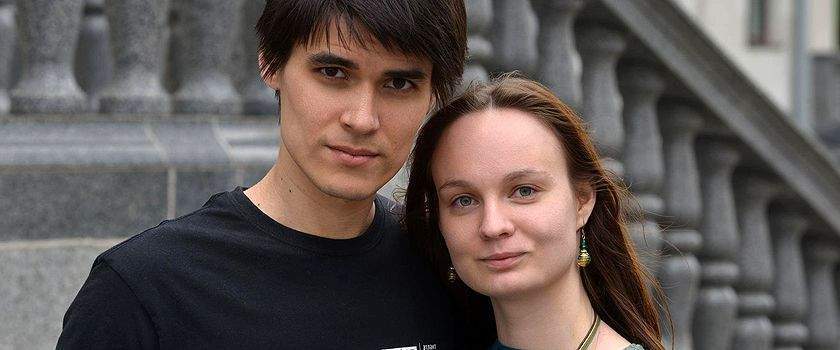
The Inspiring Journey of Andrei and Nadzeya Kim
Andrei and Nadzeya Kim have ushered in a new era for cinema in their country, making it commonplace for films from around the world to be shown in Belarusian. Their team, Kinakonga, works tirelessly on script translations, voiceovers, and negotiations for film screenings, bringing Belarusian cinema to life. In this article, they share their life journey, beliefs, and the story of their unique pet.
Meeting and Early Days
Nadzeya: We met when I was a horseback riding instructor.
Andrei: Nadzeya was my trainer.
Nadzeya: About a year after our first meeting, we met again in the city. We got to know each other better in a large group of friends. At one point, someone suggested a game where you say your name, then the first letter of your name, and give an association to it. Andrei started. He still spoke Russian back then and said, “A is for Stork.”
Andrei: Later, when we were already married, I noticed that I was saved in her phone not as “husband,” “darling,” or “Andrei Ivanovich,” but as “stork,” in Belarusian, meaning not a stork in the literal sense, but symbolically.
Faith and Beliefs
Andrei: I am a Christian who truly believes. Since I was about 7 years old, I knew that God exists, but for a long time, I didn’t want to follow Him. In my teenage years and youth, I tried many things—hippie culture, Buddhism, Rastafarianism, and even drugs. Why? Because I was deceiving myself, looking for other paths, trying to bargain with Him to be a “believer” and live my own life. But that’s not how it works. Through certain life situations, I made a choice. One day, I simply said, “My life is in Your hands.”
Christ is the reason I do what I do. Some people think that God wants submission. But in the Bible, He first calls, “Seek Me…” And if you seek, the rest will follow.
I remember how people mocked former President George W. Bush when he said he talked to God. But for a Christian, it’s normal to seek God, talk to Him, and strive to hear His voice. The problem arises when you think you’re a Christian, but it’s not important to you.
In my opinion, the existence of God and the search for the meaning of life are the most important questions. Every person should try to honestly answer: Who am I? Why am I here? What will happen to me? Where do I come from and where am I going? It’s very important not to bury your head in the sand but to sincerely seek answers. These searches led me to Christ.
I don’t understand how people can not think about the meaning of life. This question is not narrowly religious; it’s inside every person. For a year or two, I asked people on the street, “Why do you live? What is the meaning of your life?” And 90% of them said they had never thought about it. They said, “That’s a very fresh thought…” For me, this is a shock. It’s the most important thing!
Easter
Andrei: Easter is the main holiday, the coolest along with Christmas. One of our favorite films, which we always talk about and have long wanted to dub, is the cartoon “The Prince of Egypt.” It’s about the exodus of the Hebrews from Egypt, which is celebrated as Passover, known as Easter in our tradition. Another film we dubbed and will definitely show in cinemas is the classic “Ben-Hur,” which won the most Oscars and is also about Easter. Konrad Adenauer said, “If Christ is not alive today, then the world has no hope at all. Only the fact of the resurrection gives hope for the future.”
Travel
Andrei: I have traveled a lot by hitchhiking, covering about 50,000 kilometers—enough to circle the equator. Traveling is my way of relaxing. Some people prefer to retreat into their shell, but I like to go somewhere. The film “The Secret Life of Walter Mitty,” which we plan to dub in 2018, is about a man who spent his whole life sitting at a desk and then decided to travel. It helps periodically. The main thing is not to turn travel into an escape from yourself. You can gain a lot from traveling and even help many people.
My pastor said that I remind him of a character from the Moomins book—Snufkin, who was always traveling. In short, a wanderer, and I take it as a compliment. When Nadzeya and I met, she was annoyed by this trait in me. For example, we would arrange a meeting, and she would call me on the same day, asking where I was. And I would say, “Sorry, I thought it would be good to go somewhere. I’m in Warsaw now.”
Nadzeya: Then there was a terrible revenge—I went to study in the Netherlands.
Cinema and Its Impact
Andrei: I often use the “Yolki” (New Year’s trees) films as a negative example when explaining how we choose films. When asked why we decided to get involved in cinema, I say that we wanted good films to be shown in cinemas. The “Yolki” films are not the worst in the world, but they seem endless, and the plot appears to be the same from film to film. “Yolki” is an example of ruthless and senseless money-making.
Director Louis Psihoyos called cinema “a weapon of mass creation.” It is something that can heal people’s souls and change the world. Earlier, it was books; now, it is largely cinema. Every film is some idea, some propaganda.
Our cinema employees are switching to the Belarusian language. They thank me for every film we show. As if we did something incredible. Interestingly, they had seen some of the films we dubbed before, but they never thought that the films were about what we talk about before the screenings. And I see that they experience catharsis.
How can this sphere be turned into just making money when cinema can change a person and make them better? It is now the most effective way to influence people.
In my ideal world, people who do business or any other activity think about why they do it and believe in what they do.
Pets
Nadzeya: Last year, we got a pet—a Cornish Rex cat. Our acquaintances were divided into two camps: some think she is terribly ugly, hairless, and horrible. The Cornish Rex is not a sphinx. The other half thinks she is very beautiful.
The cat is very companionable, almost like a dog. For example, if I sit up late working, she sits with me at the table, falls asleep, but still stays with me until the end.
Andrei: She is a dog in the form of a cat. First, she loves to bring things, and second, she barks. Normal cats, probably, when they watch birds, crouch and jump, but this one sits and seems to say “meow-meow-meow” (Andrei demonstrates the cat’s barking). She doesn’t meow; she literally barks.
Nadzeya: And she is talkative.
Andrei: She loves to talk. Moreover, periodically you are surprised at how accurately she hits the intonation of our conversation. She answers… it even becomes a little scary.
If we talk about character, there are cat-people and dog-people. I am a dog, and Nadzeya is definitely a cat. And our cat is a cat-dog. Nadzeya took the cat, thinking it would be a calm, dignified, noble animal, but she turned out to be a crazy dog wagging her tail in all directions and wanting to talk.
Orsha
Andrei: Before getting involved in cinema, I organized pillow fights. Then no one gathered for meetings. And we had a legally permitted event, which was attended by several hundred people. It was the anniversary of the Battle of Orsha. The following year, in 2010, we organized an event for the 600th anniversary of the Battle of Grunwald, but we were not allowed to hold it.
However, we still organized the fight, about a thousand people came, including children and schoolchildren. The police arrived and said that the pillow fight had been moved to another place, get on the bus, and we will take you there.