Natalya Neborskaya: The More Active and Complex a Child Is, the More Interesting They Become
Natalya Neborskaya: The More Active and Complex a Child Is, the More Interesting They Become
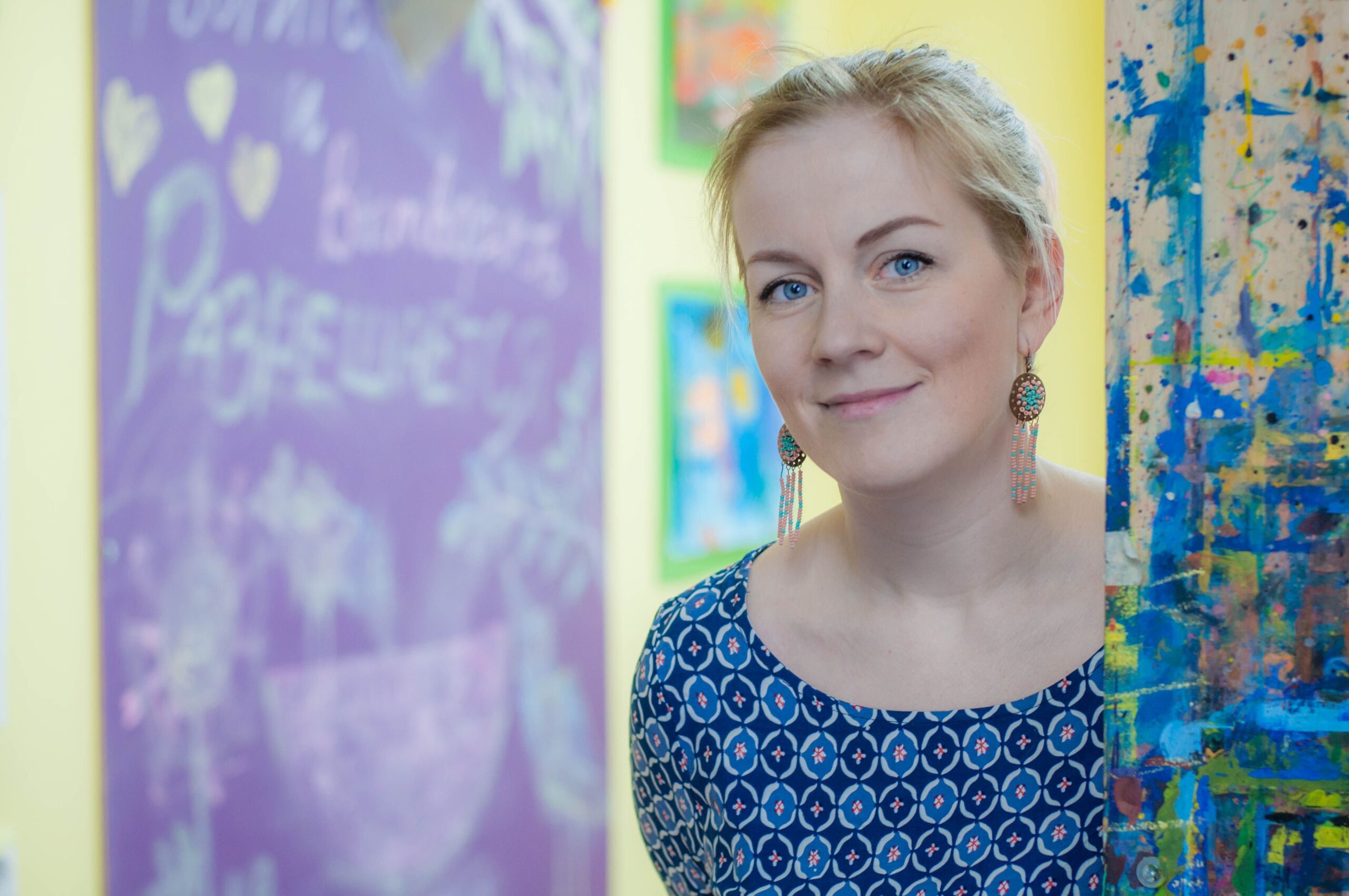
The statement “All children love to draw” is incorrect in its first and third words. Not all children love to draw. However, it is absolutely true that all children can draw, and they do not need to be taught how. They only need to be shown how to make friends with paper, paints, palette knives, and most importantly, with themselves. The art studio “Kalyaki-Malyaki” breaks stereotypes and shatters templates—children draw everywhere: on paper, on walls, on themselves, and on windows. And all of this is very effective—students from the studio win first places in international creative competitions. The head of the art studio, Natalya Neborskaya, told our magazine how she managed to create her studio and why her methods are different from others.
How is your studio different from others?
In my studio, children draw on large formats while standing. We attach A2 and A1 sheets to the walls. The learning process is structured so that children do not repeat after the teacher, as they do in kindergartens and other studios. Therefore, we never have ten identical pictures.
We try to understand each child and reveal their unique talent. Some children are more inclined towards graphics, others are passionate about painting, some are portraitists, some are marinists, and some are landscape artists. Each child has their own path. The teacher never interferes with the child’s painting by adding a nose, eyes, or ears, because what is valuable is how the child sees the world around them.
Does this form your special mission?
Yes. The main mission is to raise as many sensible people in our society as possible, who will see the world around them broadly and openly. It sounds grandiose, but I will explain. When parents who have not read anything about my studio ask, “Will you teach how to draw?”, I answer that we will not.
We will not teach drawing because all children already know how to do it. But we will teach how to work with materials, introduce basic concepts of painting, styles, and directions, and acquaint them with famous artists. If you want to learn how to draw a house as we were taught in kindergarten, then you can go to another studio; there are plenty of them.
Tell us about the children who attend your studio.
I have noticed that very talented children come to us. You see, there are children whom other places do not want to work with. For example, if they say, “Music or painting is not for you, sports are for you,” I interpret this as “Take your little monster away from here; he is interfering with our classes.” In other words, in studios where they say this, the teachers likely lack the competence to work with active children; they simply cannot handle them.
The more active and complex a child is, the more interesting they are for our studio. Because it is from such children that free people with creative thinking grow up. These are future inventors, chemists, physicists, and drivers of progress.
Have there been children who did not like attending your studio and left?
There have been a few cases. But this depends not on the child but on the parents. Sometimes mothers bring their children and expect immediate results—beautiful, “cute” pictures. I say that there will be no immediate results because the child needs to get used to it, try the paints, understand how they lie on paper, skin, hair, floor, walls, and how they mix.
In other centers, the child immediately brings out a beautiful craft, but with us, this takes 1-2 months, and for some, half a year. If a child immediately makes a beautiful picture, they did not do it themselves; the teacher helped them. I am talking about young children aged 4-6 years. Our children draw independently; teachers only supervise the process.
Sometimes they leave due to difficult logistics: we have four branches in Minsk, but not everyone finds it convenient to travel. Therefore, we started having creative get-togethers on Fridays, during which we draw inspired by different artists, drink tea, and socialize.
How do your classes go?
When a child comes to our studio and sees painted walls, they immediately experience shock. Because both at home and everywhere else they go, drawing on walls and getting dirty is usually prohibited. For our classes, I ask mothers to dress their children as poorly as possible. We call this the “artist’s costume.” And in front of the mother, I tell the child that today they are in an “artist’s costume” and it can get dirty.
Many come very constrained and are afraid to go beyond the boundaries at first. Some children spend half the class just dirtying the “artist’s costume” with a brush because they used to think that their mother would kill them for dirty clothes. But gradually, everyone opens up, first going beyond the line on the sketch, then beyond the edge of the sheet.
Recently, I read on your Facebook page that a painting by one of your students was chosen for the cover of an adult book. How did this happen?
In the publishing house “Galijafy,” a book by Franz Holer “Kamenny Patop” was released, the cover of which became a drawing by our five-year-old student Masha Gameza “Snake.” And it happened like this: someone from the publishing house saw this painting, with which, by the way, Masha went to an international competition in Moscow, on her mother’s Facebook page—and the painting was taken for the book cover.
The book is about how on Sunday, September 11, 1881, the Swiss village of Elm, in the canton of Glarus, suffered from a terrible rockfall caused by a violation of the technology for mining slate. The book describes the last two days before the disaster and the experiences of seven-year-old Katarina Dysh, a girl with a very sensitive perception of the world around her. Ultimately, this quality saves her during the collapse.
I also remember the story with another drawing by a student of your studio, which was bought at an exhibition in the House of Pictures. What else will surprise the city?
We will surprise the city by decorating the new polyclinic in Brylevich with drawings by our children. This project has passed the first stage of implementation: on the first floor, there is already a gallery of children’s paintings. When this polyclinic was opened, the mayor of Minsk noted that the equipment and staff in it are excellent, but the walls are empty.
I live in the same area, and we with the children will also go to this polyclinic. So I went to the chief doctor and suggested: children from our studio will draw large formats—and we will decorate the walls of the institution with these paintings. The chief doctor agreed. And we have already decorated the first floor. Next is the pool area and all the other floors of the polyclinic.
And you will not stop there?
No (laughs), we will not stop. In the future, there is the painting of the entrance in the house where we live. The chairman of our housing management passed by the windows of the studio, and our windows are large, and you can see how the children draw. He came to visit us and asked if we could creatively and unusually paint the entrance to the entrance hall? We said that, of course, we can! We are working on this project now.
What will you do in the summer when everyone has vacations?
In the summer, on weekdays, there will be an art camp: 10 days each month, for children from 5 to 10 years old. In June, for example, we will immerse ourselves in the world of animalistics, make animal masks, draw animals, cut out large figures of animals from cardboard, and paint them. We will settle them in the Grove (a forest park area near the studio) and go to visit them (touch up with paints).
In August, we usually hold an exhibition of works. This year, perhaps, we will again hold it in the courtyard of the historical museum.
How do you choose teachers for the branches of your studio?
Last year, I drew a lot with children myself, but I realized that with work, I began to miss my own children. So I started looking for teachers: I posted job vacancies and received a huge number of resumes. Out of ten teachers, I leave two or one. Many are not adapted to work with children or do not know why they need it.