MneNeZhalko: Belarusian Women Launch Unique Book Sharing Project (Not Bookcrossing!) – Join Now!
MneNeZhalko: A Unique Book Sharing Initiative from Belarus
The MneNeZhalko community is a Belarusian project dedicated to the temporary and free exchange of physical books. Our author, Anastasia Teteryuk, spoke with the project’s volunteers, Anya Karpovich, Vera Teterych, and Anya Valykevich, about the inception of the project, its development in Belarus, and why the trend of physical books remains relevant among book lovers.
Anya Karpovich: “Everyone has their own personal library that just sits on the shelves”
How the Idea for MneNeZhalko Came About
Anya Karpovich: The idea for the project came to me spontaneously in 2019 when I became interested in conscious consumption. I have always loved reading, and we had many books at home. At one point, I thought, “Everyone has their own personal library that just sits on the shelves.” I considered how great it would be to share books, and the name came naturally: “MneNeZhalko,” meaning “I don’t mind” sharing what I love.
At that time, I also came up with the project’s symbol—a bee. In Russian, there is an expression “жалко у пчелки” (poor little bee), but for me, it’s the opposite—I don’t mind. I put out a call on Instagram to find someone who could design a logo for free. A girl who was studying design and wanted to practice responded. That’s how our logo was born.
The most accessible tool at the time was Instagram, and that’s where it all started. I quickly created an account, and the first books were my own. People started coming, bringing their books, and the process took off. Soon, I couldn’t keep up with all the information.
Growth and Development of the Project
I didn’t immediately realize that I needed help, but that moment came when I became pregnant. That’s when Lisa (also a volunteer who continues to work on the project) stepped in and became an important part of the team. From that point on, the project began to develop more actively with people who wanted to support it and who shared the idea of conscious consumption and ecological book exchange. This is how MneNeZhalko started to grow and become the community it is today.
Vera Teterych: “By the way, in April 2025, the project will celebrate its sixth anniversary”
The Essence of the Project
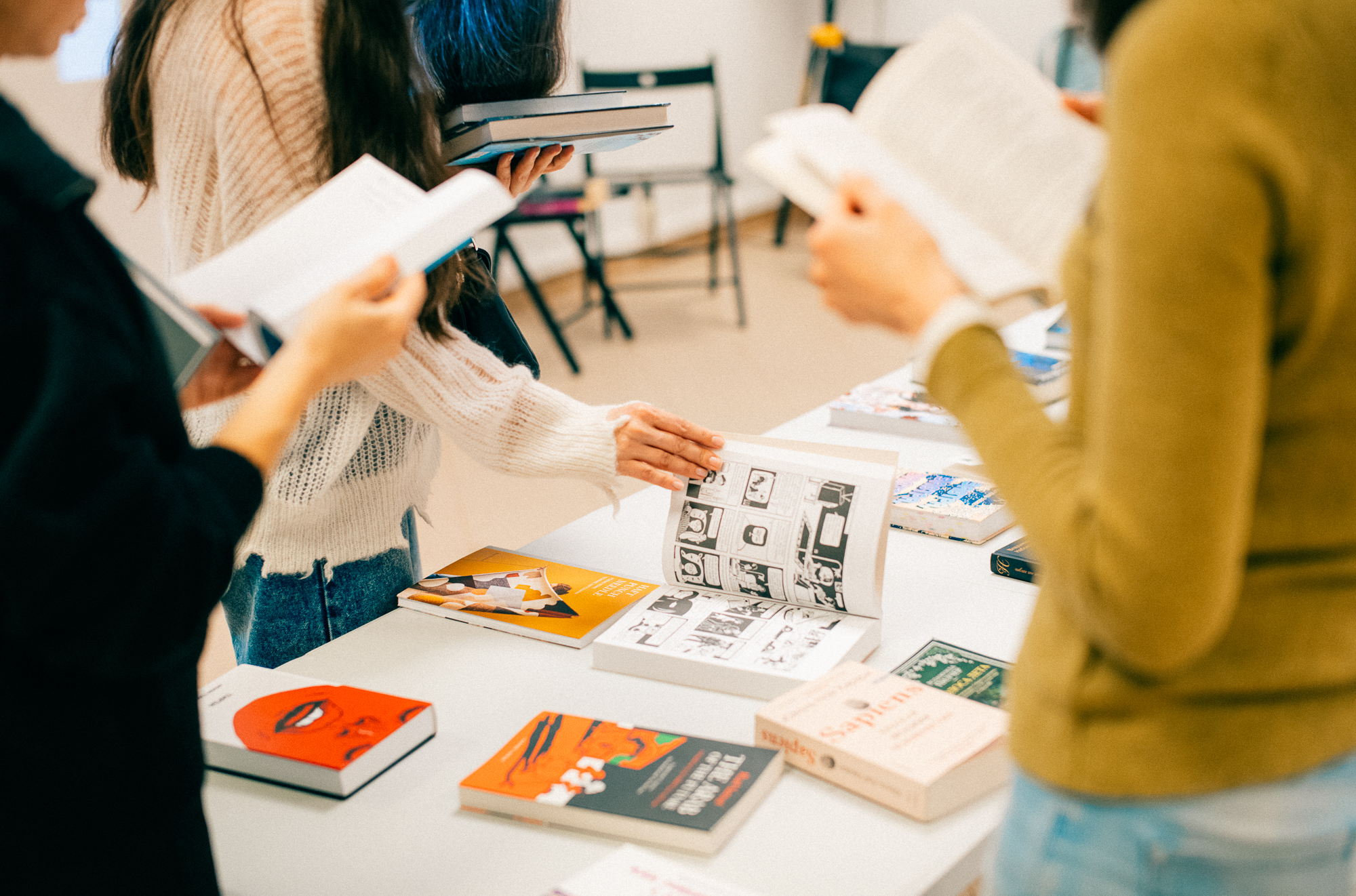
Vera Teterych: Participants in the community share physical books from their personal libraries temporarily and for free. It’s important to understand that the MneNeZhalko project is not bookcrossing, which implies that a book permanently changes ownership. Participants in our project remain the owners of their books. MneNeZhalko is about sharing physical books.
How the MneNeZhalko Project Works
Vera Teterych: There is an MneNeZhalko Instagram account where books available in the project are posted daily. We also conduct interactive activities, story activities, and create thematic book selections. You can take a book directly on Instagram—just send a personal message to the librarian.
The entire library is stored in Notion—a convenient catalog where you can find books by author, genre, language, and even location (there is surely someone near you who shares physical books, trust us).
If you are interested in a book, simply write to the librarian, arrange a meeting, and take the book for a while. To make the process as comfortable as possible, we have MneNeZhalko mailboxes—special baskets in Minsk where you can leave or pick up a book by arrangement. These baskets are mainly located in coffee shops; currently, there are 12 of them in Minsk.
Why We Believe Our Project is Relevant
Anya Valykevich: A physical book is a tactile experience. You hold it in your hands, flip through the pages, feel the slightly rough texture of the paper. It’s a live contact with the text that a screen cannot provide.
It doesn’t distract. When you read from a phone or tablet, there is always the temptation to check notifications, respond to messages, or look at social media. With a physical book, you are fully immersed in the process, without background noise and multitasking.
It gives a sense of reality. A collection of books on a shelf is the story of your life, your thoughts, your development. They hold memories: the moment you read them, what you felt, the thoughts that came to mind.
A physical book requires choice. You can’t just download a thousand books and forget about them—you choose, hold it in your hands, and dedicate time. It’s a slow ritual, not an endless stream of information.
An electronic book is impersonal. But a book with notes in the margins, dog-eared pages, and slightly worn corners is not just text; it’s a personal story.
How Many Books Are Available in the Project Today?
Vera Teterych: More than 3,500 books in Minsk alone. But the project already exists in other cities of Belarus, such as Grodno, Vitebsk, and Bobruisk.