Kick Off Your Gardening Year with Stunning Magnolias!
Welcome the New Gardening Year with Magnolias
Abbie Jury shares her excitement as the first magnolia blooms of the season coincide with Matariki, both signaling the start of a new gardening year.
My Love for Deciduous Magnolias
I’m a Jury, and that means I have a deep love for deciduous magnolias. You might wonder why one follows the other. Well, my late father-in-law, Felix Jury, created varieties like ‘Vulcan’ and ‘Iolanthe,’ and we still have the original plants in our garden at Tikorangi. I’m married to the man behind ‘Black Tulip,’ ‘Felix Jury,’ ‘Honey Tulip,’ and ‘Burgundy Star,’ with more amazing varieties on the way.
The Start of a New Gardening Year
I’ve always believed that the first magnolia blooms mark the beginning of a new gardening year. The first to open for us is always the pink Magnolia campbellii in our park. It’s one of the earliest signs of spring, and we usually see the first flower a few days after the winter solstice, around June 21.
Matariki and the Magnolia Blooms
This year, we celebrated Matariki as a nation on June 24. While we follow the Gregorian calendar, which dates back to 1582, it only determines time elements based on Earth’s position in the solar system, like the length of months and solstices. The dates we assign to celebrations are human decisions. January 1 being the start of a new year is based on northern hemisphere tradition and comes about nine or ten days after the winter solstice. Interestingly, Māori arrived at a similar conclusion, give or take a few days. It might be six months off in terms of the calendar, but it’s in sync with the seasons.
Matariki is determined by the rising of the Pleiades star formation and the start of the new lunar year. It happens to occur around the winter solstice in New Zealand, making it a logical and relevant marker for my gardening year.
The Beauty of Magnolia Campbellii
Our pink Magnolia campbellii isn’t as predictable as the solstice dates, and it doesn’t reach its peak display until well into July. But that first bloom bravely opens around Matariki and is a significant seasonal marker for me. Every year, I put on my woolly gloves on fine, frosty mornings and head out to capture the beautiful sight of the blooms on the bare tree with the snowy slopes of Te Mounga, Mount Taranaki, in the background. I use a zoom lens, as Te Mounga is over 35km away.
Magnolia campbellii was first sold in New Zealand in the late 19th century by a Lower Hutt nurseryman known as Quaker Mason. It was also the first magnolia planted in our garden by my father-in-law, Felix Jury, in the early 1950s. This pink M. campbellii is probably the most recognizable form in the country. Interestingly, white campbellii are more common internationally. The pink ones are limited to a small area around Darjeeling in India, and we’re lucky that Quaker Mason popularized a particularly good form of the unusual pink one here.
The Magnolia Flowering Season
The magnolia flowering season from late June to September is a special time for us. We have many magnolias, including named varieties, species, and unnamed hybrids from our breeding program. This is a plant family where the larger the plants get, the bigger the show they put on.
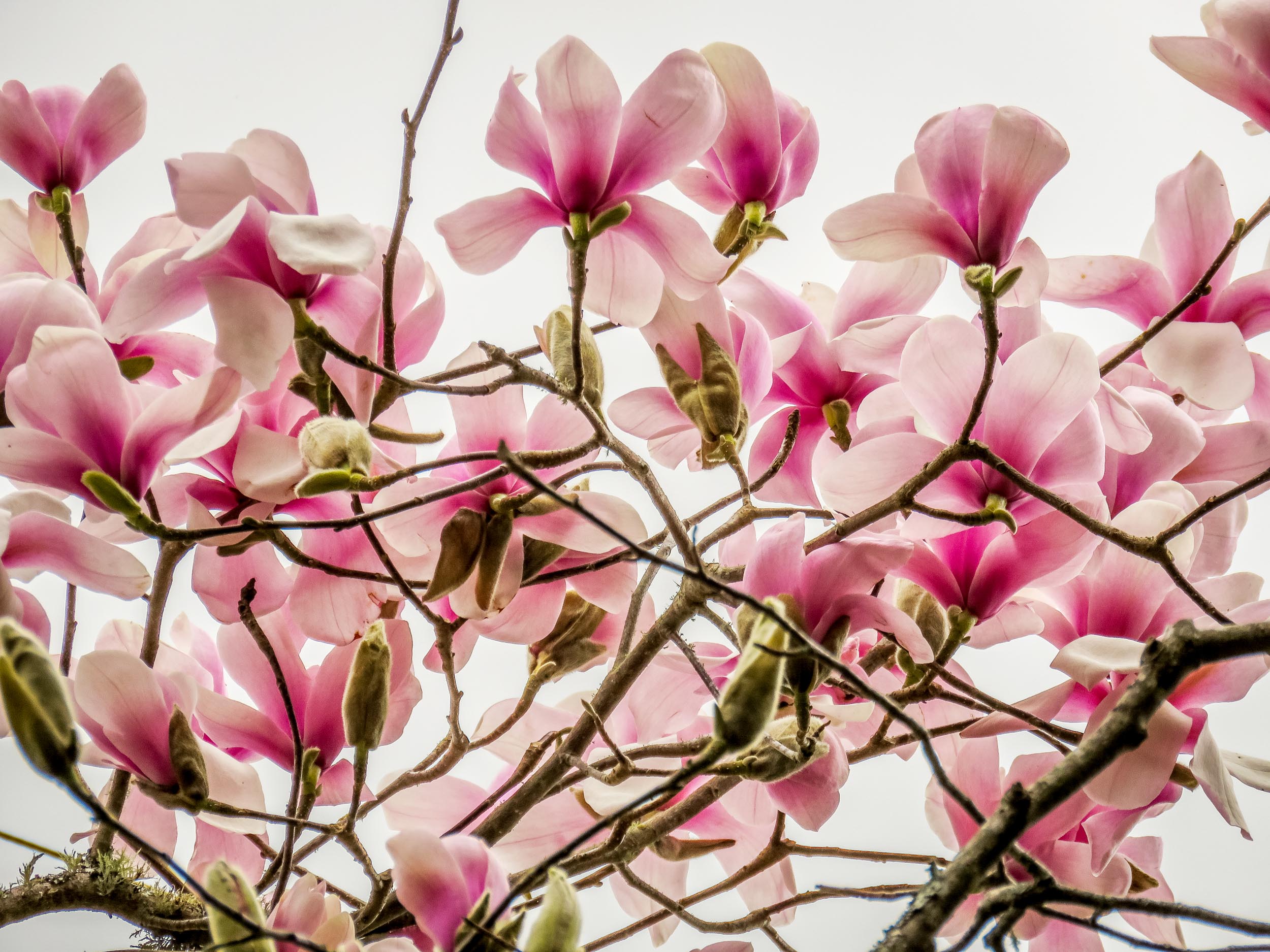
For me, deciduous magnolias hold pride of place. The display of bare blooms on a tree with no foliage can take my breath away. Because we have large trees, I often find myself looking up from below, describing it as floral skypaper.
Petal Carpets and Magnolia Care
When I look down, I see petal carpets on the ground, and I have a great fondness for them. However, I’ll admit they’re not great on paths, driveways, and sealed areas where the carpet can turn into slippery brown sludge. We use a leaf rake or leaf blower on sealed areas but leave the petals on grass or garden.
The Origins of Magnolias
Most deciduous magnolias are Asiatic in origin, particularly from China, northern India, and Nepal. The exception is the truly yellow deciduous species, Magnolia acuminata, which is from North America. It’s one of the parents of all the yellow hybrids available in the last 25 years.
The US is also the homeland of the most popular evergreen magnolias widely grown here. These are characterized by heavy, leathery leaves and large white flowers. I’m not a fan of the evergreen grandiflora types; the ratio of flower to foliage isn’t high enough for my liking. I prefer the 100% flower to 0% foliage of most deciduous varieties.
Michelias, on the other hand, are all Asian in origin, with many found in tropical areas like southern China, Vietnam, and Thailand. These are also evergreen but smaller overall, with softer, smaller leaves than the leathery American ones and a higher ratio of flowers. Botanically, they are magnolias, but they look very different from deciduous magnolias and fill a different role in the garden.
Magnolia Facts
- Magnolias are ancient, evolving before bees. They were originally pollinated by beetles and now provide a food source for bees at a time of short supply in late winter.
- We get deeper, richer coloring in magnolias in New Zealand, likely due to our soils, climate, and light clarity. The same plant can look very different with the color washing out, particularly in Northern Europe and the UK where winters are longer and colder, and light levels are lower.
- Deciduous magnolias come in pink, white, purple, yellow, and red. Aotearoa is internationally recognized as leading the way in breeding red magnolia hybrids, initiated by Felix Jury with ‘Vulcan’ and continued by Mark Jury, Vance Hooper, and Ian Baldick.
- You cannot get very large blooms on a deciduous magnolia that will stay a small plant under two meters. Smaller-growing varieties will have smaller blooms, and most deciduous magnolias are trees, not shrubs.
- If you have a magnolia where the buds either drop off or fail to open properly, it’s a sign of frost damage or pest damage by rats or possums.
- When deciduous magnolias have new leaves that are clearly distorted on opening, it’s an indication of spray drift.