How the 1960s Cosmic Era Transformed Fashion Forever
How the 1960s Cosmic Era Transformed Fashion Forever
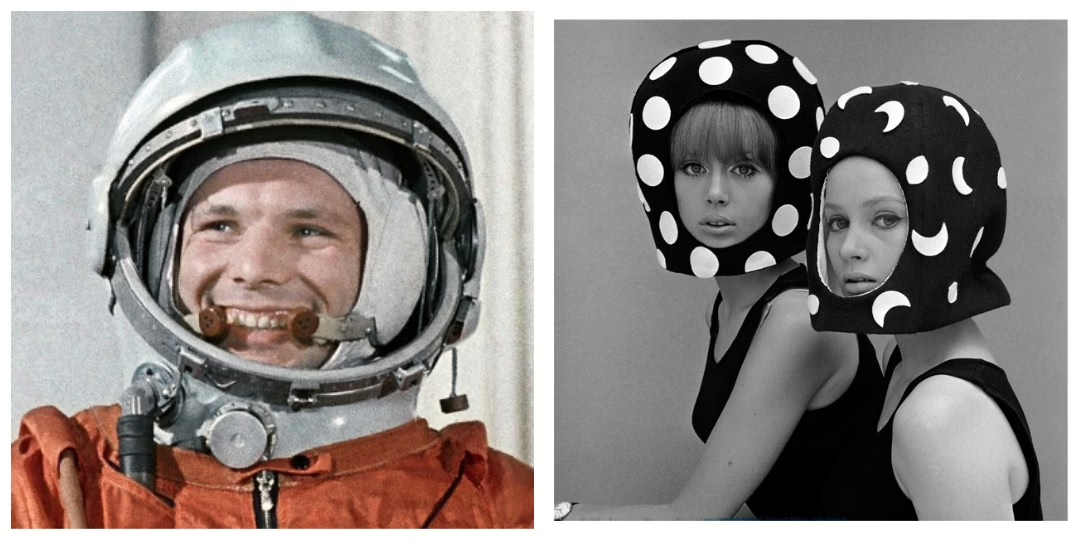
The 1960s was a decade of vibrant rebellion and cosmic inspiration. With Yuri Gagarin’s historic spaceflight, the world was propelled into a new era of exploration and innovation. The cosmos became a central theme in fashion, but the styles of the 1960s were as diverse as the universe itself.
The Cosmic Freedom of 1960s Fashion
Futurism defined the fashion and lifestyle of the 1960s. Shimmering fabrics mimicked the twinkle of stars and the sheen of astronauts’ spacesuits. Plastic jewelry, synthetic materials, and exaggerated alien-inspired looks became all the rage. Designers like Pierre Cardin were pioneers in incorporating cosmic themes into their work. Cardin’s bubble dress, inspired by dreams of space, created a sensation in the fashion world.
The fashion of the time embraced artificiality and eclecticism. By the end of the decade, the strict style rules set by Dior in the 1950s gave way to freedom of self-expression. The variety of styles and subcultures allowed people to experiment with feminine classics, like Audrey Hepburn’s looks, or embrace the hippie style, like Janis Joplin.
Fashion in the USSR: Elegance vs. Reality
In the Soviet Union, women of the 1960s were strong, intelligent, and wanted to be stylish rebels. The country’s achievements in space exploration inspired everyone. Despite the Iron Curtain, Western fashion trends seeped into the USSR. The closed network of “Berezka” stores offered exclusive Western clothing to a select few. Brands were unknown, but “French,” “Italian,” “Polish,” and “Yugoslav” clothing were coveted, with French and Italian items considered luxury.
However, the reality in the USSR was different. While Givenchy dressed Audrey Hepburn and the world marveled at her elegance, Soviet women carried string bags. Although they wore shorter skirts, reflecting the mini skirt era of the 1960s, some things remained unchanged. Soviet light industry continued to produce durable, utilitarian clothing. Women turned to knitting fashionable sweaters and dresses using the “two purls, two knits” method.
The introduction of women’s pantsuits marked the beginning of Soviet emancipation. Women in pants were criticized by society and the party, as was female smoking. The rebellious “Stilyagi” youth subculture, with their bold and liberated style, became one of the most vivid symbols of the era in the USSR.
London: The New Fashion Capital
In the 1960s, European youth gained financial independence, making travel and education more accessible. This led to an “educational boom.” With a stronger voice, the young generation gave rise to various subcultures, including mods, hippies, and beatniks.
London became the first city where designers created youth-oriented clothing collections, declaring the young as the primary consumers of the time. Thanks to Mary Quant, the “London Look” with its shocking mini skirts emerged. Before the 1960s, such short skirts were unimaginable.
The face of the era and the “queen of fashion” was Twiggy, a teenage model with an androgynous look and large eyes. She popularized the trend of very thin models. The style proposed by Mary Quant was also called the “Lolita style,” reminiscent of the character from Vladimir Nabokov’s controversial novel “Lolita,” published in 1955.
Hairstyles: The Pixie Cut and the Babette
The new lifestyle demanded new hairstyles. The short pixie cut was not for everyone, so the “Babette,” named after the French film “Babette Goes to War” starring Brigitte Bardot, became the super-popular hairstyle of the decade.
The casually teased hairstyle, despite the time it took to create, became a hit. Meanwhile, geometric cuts dominated the runways, offering a stylish, modern, and low-maintenance look.
Makeup: Emphasis on the Eyes
Makeup, like clothing, was bold and unrestrained. Thick black eyeliner, inspired by Cleopatra as portrayed by Elizabeth Taylor, and colorful eyeshadows in green, blue, purple, and red were all the rage. Hyperbolic lashes were heavily mascaraed for a dramatic effect.
Soviet women often used a mixture of black gouache and laundry soap as mascara, applying it with toothbrushes. The eyes of the 1960s women were meant to be striking. Lips could be any color, often carrot or red, but they were not as important as the eyes.
The Rise of Yves Saint Laurent
The phrase “fashion fades, style is eternal” belongs to the French couturier Yves Saint Laurent. In 1962, the first collection of the Yves Saint Laurent fashion house was released, becoming a leading haute couture house and a symbol of French fashion.