Grace of the Soul: A Unique Photo Exhibition Celebrating Women in Wheelchairs
Grace of the Soul: A Unique Photo Exhibition Celebrating Women in Wheelchairs
On November 18, Minsk will host a unique charitable photo exhibition titled Grace of the Soul at Flame Place (9-8 Masherov Avenue). This one-day event in the capital will later travel to other cities, including Vitebsk, Grodno, Mogilev, and Paris. For the first time in Belarus, the exhibition will showcase women in wheelchairs, focusing not on their disabilities but on their beauty and grace. We had the opportunity to speak with the photographer and the driving force behind this exhibition, Asya Zhikh.
Asya Zhikh: The Photographer and Visionary
Asya Zhikh, the photographer behind this inspiring project, is quick to point out that the exhibition is not solely her creation. “If it were just me, I would have photographed two girls and posted the images on Instagram,” she says. “But we have 14 participants and a massive exhibition. This is the work of many people and their support.”
Asya’s enthusiasm for the project is palpable. Despite her busy schedule—teaching at a photo school, taking care of her two daughters and husband, and preparing for her studies—she is energetic and passionate. Her responses to questions are swift and insightful, often anticipating the queries before they are fully asked.
Invisibility to Visibility: The Genesis of the Project
Over a year ago, Asya conceived the idea of photographing portraits of women with compelling stories. Initially, she planned to focus on women who had lost a child, but she couldn’t find participants and shelved the idea.
Later, while in Europe, she saw a photograph of a woman in a wheelchair that captivated her. This image sparked a realization: “I don’t see wheelchair users in our society. Are they not there? They must be. I just don’t see them. We need to show them.” Asya decided to create a portrait of a woman in a wheelchair.
When Asya told the participants that the exhibition would travel to Paris, one of them remarked, “People in my neighborhood don’t see me! But in Paris, they will.”
Beyond Disability: Celebrating Femininity
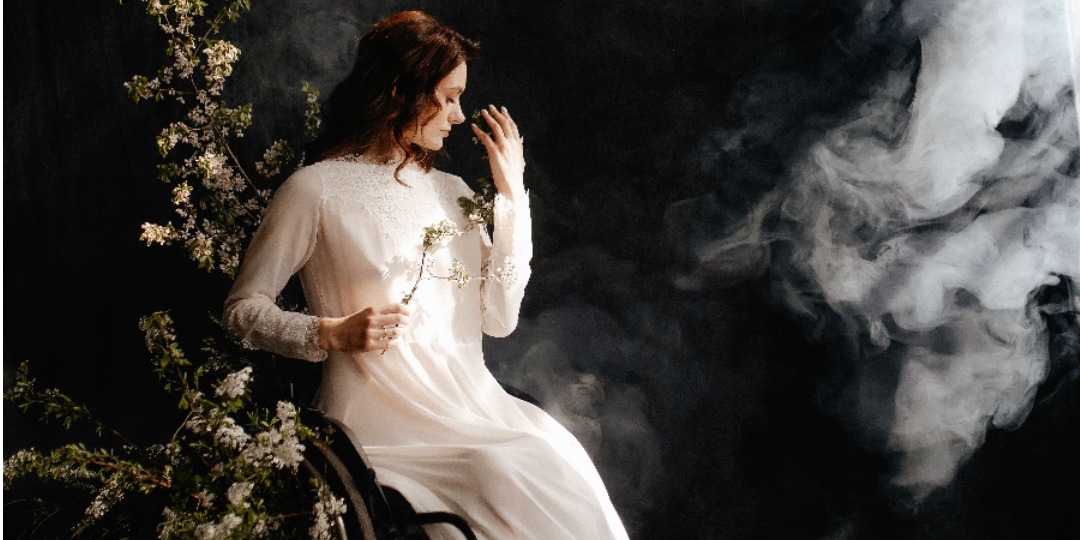
Asya’s vision was clear: “I didn’t want to photograph disability. I wanted to show female beauty.” Many of the participants had been photographed before, but the focus was often on their wheelchairs and disabilities. Asya wanted to change that narrative.
“We always see the wheelchair first, and then the person. I wanted to reverse that. I wanted people to see the woman first, and then the wheelchair,” she explains. “This exhibition is a chance for many of us to learn to see the person first, and then the wheelchair.”
To achieve this, Asya photographed the women without their wheelchairs. “Two photos without the wheelchair, one with it. To gently bring them back to reality,” she says. “She is beautiful! And she is in a wheelchair? Yes, she is in a wheelchair. And she is still captivating.”
Empowerment and Transformation
For the participants, the experience was transformative. “I think the most challenging moment for them was when we took them off their wheelchairs. They felt vulnerable without their wheelchairs,” Asya recalls. “But then I asked them to take certain poses—put your leg here, lie down beautifully, squat—and they realized that we were seeing them as healthy, ordinary women.”
Asya’s approach was direct and respectful. “At first, I kept apologizing, asking if they could turn this way or raise their hand. But the first participant, Dasha, told me, ‘Stop apologizing! Just tell me what to do, and I’ll try,'” Asya shares. “Dasha set the tone for the entire project. Thanks to her, I started photographing them as I would any woman.”
Beauty and Pain: The Emotional Journey
The emotional impact of the project was profound. “Why are you crying?” Asya found herself asking her assistants repeatedly during the first shoot. “They would say, ‘Asya, you can’t imagine how beautiful this is!'”
Asya and her team saw more in the participants than they saw in themselves. “We didn’t ask them how they saw themselves. It was a fashion verdict: they came, we styled them, dressed them. It was amazing,” she says. “If we had asked, ‘How do you want to be photographed?’ we would have limited ourselves. We saw so much more in them than they saw in themselves.”
There were tears and moments of deep emotion. “We would say, ‘Look, this is you! I didn’t make you this way, you are this way,'” Asya recalls. “There was so much pain, so much female pain… But all the girls were open to it. Some needed more time, some less. Sometimes, all it took was a dress, and they would transform. It’s amazing how little it takes.”
In the end, the participants were empowered. “They would say, ‘Wow, I can be like this,'” Asya shares. “They saw themselves in a new light, and it was beautiful.”
Asya reflects on the feedback she received about the exhibition’s promotional materials. “Some people said it was too somber, that it should be more cheerful. But I thought, ‘Somber? It should be cheerful? How?'”
For more information, visit the official Instagram page of the exhibition.