Beyond Snowflakes: The Revival of Paper Cutting Art and Its Reflection of Belarusian Women
Exploring the World of Paper Cutting Art
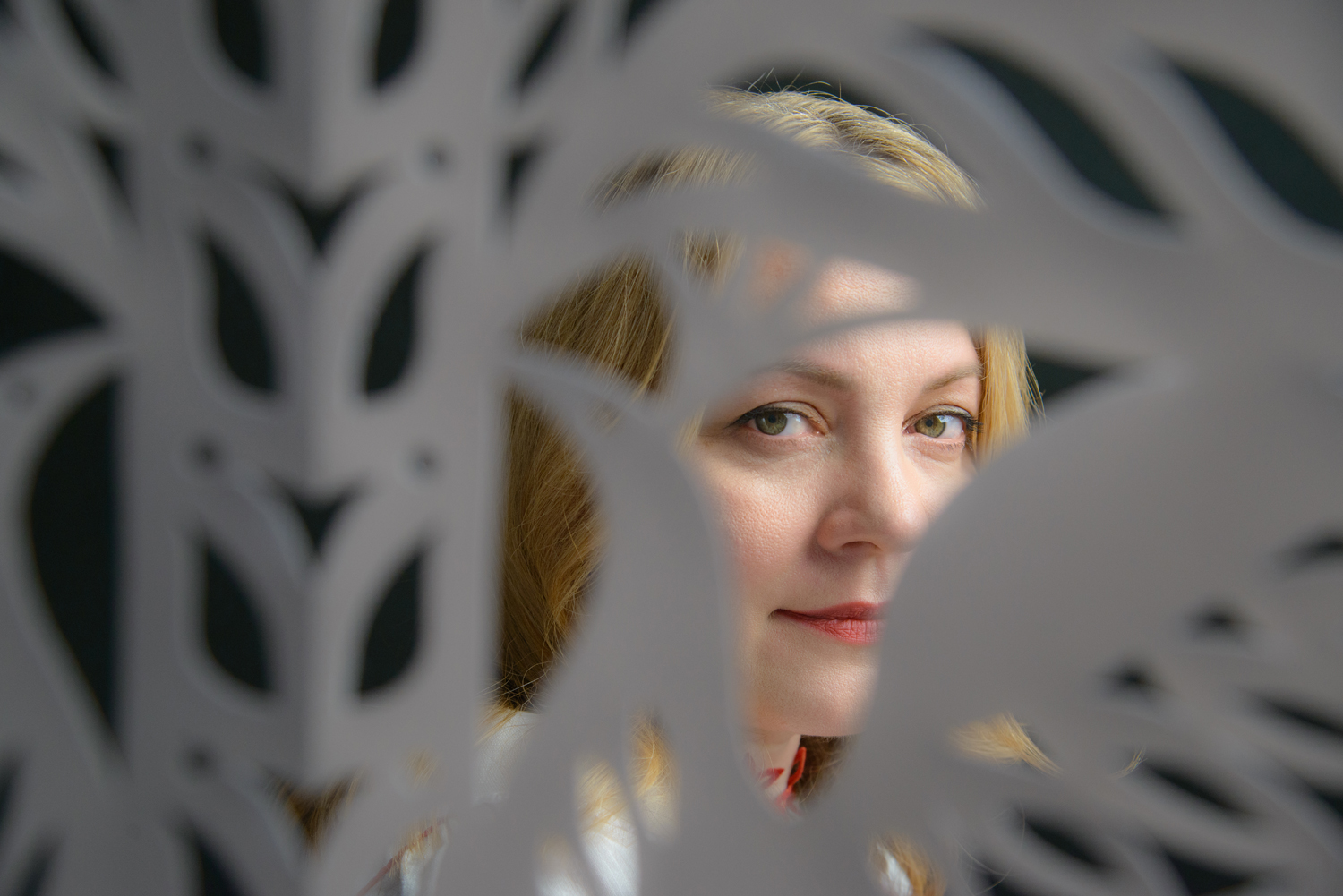
In a small gallery and workshop dedicated to folk crafts, we delved into the fascinating world of paper cutting. We discussed how our ancestors used this art form, what heritage remains today, the differences between various Belarusian paper cutting schools, the archetype of Belarusian women, and how to blend pagan and Christian elements. All this and more in an interview with the artist Lizaveta Chyrvontsava.
Lizaveta Chyrvontsava: A Legacy of Paper Cutting
Lizaveta Chyrvontsava is an artist and a second-generation paper cutting master. She is also a teacher at the decorative and applied arts department of the M. K. Oginski Music College. Lizaveta chose the craft of paper cutting, which her mother practiced, and has continued this folk art tradition with great dignity, brightness, and refinement. She has also passed on this art to her two daughters. Moreover, Lizaveta is a national master of Belarus and has contributed significantly to the recognition of paper cutting as a distinct form of folk art.
Today, paper cutting is an intangible cultural heritage of Belarus. The next step is for it to be recognized as a cultural heritage by UNESCO. Lizaveta shows that traditional, folk, and modern elements can be combined. She has collaborated with the watch brand Hvilina, and her paper cutting motifs can be seen on objects at the Kaval’skaya Slabada metro station. Her works are displayed in the children’s museum of mythology and forest in Zaslaŭ and many other places. Currently, Lizaveta is a central figure in the Maladzyechna school of paper cutting. Journalist Yulia Vauchok met with the artist at the Oginski Music College in Maladzyechna to talk about the wonderful world of paper cutting.
From Childhood to Mastery
Lizaveta, when did you realize that you would dedicate your life to paper cutting, considering your mother also practiced this art?
I have been doing this since childhood. My mother showed me, and for me, it was always a game. As a little child, I could do it quickly and easily. It seemed simple to me, a child’s pastime. Paper cutting is done by folding the paper and cutting out a piece of what you are creating. When you unfold it, it’s always a moment of wonder for a child, as something very beautiful appears. I also did my diploma project on paper cutting at art school. When I entered the University of Culture, there was no paper cutting; it was a revival of this folk craft. It was in decline. People only remembered it during the New Year holidays when they started cutting out snowflakes. People did not consider paper cutting a separate form of art.
Reviving a Lost Art
I tried various directions of traditional folk art: ceramics, weaving, straw plaiting. I liked them all, but I did not feel that any of them were my true calling. All the teachers who knew me laughed and said, “Oh, what can you do? You are a graphic artist. Go into illustration or something.” Perhaps because paper cutting is a graphic form, it resonated more with me. The process of cutting, the motor skills involved, it all came together. I felt that this was mine, and I realized it around the age of twenty.
When I was in my fifth year, I had to do a diploma project and choose a direction. I thought, “What should I do?” I also liked tapestry. But there were many girls doing tapestry. Then my teacher in Maladzyechna, Yuri Pavlovich Gerasimenka-Zhyznevski, an illustrator and graphic artist, said, “Why don’t you do paper cutting?” I said, “We didn’t study paper cutting at all.” He replied, “So what? It’s traditional folk art! What is your faculty? Folk crafts. This is a folk craft—why not?” He insisted, saying, “You are good at it.” He pushed me strongly. Then my mother supported me, saying, “Why not? Let’s do it!”
The Diploma That Started It All
I started looking for a scientific supervisor. At the university, I turned to a teacher who taught straw plaiting, Lidia Alehavna Malakhova. She agreed and supported me. Paper cutting is such a wonder! It started to spread and develop easily because of certain people who supported others at the right time.
They supported my mother here in Maladzyechna. They supported me. And this craft began to gradually captivate the entire space. The feeling that it is needed, that people like it, that it is very interesting and deep, that through paper cutting you can not only cut out some utilitarian snowflakes or crowns, it is generally the boundary between easel and folk art. It can look like very complex and interesting graphics. But the traditional, folk beginning must always be preserved. We felt this power, the potential of this art form, so, it seems to me, it began to develop so strongly.
Breaking Barriers and Combining Traditions
Can we say that everything started with your diploma? Then you began to “weave, connect” the traditional and the modern?
Yes. For me, it was a moment of acceptance. There was a notion that traditional art should not be moved too much. It should not be touched and transferred to a modern context. The fact that we wanted to take it to another level was unacceptable to many. And if you start to invent something, new forms, it can take this type of creativity out of its framework, and it will no longer be traditional or folk, but some kind of modern graphics.
How did you defend your diploma, being the first to do paper cutting in “Folk Crafts”? How were you evaluated?
Very well. Everyone liked it. It was something unusual in general. At the same time, it was a tradition and variations of graphic images. I had “The Circle of Life,” a cross with decorative elements and the main points of the calendar circle. It was like the cycle of human life. Of course, there was no significant disapproval [from the teachers]. Traditional paper cutting was very often dark, black. I had a paper cutting from black paper. The graphics of this form are very expressive through the background and the contrast of the paper itself. I remember there were moments when they said, “Oh dear, black angels, how so.” There were things when I had to say—it’s normal, it can be. There were people who said, “Yes, it’s very interesting, do it, do it.” And there were people who said, “Oh no, what is this? It’s not Belarusian, it’s not traditional.” There were different attitudes.
Uses and Misconceptions
I read that paper cuttings were most often used as curtains. How else were they used?
Curtains were made, then round overlays. They could be placed under a vase, on a table. They also decorated with crowns, called “podzory.” They decorated icons. In the western territory of Belarus, printed icons from Poland were very common. They were painted in different colors and decorated with paper cuttings as frames. They were always quite simple.