Between Life and Death: A Puppet Theater’s Premiere of Vasily Bykov’s Masterpiece
Between Life and Death: A Puppet Theater’s Premiere of Vasily Bykov’s Masterpiece
In the year marking the 80th anniversary of the victory in the Great Patriotic War, the Belarusian State Puppet Theater has staged a performance based on Vasily Bykov’s novella “Sign of Misfortune.”
The Impossible Made Possible
Six months ago, when the Belarusian State Puppet Theater announced a production based on Vasily Bykov’s novella “Sign of Misfortune,” it seemed impossible! Bykov’s prose is notoriously difficult to adapt for screen or stage due to its intricate subtext and deep psychological elements that are best experienced through personal reading. However, the puppet theater in the capital was determined not to remain silent on the topic of war in this significant year. After six months of hard work and rehearsals, the premiere of “The Hamlet” took place on a special day, June 21, 2025. This date is also significant as it marks the 101st anniversary of Vasily Bykov’s birth—a writer whose life and work were deeply intertwined with the war.
A Heavy Performance
The performance is a challenging experience for the audience, not only due to its heart-wrenching content but also its duration: 2 hours and 10 minutes without an intermission. It is physically demanding to sit through, but that is precisely the intention. This performance is not meant to be comfortable or convenient. The people about whom Bykov wrote endured and survived the war—and so must the audience.
An Immersive Experience
Eugeny Korniag deliberately denies the audience comfort and ease, preventing them from passively watching the performance. Like a true puppeteer, he pulls the strings and creates situations that do not allow the viewer to remain a detached observer. He provokes, makes you feel, suffer, fear, experience, and think. He forces you to hide your eyes from the harsh light of the spotlights that search for their victims in the darkness. The screeching sound of tank metal grates on your nerves and receptors. He transforms the auditorium into a hamlet from which there is no escape. Suddenly, you feel the genetic memory of fear awakening within you, and the stories of your grandmother or great-grandfather come to life in your mind. We are still the generation that knows about that war not only from books and films but also from living stories told with tears in their eyes.
The Magic of Puppet Theater
The creative trio of Eugeny Korniag, Tatyana Nersisyan, and Ekaterina Averkova (director, artist, and composer) conquers the hearts of an increasing number of viewers with each performance. While other theaters struggle to attract young audiences, the puppet theater draws them in naturally—young, intelligent, seeking, and caring viewers who come on their own. Getting a ticket for adult performances at the Minsk Puppet Theater is a quest in itself! Even for performances that have long been in the repertoire. And for the premiere of “The Hamlet” based on Bykov’s work, they say all the tickets were sold out not in hours, but in minutes!
This theater has its own special magic—the magic of puppetry, created by the masters of puppet craft. Among them is Oleg Nikolaichik, the oldest stagehand of the theater, an honored cultural worker who has been breathing life into puppets for 60 years! He started working with the legendary Anatoly Lelyavsky, then created with his son Alexey, and now with Eugeny Korniag—three generations of directors!
Puppets Come to Life
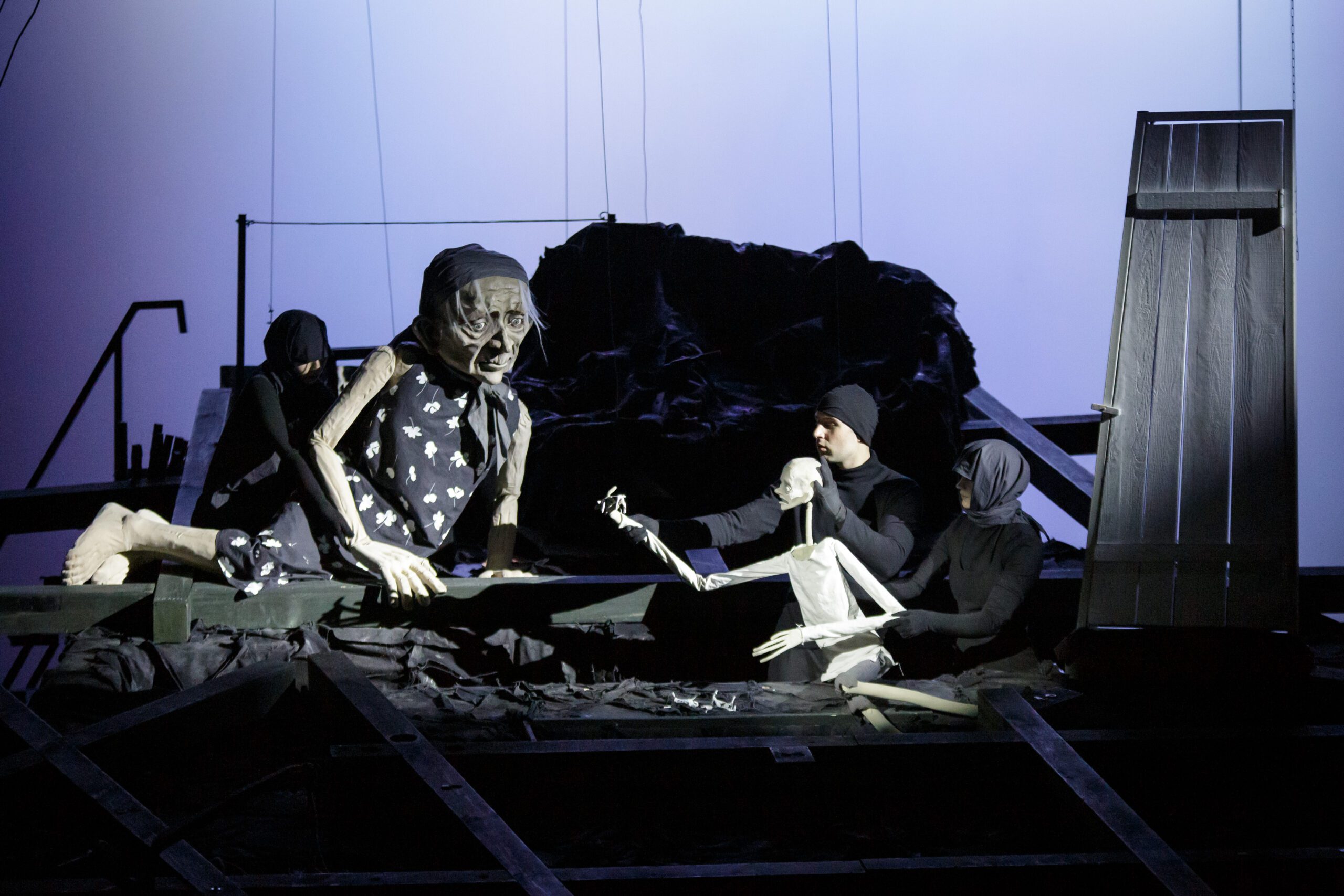
The puppets in “The Hamlet” do not replace people; they become them. At some point during the performance, you forget that there is an actor behind the puppet, who has a dual role: to play the puppet and to become one with it, not just giving voice to the character but becoming one with it. In the scene where Petro is killed, there is a sense that a weak, dry, emaciated, but real and living body is struggling with its last strength. You believe that it hurts him not like a puppet, and you shrink in your seat with fear…
Characters and Symbolism
Distributing roles in this performance means giving the puppet a scale commensurate with the character’s personality. The traitors and policemen are small, pitiful, sticky like gnats, crawling through windows and doors—you want to shake them off with disgust. The Nazis are boots that march, break down doors, and beat to death. They speak in machine-gun bursts in the only language they know. Death is a giant skeleton in a German military cap: with its long bony arms, it can reach anyone. Its eyes are lanterns searching for the living in the darkness, all-seeing and all-searching… There is something in these images of evil reminiscent of the style of Guillermo del Toro’s films, his “Pan’s Labyrinth,” which is also about the struggle of man against fascism.
The human likeness is only in the main characters (Stepanida and Pyatrok) and in the mute shepherd Yanka, who is like a semi-angel, not of this world. The policeman Guzh is already a semi-human or subhuman: he has the body of a living actor, but his face is deathly, disfigured by his actions—he is a monster whose terrible essence affects the body like a disease. His face is a mask that changes every time power changes. But this one, terrible and ugly, has already grown into him over the years of war—it cannot be removed.
According to the director and artist’s concept, Pyatrok and Stepanida are disproportionate in scale, just like their personalities. He is a small man, fearful, doubting, trying not to resist evil, hoping to wait out and survive the trouble without fighting it. Stepanida is a huge puppet, just like her courage and actions. A heavy puppet that is difficult to control, just as it is impossible to control Stepanida. A big person, they say about such! Her figure fills the stage. She is afraid of nothing, and how can these small, gnat-like policemen, these soldier-boots break and destroy her? Stepanida is bigger, stronger, tougher than them! But Bykov does not have the usual happy ending, unless you consider the triumph of the spirit over the body a victory.
In this performance, there is such silence in the hall that the tension rings in your ears. In this silence, a very important conversation takes place in each person’s mind: how would I have acted in a war where it is impossible to remain on the sidelines? There is no escape from these thoughts.