Barbie Turns 62: The Evolution of an Iconic Doll
Barbie Turns 62: The Evolution of an Iconic Doll
Today, we celebrate the 62nd birthday of a lady who has captured the hearts of millions and become a legend—the Barbie doll. Barbie has had a dazzling career: she was the first “non-human” to become an exhibit in a wax museum, she was placed in a time capsule as a special message for future generations, and over 70 couturiers have designed dresses for her.
Barbie has graced the canvases of renowned artists, including Andy Warhol. Moreover, the doll has her own registered color. Today, the earliest Barbie dolls are rare collector’s items that sell at auction for $30,000.
The Birth of a Long-Legged Friend in 1959
Barbie’s birthday is March 9, 1959. The doll was “born” an adult, and for a good reason: Barbie’s creator, Ruth Handler—the wife of Mattel founder Elliot Handler—noticed that her daughter and her friends were trying to “age up” the dolls they played with. At the time, most dolls were “babies” that could be nurtured, not taken on a date. Girls wanted a friend they could dress up and style.
Thus, Barbara Millicent Roberts was born. Yes, the first doll had a full name and surname, named after her creator’s daughter. The world saw a plastic “girl” with an adult face and figure.
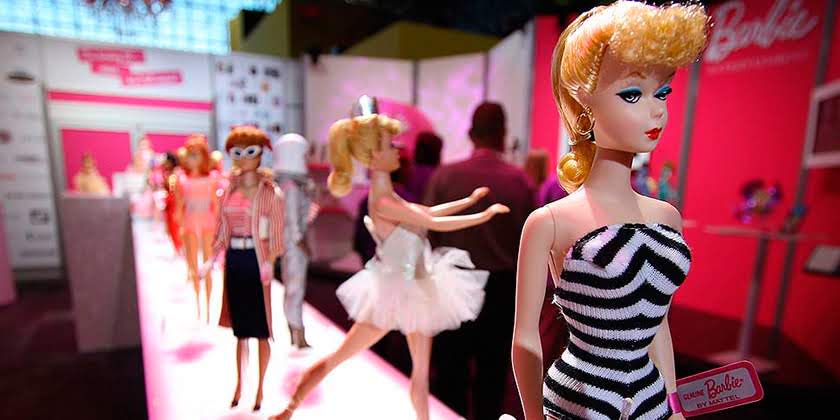
Several versions were released: a brunette and a blonde, with hair tied in a ponytail and with bangs. The lady was dressed only in a black-and-white swimsuit, and her feet were adorned with open-toed sandals. The first Barbies cost three dollars. The first batch sold 3,000 units, and in the first year, 300,000 were sold.
The 1960s: A “Vulgar” Model with Bold Makeup
The first year of sales saw a real boom: American girls went crazy over the new long-legged friend. Although parents did not approve of the “vulgar” doll with a bust and bold makeup.
During this time, Mattel began to work more actively: outfits for Barbie were sold separately for $1-5, a family and friends were created for her, and in 1961, Barbie got a boyfriend, Ken.
The 1970s: A Younger Look and a Job
With each passing year, the doll became younger and younger. If the first models resembled 30-year-old women, they soon began to look like teenagers. The bright makeup disappeared from her face, her features became softer, and a blush appeared on her cheeks.
The year 1973 was very important in this story: the dolls’ eyes stopped “crossing,” and the girls began to look confidently straight ahead. Before this, Barbie gently lowered her eyes down and slightly to the side. And in 1975, a breakthrough occurred: the long-legged model finally began to smile.
Despite the constant attempts to “rejuvenate” the doll, she was sent to work. She tried on different professions—from a nurse and ballerina to a fashion designer, singer, and teacher.
The 1980s: A Dark-Skinned Barbie—No to Racism
In the 80s, Barbie’s body was thoroughly reworked: almost all parts of her body began to bend and turn—from wrists to knees, from waist to head.
However, not all functions took hold; some were soon abandoned. For example, the blinking and talking Barbies, who said things like “I love shopping,” did not catch on.
In 1980, a very important fact occurred in the biography of the incredibly popular doll—a dark-skinned Barbie was released for the first time. After that, the wave could no longer be stopped: “Dolls of the World” appeared—fiery Barbie-Spanish, Barbie-Queen of Great Britain, Barbie-Eastern Princess, and many others.
The 1990s: The Peak of Her Career—Presidential Candidate
The most successful and best-selling Barbie in history was released in 1992: she had very long curly hair down to her ankles and a fashionable look—a mini-dress barely covered her “modesty,” and her feet were adorned with pink “boats.”
This became the peak of Barbie’s career; a presidential candidate doll went on sale. Accompanying products immediately went into action: stationery, books, cosmetics, accessories, jewelry, clothing for children and adults, rights to screen the image, the release of official magazines, and book series.
In the 90s, Barbie was the most stylish in her entire history: her wardrobe included leather jackets from Harley Davidson, evening dresses from Dior, and jeans from Calvin Klein. World-renowned designers themselves offered to create outfits for the doll.
The 2000s: Breakup with Ken and Lawsuits with Competitors
The “zeros” period became a time of continuous losses for Barbie. If in the 90s, statistically, three dolls were sold every second in the world, then in the 2000s, such indicators could only be dreamed of.
Competitors did not waste time in vain: girls began to pay more attention to Bratz rather than Barbie. In response to the decline in sales, Mattel began a long legal battle with competitors, proving that they had stolen the idea.
However, Barbie’s problems did not end there. The main drama unfolded in the personal life of the beauty: she broke up with Ken, and on Valentine’s Day. The official press release on this matter stated that “Barbie wants to get married, and Ken is stressed about it.” It turns out that designers created wedding dresses for her every year in vain.
The 2010s: Body-Positive Barbie on the Cover of Time Magazine
It was necessary to follow the times, so the model was sent to the gym. On this wave, she got a whole collection of sportswear, shoes, bags, and exercise equipment.
The 2020s: A Ukrainian Girl
The creators of the doll decided to take a rather unconventional step: for the first time in history, a Ukrainian woman became the prototype for Barbie—world-renowned fencer, Olympic champion Olga Kharlan. Barbie-Olga entered the Role Models collection. It is based on portraits and stories of famous women from around the world: athletes, singers, models, actresses.
Representatives of Mattel explained that they want to show worthy examples for girls around the world to follow and be inspired by.
For Kharlan herself, this was a surprise; she explained that she is very happy to have her own personal Barbie.
Text: Kristina Gavrilovich