A Must-See Ballet Extravaganza: The Mariinsky Theatre’s Grand Tour
A Must-See Ballet Extravaganza: The Mariinsky Theatre’s Grand Tour
“The touring summer always brings new troupes, fresh choreography, exciting performances, and remarkable discoveries,” says Ekaterina Dulova, the director of the Bolshoi Theatre of Belarus, on the opening day of the grand summer tour in Minsk by the Mariinsky Theatre of Opera and Ballet. This statement couldn’t be more accurate! The arrival of the ballet company from the main theatre of the Republic of Mari El is a precious gift to the ballet enthusiasts of Minsk. While we share why this is a significant event, we urge you to hurry and purchase your tickets for one of the six days of their guest performances at bolshoibelarus.by. This is truly a ballet that you must see!
Romeo and Juliet
In the queues at the Bolshoi Theatre’s box offices, people are glued to their smartphones, either searching for information about the performances brought to Minsk by the Mariinsky Theatre or looking up the location from where the troupe has arrived. The Republic of Mari El is situated in the European part of Russia, on the left bank of the Volga River. Its name translates to “the land of the Mari people,” who still make up 45% of the republic’s population. The capital city, Yoshkar-Ola, has been home to the Mari State Academic Theatre of Opera and Ballet since 1968, named after Erik Sapaev, the composer of the first Mari national opera.
The Mari Wonder
The Mari ballet has been a serious topic of conversation since Konstantin Ivanov, a former premier of the Bolshoi Theatre of Russia, took over as the artistic director of the ballet company in 2001, and later the entire theatre. Without resorting to pathos, it’s fair to say that one person can significantly impact not only a theatre but also the culture of an entire country. Konstantin Ivanov’s name will undoubtedly be inscribed in the history of Mari ballet as one of its founders!
Konstantin Ivanov became the artistic director of the republic’s main theatre at the age of 28, a record for modern Russia. We can draw a parallel with our own history: Valentin Elizariev became the chief choreographer of the Belarusian Bolshoi Theatre at the age of 26! Interestingly, the parallels between Ivanov and Elizariev can be extended further. Valentin Nikolaevich was the first in the USSR to turn to the music of Carl Orff, staging the ballet “Carmina Burana,” which has remained a contemporary production for 40 years. The Mariinsky Theatre is the only one whose repertoire includes all three ballets based on the music of Carl Orff’s triptych “Triumphs”: “Carmina Burana,” “The Triumph of Aphrodite,” and “Catulli Carmina.” At the invitation of Konstantin Ivanov, the legendary Estonian choreographer Mai-Ester Murdmaa staged these performances. The ballet “A Midsummer Night’s Dream” to the music of Mendelssohn was staged for the theatre by Japanese choreographers Ozaki Akihito and Michiko.
A former soloist of the Bolshoi Theatre, Konstantin Ivanov performed leading roles in the productions of the modern classic of ballet, Yuri Grigorovich. He has staged many performances for the Mariinsky Theatre troupe and created his own versions of famous ballets. Today, the ballet repertoire of the Mariinsky Theatre includes about 30 ballets, ranging from the old classic favorites like “Giselle” and “Swan Lake” to contemporary choreographers’ productions based on classical dance language, such as “Spartacus” and “Aniuta,” and the national ballet “Forest Legend” based on Mari folklore with the use of folk music. There are also productions that can be called true gems. Two of them have been brought to Minsk by the theatre: the ballet “War and Peace” by Andrei Petrov and “Russian Hamlet” by Boris Eifman.
War and Peace
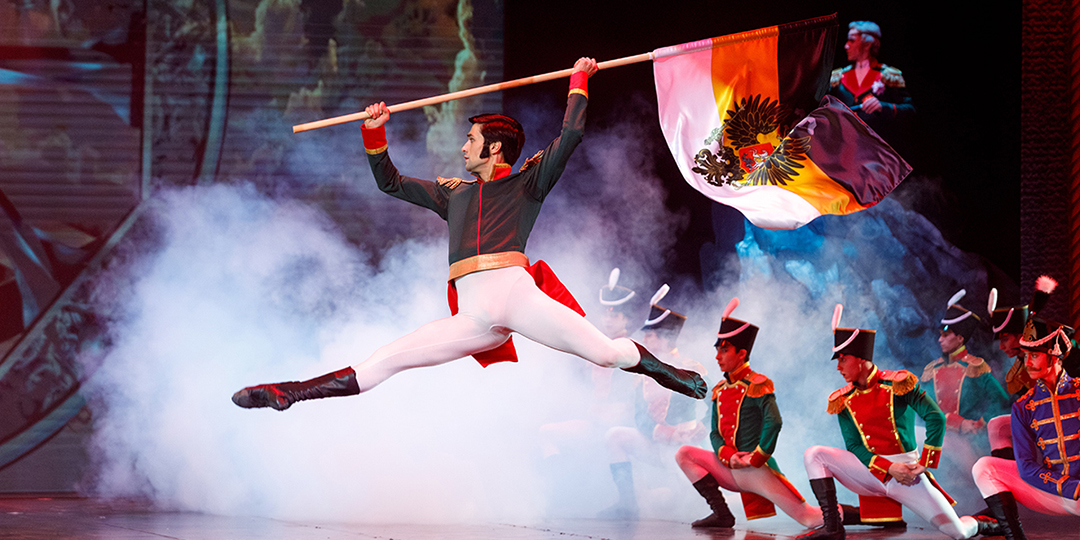
“The ballet ‘War and Peace’ is a unique performance, a real exclusive that can only be seen in two theatres in the world – Donetsk and Mariinsky,” says Konstantin Ivanov about the ballet based on Leo Tolstoy’s novel, which opened the “Touring Summer” in Minsk. Even earlier, at the beginning of July, the theatre’s troupe presented its new production at the “Summer Ballet Seasons” in Moscow.
This unique large-scale production was first presented to the public in the summer of 2023. The premiere involved about 200 artists from three theatres: Mariinsky, Donetsk, and the “Kremlin Ballet,” led by the choreographer of the performance, Andrei Petrov. After his death, Konstantin Ivanov approached the widow of the choreographer, as well as the composer Vyacheslav Ovchinnikov (the ballet is set to his music, once written for Sergei Bondarchuk’s Oscar-winning film “War and Peace”) with a request to transfer the performance in a new version to the stage of the Mariinsky Theatre.
The scale of this production is impressive! Have you ever seen a ballet that recreates such a massive battle scene as the Battle of Borodino on stage?! Not only with stage cannons but also with dance, turning a military confrontation into a choreographic action! This ballet has a very complex choreographic language based on classical dance. There are many interesting directorial findings. For example, the scene of the waltz of Andrei Bolkonsky and Natasha Rostova at the ball: as Natasha’s feelings grow, the dancer lifts the ballerina higher and higher in a series of supports, lifting her off the ground. And soon she is literally soaring above everyone, being in love. “This is a very difficult scene for my partner, who, in fact, holds me in his arms throughout the entire dance,” admits Kristina Mikhailova, the prima of the Mari Ballet, who plays the role of Natasha Rostova, paying tribute to the skill of her partner, Artem Vedenkin.
It must be admitted that the Minsk audience, nurtured on the ballets of Valentin Elizariev, is very discerning and attentive. Among the brilliant soloists of the Mariinsky Theatre in the production of “War and Peace,” the leading soloist Artem Vasilyev stands out with his flying leap and intellectual artistry. When asked at a press meeting whether he relied on the book or the film in creating his character, the artist, who so accurately embodied the image of Pierre Bezukhov, replied that this ballet is a completely separate product, not copying either the novel or its film version. And these are very accurate feelings from the performance. This is not a retelling of Tolstoy’s novel, not an attempt to transfer Bondarchuk’s film to the stage – this is a grand ballet about war and peace, which still alternate.