Unforgettable Eurovision Looks That Made History
Unforgettable Eurovision Looks That Made History
Eurovision, the annual song contest that began in 1956, has evolved into a spectacle of music, culture, and unforgettable fashion statements. Initially focused on songs and performances, the contest has seen a shift towards iconic and sometimes controversial outfits. Let’s take a journey through some of the most memorable Eurovision looks that have left a lasting impression.
The Early Years: Elegance and Simplicity
In the early years of Eurovision, participants emphasized musical performance over fashion. However, some standout looks from this era include:
- Jacqueline Boyer (France, 1960): Boyer’s elegant and timeless dress reflected the sophistication of the era.
- Dana Rosemary Scallon (Ireland, 1970): Scallon’s graceful attire complemented her winning performance.
The 70s and 80s: Glamour and Bold Statements
The 1970s and 80s brought a wave of glamour and bold fashion choices to the Eurovision stage.
- ABBA (Sweden, 1974): ABBA’s “rodeo chic” look, combining cowboy style with futuristic elements, became iconic.
- Co-Co (UK, 1978): The group’s daring and revealing outfits pushed the boundaries of fashion on the Eurovision stage.
- Sheeba (Ireland, 1981): Sheeba’s futuristic costumes, inspired by Thierry Mugler, featured sharp shoulders and metallic inserts.
The 90s and 2000s: Innovation and Controversy
The 90s and 2000s saw a mix of innovative and controversial fashion choices.
- Judith (Israel, 1994): Judith’s inside-out dress, which she manipulated throughout her performance, became a talking point.
- Angelica Agurbash (Belarus, 2005): Agurbash’s transformer dress, designed by Valentin Yudashkin, featured multiple looks in one.
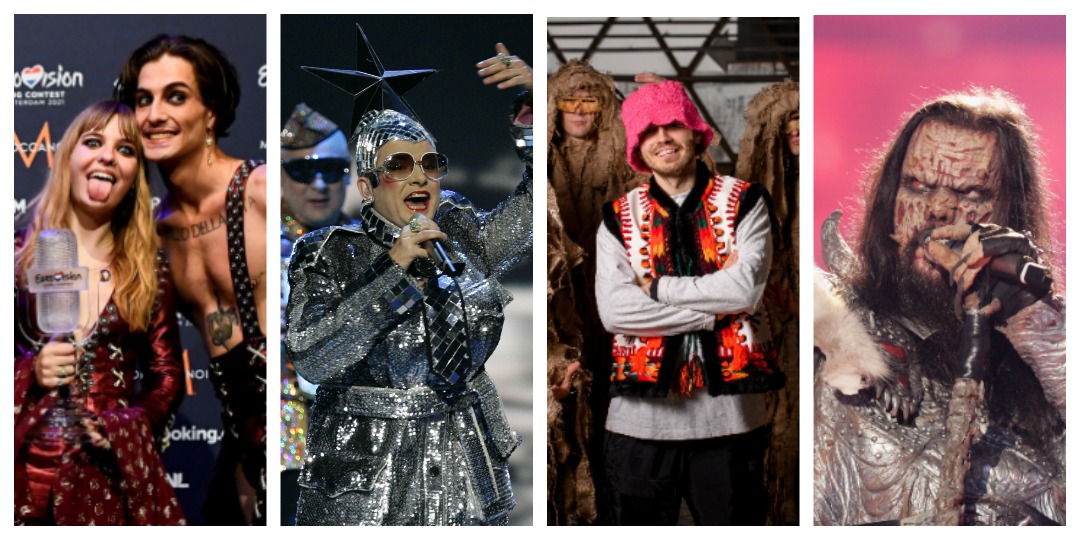
- Lordi (Finland, 2006): The hard rock group’s monster costumes and masks were a stark contrast to traditional Eurovision fashion.
- Verka Serduchka (Ukraine, 2007): Serduchka’s foil outfit, complete with a flight attendant’s cap and a star on her head, was a standout look.
Recent Years: Diversity and Empowerment
In recent years, Eurovision fashion has embraced diversity and empowerment.
- Aliona Moon (Moldova, 2013): Moon’s avant-garde outfit signaled Eurovision’s shift towards more experimental fashion.
- Nina Kraljić (Croatia, 2016): Kraljić’s futuristic kimono-like cloak, with its intricate design and silver inserts, divided critics but captivated audiences.
- Hatari (Iceland, 2019): The group’s BDSM-inspired performance, complete with latex, chains, and spikes, was a bold statement.
- Madonna (Guest Performer, 2019): Madonna’s Joan of Arc-inspired outfit, featuring a cone-shaped bra and armor-like sleeves, was a highlight of the evening.
- Manizha (Russia, 2021): Manizha’s dress, representing Russia’s multiculturalism, transformed into a red jumpsuit, symbolizing women’s freedom.
- Måneskin (Italy, 2021): The group’s glam rock-inspired outfits, designed by Etro, featured bold makeup and platform boots, sparking a TikTok trend.
- Kalush (Ukraine, 2022): The group’s traditional Ukrainian costumes celebrated their national heritage and won the hearts of viewers.
For more insights into the world of fashion and entertainment, check out this authoritative source.