Kathmandu: A Journey Through Time and Resilience
Kathmandu: A Journey Through Time and Resilience
Until 1951, Nepal remained a secluded kingdom, preserving its unique culture by closing its borders to foreigners. Thanks to a resourceful Russian named Boris Lisanovich, Kathmandu transformed into a tourist haven for the wealthy. By the late 60s, the city became a hotspot for thousands of hippies, renowned for its psychedelic experiences. Today, Kathmandu, a sister city to Minsk, is rebuilding after the devastating 2015 earthquake.
Rewriting the Guidebooks
Travel guides to Nepal are being rewritten. Websites now append tragic notes to their descriptions of attractions: “destroyed” or “partially destroyed” during the 2015 earthquake. Many unique and ancient temples, palaces, towers, and monuments were damaged. However, the essence of Kathmandu, which attracts diverse tourists—from elderly aristocrats to young hippies, adventurous mountaineers, trekking enthusiasts, history buffs, and religious pilgrims—remains intact.
Following Lisanovich or the Hippie Trail?
Boris Lisanovich’s personal connection with the king opened Nepal to wealthy tourists. He convinced the royal family to convert an entire palace wing into a luxurious five-star hotel, complete with a high-end restaurant and a large casino. Today, the Yak and Yeti Park Royal Hotel thrives, with rooms starting at $100 per night. The restaurant even serves Boris-style pelmeni, borscht, and vodka.
For those drawn to the spirit of the free-wheeling 60s, Freak Street offers a glimpse into the past. This narrow lane near the palace is home to some of the city’s cheapest lodgings. For a few dollars, you can experience minimalist interiors, cardboard walls, shared toilets, and lively crowds. And yes, marijuana is readily available, offered to all, including children. This is not an exaggeration; my ten-year-old daughter was approached.
Most tourists prefer the middle ground: affordable yet comfortable hotels in Thamel. This tourist district is akin to the “old town” of European capitals. Thamel boasts a high concentration of hotels, restaurants, and shops, yet remains a residential area, unlike tourist enclaves in Bali where locals only come to work.
Thamel is also a hub for the city’s renowned exports, which account for over 20% of its income. Here, you can find clothing, pashminas, carpets, artworks, and handicrafts.
Must-See Attractions
Most travel guides and websites agree on the essential sights in Kathmandu.
Durbar Square
Durbar Square is Kathmandu’s signature attraction and the emblem of Nepal’s capital. Recognized as a UNESCO World Heritage Site, it encompasses around 50 temples and monuments, a palace where all Nepali kings were crowned (the last coronation was in 2001), as well as alleys, courtyards, fountains, and various sculptures. The palace exhibition is modest, featuring personal items of the last king, coins, and photographs.
Given the photography restrictions and stringent security measures, including the requirement to leave handbags in storage, I expected more.
Durbar Square began to take shape in the 12th century, with most of its construction occurring between the 15th and 17th centuries. At its heart lies the Hanuman Dhoka complex, dedicated to Hanuman, the monkey king from the “Ramayana” epic. Essential temples include those of Shiva, Parvati, Vishnu, and Ganesha.
For Kathmandu residents, who enter for free, Durbar Square is a place for leisurely strolls, relaxation, and shopping. Once, it was a haven for hippies indulging in sweet narcotic dreams. The square is also home to the Kumari Palace, where the living goddess Kumari occasionally appears at the central second-floor window.
Photographing the palace is allowed, but not the window when Kumari is present. Before her appearance, attendants strictly prohibit photography, with severe penalties for violations.
Pashupatinath
The Pashupatinath Temple complex, situated on the banks of the Bagmati River, shares similarities with the Indian city of Varanasi. Along the river, platforms for funeral pyres are visible. Only Hindus are permitted inside the main Shiva temple. Others can witness the final part of the funeral ceremony—the cremation itself.
The more prominent the individual, the higher up the river the cremation takes place. Royal family members are cremated beyond the bridge. The Bagmati, like the Ganges, is heavily polluted with ash, offerings, and garbage. Amidst the filth, pilgrims bathe and cleanse the bodies of the deceased.
Crossing the bridge, you enter a park filled with temples. Since Shiva is the patron of all living beings, animals such as monkeys and deer are fed here. It is believed that these animals will be reborn as humans in their next life.
At the entrance, you can see sadhus (holy ascetics) in yellow and orange robes. Sadhus are the only ones in Nepal allowed to smoke marijuana in public places.
Guides warn that the cheerful, dirty, and painted sadhus who pose for photos with tourists are not genuine. The real sadhus live in caves upstream along the Bagmati and do not interact with people.
Some saints reside in small towers within the tourist-accessible area. For example, the world-famous Milhi Baba, a holy man who subsists solely on milk. He sits on an open platform with a sign in English: “Here sits the great saint Milhi Baba,” along with a brief biography. My daughter Stella and I also encountered a strange old man who comes to Pashupatinath every morning, reads sacred texts aloud, sings, rattles, and waves his arms all day. In the evening, he closes his book and leaves, only to return the next day at dawn. No one knows his name or origin.
A steady stream of pilgrims climbs the 365 steep steps to the 100-meter hill almost continuously, even off-season.
The walls of one temple are adorned with paintings by a European artist. Additionally, the complex houses a shelter established by Mother Teresa.
Boudhanath
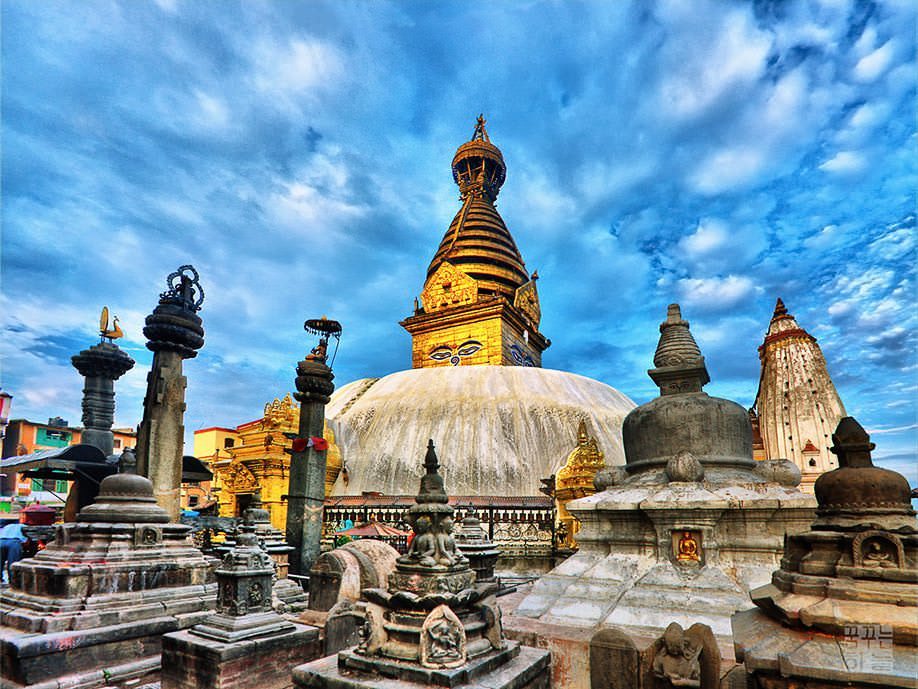
Boudhanath is one of the world’s largest Buddhist stupas and a UNESCO World Heritage Site. It is considered the center of Tibetan Buddhism in Nepal. Built in the 6th century, it is surrounded by dozens of monasteries representing various schools and traditions, as well as hotels, restaurants, shops, beauty salons, and other infrastructure catering to tourists and pilgrims.
Once, this was a pilgrimage route from Tibet to India. Europeans may recognize Boudhanath from Bernardo Bertolucci’s film “Little Buddha,” where it is prominently featured in central scenes.
Over a hundred prayer wheels encircle the stupa. These wheels, which pilgrims spin while chanting mantras, are adorned with colorful flags symbolizing the wind horse. In Tibetan culture, the wind horse represents life force, and it is believed that placing these flags high, such as on rooftops, brings protection and good fortune.