Catania: The Phoenix City Rising from Lava
Catania: The Phoenix City Rising from Lava
Nestled on the triangular island of Sicily, along the shores of the azure Ionian Sea, amidst the black cobblestones of solidified volcanic lava, and under the golden rays of the scorching, almost African sun, lies a city that has risen from the ashes—Catania.
A Glimpse into History
Founded by the Greeks in the 8th century BC, Catania has endured a tumultuous past. It has been under the rule of harsh Syracuse conquerors, part of the Roman Empire, inhabited by Arabs, and conquered by Normans. In 1169, it was completely destroyed by an earthquake, and in 1669, it was buried under a layer of lava and ash during a massive eruption of Mount Etna, at the foot of which it is located. Yet, like a phoenix, it rose again, blooming with crimson oleanders, pink almond trees, ruddy pistachio shrubs, snow-white apricot blossoms, and luxurious city streets paved with solidified volcanic lava and adorned with the pompous architectural frills of the Baroque.
The Spirit of Catania
Visiting this city, one can’t help but feel the strength that has endured through countless upheavals. Living at the foot of an active volcano means accepting that at any moment, everything can be lost, including life. It takes a measure of courage, a touch of recklessness, and an immense love for life. These qualities permeate the people of Catania, making them a fascinating subject of observation.
Mount Etna: The Heartbeat of Catania
Mount Etna, the largest and most active volcano in Italy, has around 400 craters that erupt at least once every three months. The lava from these eruptions is skillfully directed, collected, and transformed into building material for roads and structures. Approximately every 150 years, an eruption destroys a village. Yet, the fertility of the volcanic lands, rich in minerals, compels the people of Catania to resettle and cultivate olives, whose oil is infused with the flavors of flowers and citrus, almonds, whose milk is sold in supermarkets alongside cow’s milk, and much more.
Exploring Catania
The Old Town
As with any European city, the Old Town of Catania is a must-visit. Imbued with Sicilian Baroque style, it is adorned with wrought-iron balconies, well-houses, and magnificent churches. The streets, paved with black lava cobblestones, are bustling with life. Start your journey from via Etnea, the main street of the historic center, and stroll from the sea, or rather, from the railway tracks that block the way to the sea. Here, you’ll find the local market, where you can’t leave without buying something—sunny sweet apricots, black cherries, batteries of magnificent zucchini, huge onions, homemade cheese, and more.
Piazza del Duomo
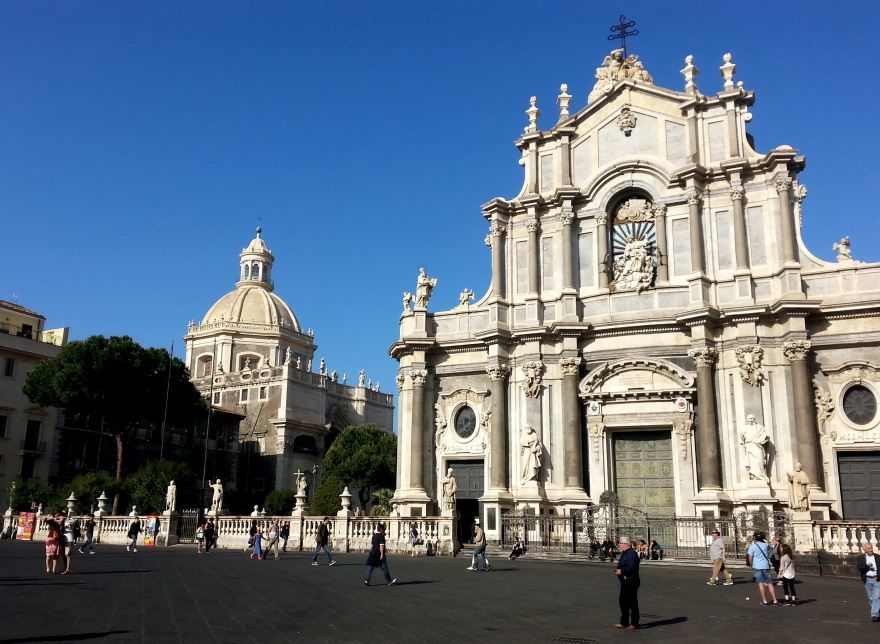
Follow the zigzag of the market, which leads you through its labyrinths and around the central streets. Eventually, you’ll find yourself at the Cathedral Square, Piazza del Duomo. This square is rich with magnificent Baroque palaces, pompous churches, and at its center stands an elephant carved from a single piece of lava stone—the symbol of the city for several centuries. Opposite the elephant is the Cathedral of Catania, dedicated to Saint Agata, the patron saint of the city. The cathedral was built in its current form in 1711.
Piazza Università
As you move through the city, the Cathedral Square gives way to Piazza Università. In July, a stage is set up here for the Teatro Massimo Bellini, and in the evenings, the sounds of the orchestra fill the city. The theater is named after the composer Vincenzo Bellini, a native of Catania. Signor Bellini was born into a family of musicians and gifted the world with 11 spectacular operas.
Architectural Marvels
The magnificent churches of Catania are seamlessly integrated into the city streets, cleverly hidden in small squares. As you pass by, you might suddenly hear the beating of your heart, so awe-inspiring are these giants, mostly from the 17th century. In their Baroque finery, they stand here for centuries, commanding respect for the people who built them.
Cafes and Gelaterias
Cafes, gelaterias, shops, and eateries adorn the gray-black architecture of the city. Further down the street, you’ll encounter the ruins of a Roman amphitheater from the 2nd century BC. It could accommodate 7,000 people and had a diameter of about 80 meters. This splendid black spectacle lies at the foot of the Church of Saint Placido, dating back to 1723.
Villa Bellini
A little more of the scorching sun and the city’s hustle and bustle, and you can escape to the shade of the greenery and intricate landscape labyrinths of Villa Bellini, a park laid out in the 18th century. Here, you’ll find water bodies, sculptures, busts of figures from the Teatro Bellini, playgrounds, luxurious crowns of exotic trees, flower beds, and floral clocks. You could spend the entire day here if you wish. But opposite the main entrance to the park is one of the oldest confectioneries in the city, and knowing this fact, it’s hard to remain indifferent. Of course, we’re going there!
Pasticceria Savia
The Savia Confectionery (Pasticceria Savia) was opened in 1897 by the family of the same name. This is the ideal place to try the traditional Sicilian dessert “Cannoli” for the first, second, third, or any other time. The fried pastry tube is filled with the tenderest ricotta cheese cream and sprinkled with pistachio shavings. Rumor has it that this is the place to try the local fast food called “Arancini.” These are balls of rice with filling, fried in oil. The filling can be meat ragout, mozzarella cheese, or spinach. A huge ball or cone is served in a napkin and eaten on the go with such pleasure that is characteristic of a person who has been wandering around the city all day and is fed only by impressions. Moreover, the coffee culture in Italy will not allow you to deprive yourself of the pleasure of a noon espresso from the hands of a black-eyed barista.
Panini
And don’t forget to try the panini! There are special paninoteche for this, where caring signori will make you a panini to your taste from the freshest ingredients. Two pieces of dense gray bread, and between them—a whole world: the gold of olive oil moisturizes, cherry tomato halves add sweetness, fresh mozzarella makes the taste of the Italian sandwich creamy and tender, and pancetta gives it a piquant touch and makes it more satisfying. Had a snack? Then let’s move on!
Modern Catania and the Sea
Gradually, we leave the Old Town behind and find ourselves on the wide streets of the modern city, heading towards the sea. After no less than 5,000 steps, its sparkling blueness and black coastline attract the eye. Across the road from the coastline, there are many gelaterias and cafes where you can have a snack or enjoy a dessert. There’s no need to rush—the sea is waiting here, and the weather in summer rarely changes: standard +32 degrees and sunshine.
The Volcanic Coastline
At this point in the story, it’s worth mentioning Mount Etna again, which has influenced and continues to influence the life of the city and its geography. The coastline is strewn with huge black boulders, which are the very volcanic lava solidified over the centuries. In places, these coal-black stones transform into flowers that dot the entire coastline. Moving across such a surface, one can safely imagine that this is not Earth at all, but Mars, for example.
The Beach Experience
There is no sand, no gradual increase in depth, only hardcore: black stones and from them—into the transparent sea depth. This is if we are talking about the beach for locals, where, having settled on a comfortable stone, you can spend a couple of hours quite well. It will be more difficult to stay longer—the body will take the shape of the stone and will be capricious and demand comfort.
Comfortable Beaches
Comfort will be provided by paid beaches, the entrance to which costs from 7 to 10 euros per person per day. These are metal structures above black stones that hold spacious wooden platforms with sun loungers, umbrellas, pools, bars, toilets, showers, lockers for things, and play areas for children. You can enter the sea from such beaches along a ladder that descends into it. And again, swim in the transparent blueness in the company of
For more information on the history and culture of Catania, you can visit the official tourism website of Sicily: Visit Sicily.