Anastasia Ballet: A Timeless Love Story
Anastasia Ballet: A Timeless Love Story
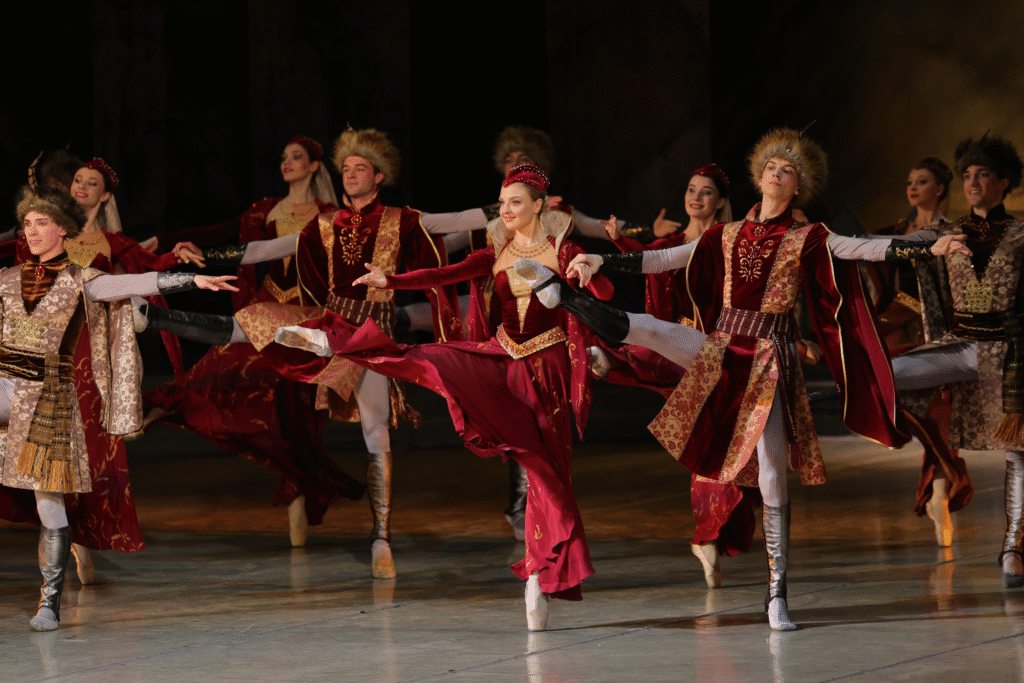
This summer, the National Academic Bolshoi Theatre of Belarus revived the ballet “Anastasia,” a production that is typically reserved for special occasions. The first performance after its hiatus took place in July 2025, celebrating the 70th anniversary of composer Vyacheslav Kuznetsov. We had the privilege of experiencing this vibrant choreographic epic on the festive Day of Unity on September 17. The next performance of “Anastasia” is scheduled for October 8, as part of the “Life in Profession” project initiated by the theatre’s chief choreographer, Igor Kolb. This benefit performance will honor the choreographer Yuri Troyan, who celebrates his 75th anniversary this year, and will be preceded by a creative meeting with the master in the Gobelin Hall of the theatre.
Why You Shouldn’t Miss This Ballet
We’ve compiled several compelling reasons why every lover of Belarusian ballet should not miss this performance at the National Academic Bolshoi Theatre of Belarus.
Uniquely Belarusian
While ballets like “The Nutcracker” and “Swan Lake” are performed worldwide, “Anastasia” is unique to Belarus and can only be seen at our National Academic Bolshoi Theatre. This ballet stands as a one-of-a-kind production and is currently the only ballet with a national theme in the theatre’s repertoire. In comparison, the opera repertoire is richer, with two operas in Belarusian based on works by Vladimir Korotkevich: the rare “Sivaya Legend” (2012, music by Dmitry Smolsky) and the large-scale mystical opera “Wild Hunt of King Stakh” by Vladimir Soltan, staged by Anna Motornaya in 2021.
Inspired by Belarusian History
Over the years, Belarusian history and cultural heritage have inspired choreographers. The first national ballet of independent Belarus, “Passions (Rogneda)” with music by Andrei Mdivani, was staged by Valentin Elizaryev in 1995. Yuri Troyan was the second choreographer to draw inspiration from a legendary figure in Belarusian history. His ballet “Vitovt,” set to music by Vyacheslav Kuznetsov and premiered in 2013, was based on historical events from the Grand Duchy of Lithuania. Five years later, in 2018, the same creative team brought the story of Princess Anastasia to the ballet stage. After her husband’s death, Anastasia led the defense of Slutsk against a Tatar invasion.
A Romantic Retelling
The libretto for “Anastasia” was written by Anatoly Delendik, who had previously created the screenplay for the Belarusian historical blockbuster “Anastasia of Slutsk.” For the ballet, Delendik’s task was not to adapt the screenplay but to craft a new story with a more romantic and less martial tone. He succeeded brilliantly! Although the ballet is often compared to the story of Joan of Arc, this comparison may not be entirely accurate. Unlike the French national heroine, Princess Anastasia is a more multifaceted character: she is a lover (the libretto features a genuine love triangle!), a devoted wife, a caring mother, and only then a warrior. Love in all its forms plays a crucial role in this ballet.
A Fairytale Come to Life
Ballet is an art form that does not strive for absolute historical accuracy. It should come as no surprise that the librettist took creative liberties with historical events, preserving only the basic narrative framework.
“Undoubtedly, it is important to understand that this is not a historical study,” says choreographer Yuri Troyan. “We created a choreographic legend and tried to incorporate as organically as possible the facts that occurred in the lives of the main characters. Yes, Anastasia led the defense of Slutsk. This is a historical fact. But I was interested in showing the backstory. What did this fragile woman have to go through to gather an army and lead it into battle?”
Clearly, no one expects to see chapters from a history textbook on the ballet stage. In this performance, emotions and passions take precedence over facts. And there are plenty of both! At one point during the performance, I glanced at the audience and saw people of all ages watching the stage with bated breath. Although the ballet is rated “12+”, it can be enjoyed by younger children as well—it unfolds like a fairytale! The enchanting atmosphere is enhanced by vibrant costumes, impressive sets, and stunning video projections. Today, special effects on the stage of the National Academic Bolshoi Theatre are nothing new, but in 2018, there were perhaps even too many of them. However, it must be acknowledged that they are fitting here! When burning huts are projected onto the stage, one is reminded of Khatyn, and the mind inevitably draws a tragic parallel: how many such wars have scorched our land! The icon-like face of Saint Euphrosyne of Polotsk is consumed by flames (set designer Alexander Kostyuchenko effectively uses the frescoes from the walls of the Spaso-Euphrosyne Monastery in the scenery). And then hordes of Tatars gallop on horseback… In this production, the visual effects (video content artist Nikolai Yarunin) do not distract from the choreographic action but enhance it. This is a very bright and spectacular ballet in which historical facts are subtly woven into the mythological, fairytale, and romanticized fabric of the narrative. It is more of a ballet-fairytale, with a hint of historical events and a direct lesson for the “good young men”: good triumphs over evil, and love changes everything for the better.
A Legendary Trio
In this production by Yuri Troyan, there are battles on stage, but the struggle for love plays a key role. The defense of everything dear—homeland, principality, city—is inseparably linked with the protection of one’s family and honor. From the first to the last act, the battles on stage take place primarily within the triangle of relationships, where the line between love and hate is thin. Just like in life and in ballet! The young princess falls in love with Mikhail Glinsky, is married off and sincerely loves Prince Semyon of Slutsk, bears his children, becomes a widow and a captive of the enemy… Her loyalty and nobility will cause the transformation of the negative character Glinsky in the finale of the ballet.
Remarkably, in 2025, the principal roles in this ballet are still performed by the same dancers as in 2018. This adds to its rarity and uniqueness: you are transported by a “time machine” not only to the era of the Grand Duchy of Lithuania but also to the time when Irina Yeromkina, Anton Kravchenko, and Yuri Kovalev shone on the stage of the National Academic Bolshoi Theatre of Belarus at the height of their careers. As in 2018, the role of Zaira is performed by Alexandra Chizhik. The image of the Mongol khan is embodied by Vladimir Ruda, one of the most “jumping” soloists of the troupe.
For more information, visit the official website of the National Academic Bolshoi Theatre of Belarus.