Zoya Lutsevich: “I Always Follow My Heart. It is My Guiding Light”
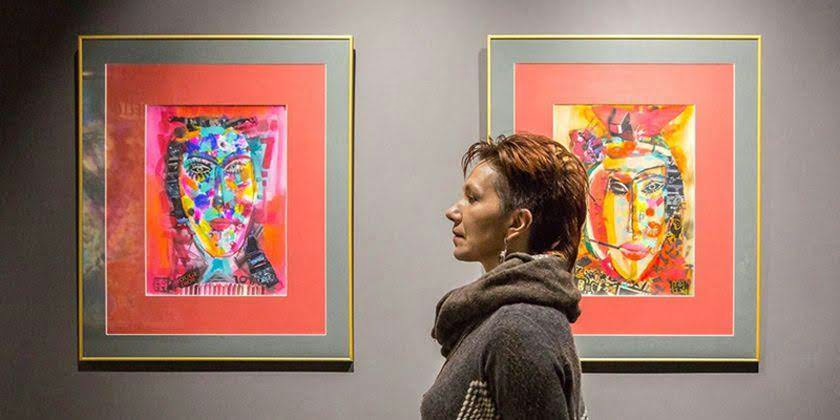
Zoya Lutsevich: A Beacon of Artistic Innovation
Zoya Lutsevich, a luminous figure from the renowned Katkov-Lutsevich creative dynasty, has captivated Belarusian and European audiences for years with her groundbreaking artistic projects. Each of her exhibitions is a testament to her unique style and technical prowess, showcasing a diverse array of art objects. In our spring interview, Zoya shares her insights on life, profession, and inner calling.
The Influence of a Creative Dynasty
Being part of a celebrated artistic family undoubtedly comes with responsibilities and expectations. Zoya reflects on her artistic lineage and its impact on her professional journey:
“I am fortunate to be born into a talented and close-knit family where art has always been the top priority. The atmosphere of respect and kindness has surrounded me since childhood, guiding my first steps on the creative path.”
Her grandfather, Sergey Petrovich Katkov, was a pioneering educator and the founder of modern Belarusian visual arts. He established the first art studio in Minsk at the Palace of Pioneers before World War II. Sergey Petrovich’s approach was unique, much like Vladimir Mulyavin, who fell in love with Belarusian land and celebrated it in his works. This distinctive perspective significantly influenced the development of the national school of visual arts.
Zoya’s father, Oleg Vikentyevich Lutsevich, had a profound impact on his students. Working at the Minsk Art School (now the Minsk State Art College named after A.K. Glebov), he developed an individual teaching methodology. Oleg Lutsevich emphasized the importance of three-dimensional vision and drawing, demanding excellence from his students. Unlike his father, who never criticized his pupils, Oleg was strict and uncompromising, becoming a spiritual guru to many.
Her mother, Svetlana Sergeevna Katkova, possessed a poetic soul. Her work is imbued with deep love for nature and her loved ones. Svetlana’s still lifes are unique symphonies of light and color, filled with subtle philosophy and lyrical expressions.
Zoya’s spiritual mentor is Zoya Litvinova, a former student of her grandfather. Following Sergey Petrovich’s teaching principles, Zoya Litvinova never criticized but instead nurtured Zoya’s individual creative abilities. She introduced Zoya to the vibrant world of contemporary European art, leading to twenty happy years spent in Austria and Germany. Their bond remains strong, both in life and art.
The Interplay of Character and Art
Zoya believes that an artist’s character significantly influences their technique, color palette, and choice of themes:
“While we, as artists, reject the notion of gender-specific painting, the boundaries in contemporary art are becoming increasingly blurred. However, certain themes can reveal gender tendencies. Men often embody strength and conflict, while women represent peace and softness. Character plays a crucial role in art. For instance, the creative tandem of Katkova and Litvinova showcases different styles and color palettes, yet they complement and enrich each other, much like yin and yang.”
The Evolution of Artistic Style
Zoya’s work spans various styles, genres, and techniques. She attributes her versatility to her curiosity and continuous search for her unique style:
“I am an inquisitive person who loves to travel and participate in plein airs, symposia, and master classes. The ever-growing variety of artistic materials and techniques inspires me to experiment and innovate. Being recognizable is essential for a contemporary artist. It’s rewarding to see when technical mastery aligns with an artist’s inner content. While modern art encompasses numerous themes, the aesthetic principle should always dominate.”
Art as a Reflection of the Soul
Zoya’s works invite viewers to embark on an internal quest for meaning:
“I never create art with a predetermined goal. I paint as I see, feel, and understand at the moment. My heart is my guiding light. Life has its ups and downs, and my art reflects these emotional journeys. Diversity in my work signifies internal movement and changing emotional states. My art speaks for itself, and interpretations are subjective. I value open dialogue with my audience and always strive for honesty.”
The Importance of Art Education
Zoya emphasizes the significance of art education in shaping a child’s worldview and thinking:
“Art education is crucial for a child’s holistic development. The ancient Greek education system, which combined visual, musical, and performing arts with sports, is an excellent model. This approach fosters multifaceted and unconventional thinking. While academic subjects like mathematics, biology, and physics are essential, children should also have the time and freedom for creative self-expression.”
Praise and First Exhibition
For Zoya, the most valuable praise comes from her loved ones. She cherishes their opinions and respects their artistic preferences. Additionally, she appreciates thoughtful art critiques that offer objective and unbiased perspectives.
Zoya vividly remembers her first youth exhibition at the Palace of Arts when she was 18. It was a significant milestone in her artistic journey, marking the beginning of her illustrious career.
For further insights into Zoya Lutsevich’s work, visit the ArtNews website.