Why Athletes Leave Sports: Unveiling the Untold Stories
Why Athletes Leave Sports: Unveiling the Untold Stories
This week, news emerged that Olympic champion Evgenia Medvedeva may not be able to continue her career due to a foot injury. Now, she has decided to try her hand at television hosting, joining Alexei Yagudin as a co-host for the show “Ice Age.” This situation reminds us of several other prominent athletes who were forced to leave their life’s work behind. Let’s explore the main reasons that influenced their paths.
Injuries
Renowned chef and TV host Gordon Ramsay was once a promising footballer with the professional club Glasgow Rangers. However, a knee injury dashed his dreams of world championships. Another successful footballer, Julio Iglesias, radically changed his life after a car accident that injured his spine and crushed his leg. It became clear that he could not become the goalkeeper for Real Madrid. During his hospital stay, he learned to play the guitar and eventually became the most successful Spanish-speaking singer in history.
On the other hand, some athletes cannot imagine life outside of sports and ignore any medical advice. Figure skater Aliona Savchenko participated in her fifth Olympics this year and returned with a gold medal for the German team. The stubborn and determined 34-year-old athlete underwent serious leg surgeries and numerous partner and coach changes. People unfamiliar with her character might say that with such injuries, people can barely walk, let alone perform complex tricks on the ice.
There is an expression – walking on the edge of a razor. When you skate at the Olympic Games in the strongest warm-up, you really start to feel what it means. For four minutes on the ice at the Games, an athlete works for four years. Divide the number of hours spent training during this time by the number of seconds that the free program lasts, and you will understand how great the tension is in each of these seconds. How hard it is to pull yourself together and give your maximum.
Losses
Even great athletes do not always achieve the best results. Talented basketball player Michael Jordan, who outplayed all his opponents in terms of jumping ability and explosive manner of attack, did not often lead his team to victory.
More than 9,000 of my shots did not reach the target. I lost almost 300 matches. 26 times I was entrusted with the right to make the decisive shot at the end of the game, but I missed. I made one mistake after another. That is why I achieved success.
He could score the most points in a match but still not lead the team to the playoffs. Even in his last career match, he left the bench 4 minutes before the end of the competition. In any case, despite his scandalous misses, Jordan remains an icon of basketball and a role model for thousands of athletes.
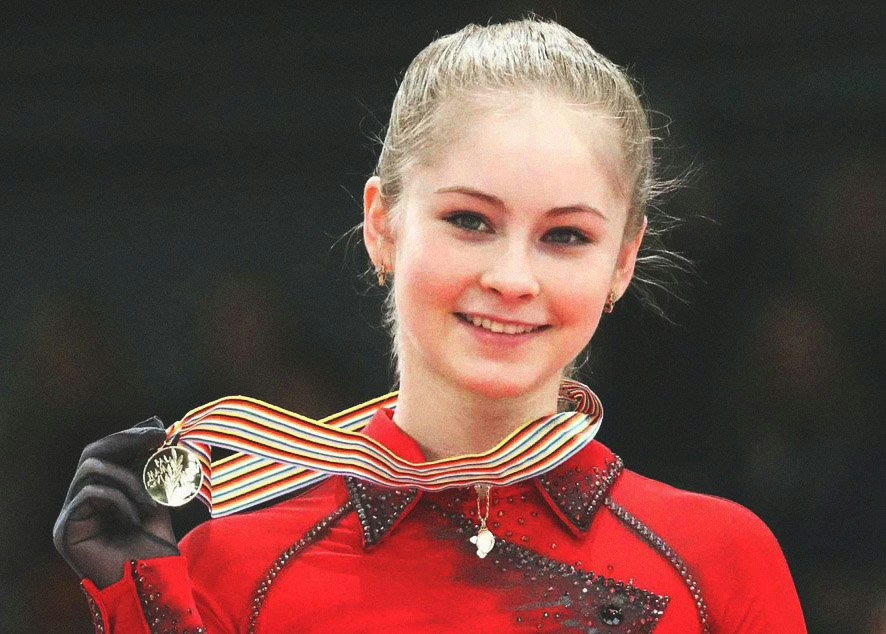
Russian figure skater Yulia Lipnitskaya was applauded even by Russian President Vladimir Putin after her team skate. At 15, she became the youngest Olympic athlete in the history of the Winter Olympics, and only victory was expected from her in the individual competition. Alas, Yulia made several serious mistakes, and another Russian figure skater, Adelina Sotnikova, received the medal. After the performance, Yulia developed weight problems and subsequently anorexia. After a couple more years of struggling with her own body and mental disorder, the girl decided to leave the sport.
It was incredibly difficult to come to the decision to end my sports career. Seriously, every day I went to bed and woke up with one thought: what will be. While lying in the clinic, we worked a lot with psychologists. There are strong psychologists, and they helped me compose life priorities.
Bans
Sometimes athletes do not plan to end their careers, and neither injuries, nor problems in their personal lives, nor even age interfere – but a judge’s ban does. Famous figure skater Tonya Harding was stripped of her 1994 US Champion title, motivated by “complete disregard for honesty, good sportsmanship, and ethical behavior.” For organizing an attack on her main competitor Nancy Kerrigan, the girl was sentenced to three years of probation, 500 hours of community service, a fine, and a ban on participating in any figure skating competitions. Tonya, unable to live without the race to the championship, decided to take up professional wrestling, but after a few years, she left this sport to raise her son.
Hobbies
Multiple world and European champion Maria Kiseleva left synchronized swimming to work in television. She combined swimming training with studying at the journalism faculty of Moscow State University. At a certain point, the number of news broadcasts exceeded the number of competitions. Currently, she is also involved in staging water shows – full-fledged performances with original music, script, and costumes.
Some athletes managed to combine two different professions, such as Mike Tyson, who often appeared in films, shows, and series. Moreover, in 2012, he even worked on stage in a theater with an autobiographical show.
Money
Even if the headlines flash that our champions receive apartments from the state, do not rush to think that now, thanks to the victory, their life will be carefree. For example, the richest Russian athlete Maria Sharapova earned all her fortune from advertising contracts, not from awards for prize places.
Japanese journalists showed a report this March about the life of 15-year-old Olympic champion Alina Zagitova. The footage showed a one-room apartment without renovation, where she lives with her grandmother and sister. Until she receives large advertising contracts, she is forced to live in a rented apartment. As a reward for her victory in Pyeongchang, she was given a car, which Alina eventually gave to her parents, as she cannot even get a driver’s license. Moreover, it is not a fact that the received medal will help her move forward.
In Russia, there are no benefits for Olympians in education. Only personal connections and something like “we have an Olympic champion studying at our faculty.” Again, he is interesting as long as he performs. If they say that “an Olympic champion is studying, performing, becoming a world and European champion at our faculty” – then yes. But if you are a former Olympic champion, then there will be no preferences in education for you.
In other countries, the situation is similar to the Russian reality: American football player Wayne Schreiber earned many times less during his entire NFL career than in the few years after it, retraining as a financial analyst. In five years, he earned more than 50 million dollars and continues to invest in stocks and open funds to support young athletes.
However, as statistics show, the remuneration of athletes does not always affect the result. For example, in Great Britain, Sweden, and Norway, they do not pay for the award at all, and performing at the Olympic Games is a matter of honor.