Vladimir Gromov: The Opera Star Who Could Have Been Anything
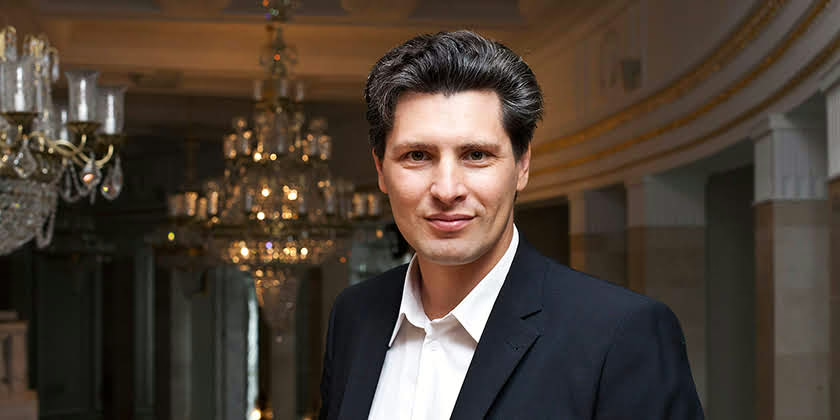
Vladimir Gromov: The Opera Star Who Could Have Been Anything
Vladimir Gromov, a baritone opera singer, often embodies the quintessential macho character on stage—not always the hero, but invariably powerful and compelling. With his towering presence, radiant smile, and lush voice, he has captivated opera enthusiasts, particularly his devoted female fans. As a People’s Artist of Belarus, Gromov’s performances transcend borders, enchanting audiences in Russia, Germany, Spain, France, Luxembourg, Thailand, the UK, and beyond. In Minsk, he has masterfully portrayed a diverse range of characters, from the noble Prince Igor Svyatoslavovich to the cunning barber Figaro, the dashing toreador Escamillo, and the authoritative boyar Gryaznoy.
The Big Theater and Big Happiness
There’s something truly special about the phrase “Big Theater.” I consider myself incredibly fortunate to work at our esteemed Big Theater. While some measure success by performances at La Scala and other renowned venues, the essence of an artist’s journey lies not in the “where” but in the “what.” It’s about what you aspire to sing and whether you achieve that aspiration. Perhaps my performance geography could have been more extensive, but I genuinely enjoy shorter tours abroad and always look forward to returning home. This way, I get to watch my children grow up, live with my family, and not be far away, yearning for a reunion. I believe I am lucky to work where my home is, and the theater is also my home.
Teaching and Learning
Reflecting on my time teaching at a music school brings back fond memories. I began teaching in 1989 while studying at the Minsk Music College, specializing in guitar. From my second year, I started teaching children how to play the guitar in a studio and later at a music school. I always addressed my students formally, even the seven or eight-year-olds. It just felt right. After serving in the army, I returned to teaching and simultaneously pursued vocal training. However, I realized that balancing both was challenging due to the strain on my voice.
Family and Aspirations
I hope my children find their path to happiness and fulfillment. It’s often said that parents try to achieve their unfulfilled dreams through their children. However, it’s crucial to consider what’s best for the child rather than what we desire. I want my children to find a path where they feel comfortable and where their passion for professional growth comes from within.
My elder son, Makar, studied piano at the Academy of Music but chose to pursue a career in dramatic theater and cinema at the Russian State Institute of Performing Arts in St. Petersburg. The admission process was challenging, especially with the pandemic, but he managed to get into both the Minsk Academy of Arts and the institute in St. Petersburg. Choosing the latter was tough, especially for us parents, but he followed his heart. The acting profession is demanding, and his schedule is grueling, but he loves it.
My younger son, Fyodor, is only eight. Perhaps he will find his calling in music. I wish for my children to excel in their professions and future families. Contrary to stereotypes, men worry about their children just as much as women do; they just show it differently.
Freedom and Respect
The freedom of your “I” should not infringe upon the freedom of another “I.” We are surrounded by “I”s with their own interests, rights, and views. The pronoun “I” must respect the pronoun “We.”
Passion and Profession
Choosing a profession is a pivotal moment in life. Some make mistakes and suffer the consequences, while others find their calling and live happily. I believe I made the right choice. However, I sometimes wonder, what if I hadn’t become a singer? Despite always seeing myself in music, I think I could have excelled in other fields such as teaching, instrumental performance, or even construction.
Recently, we moved into a private house where I enjoyed doing most of the interior work myself. During the theater’s downtime due to the quarantine, I had more free time and less work, so I delved into electrical work, plastering, painting, and more. I also enjoy tinkering with cars, although complex electronics and diagnostics are not my forte. A man is often seen as the provider, and he must ensure his family’s happiness, prosperity, and love. If he takes on this responsibility, he should find joy in his work, not do it out of obligation. Otherwise, he might blame others for not doing what he loves. For most men, work is as important as family.
Love and Memories
Love is a profound word with unique associations for each individual. One vivid memory from my childhood is of my mother singing at the piano while I stood behind a glass door, mimicking her. I also remember her graduation performance at the conservatory, where she sang in “Eugene Onegin.” I was just a little boy, sitting in the audience, admiring my mother. I often joke that I started vocal training before I was born and absorbed music with my mother’s milk.
After graduating from the conservatory, my mother joined the Belgosfilarmonia and worked as a soloist on the chamber stage throughout her career. As I grew older, I began attending her solo concerts, always enchanted by her beautiful voice and her meticulous attention to the text. Her performances were like monodramas, where she captivated the audience with her voice, emotion, and diction. Now retired, she enjoys spending time with her grandchildren and attending all my premieres and repertoire performances.
My wife, Natasha, is also a musician and pianist. Perhaps that’s why we understand each other without words. Is there a formula for love? I don’t think so. Once you start analyzing it, it becomes mathematics or physics, but love is something entirely different. It happens on an ethereal level and affects each person uniquely.
Performances and Characters
I am fortunate to perform in operas like “Tosca,” “Macbeth,” “Rigoletto,” “Eugene Onegin,” and “Carmen.” The characters I portray are diverse, ranging from heroes to villains. To bring them to life, I must understand and even love them, finding justification for their actions. For example, Scarpia in “Tosca” believes he is doing the right thing—driven by duty, personal convictions, and an intense desire for Tosca’s love. Yet, the audience perceives him as a despicable villain.
When preparing for the role of Onegin, I recall his meticulous attention to his appearance and his thoughts on the “beauty of nails.” I understand how particular my character was about his outward appearance. Eugene Onegin is not typically seen as a positive hero, but what terrible thing did he do in the first act of the opera? He simply told a young girl that he was too old for her (he was 26, and she was nine years younger).
Once, during a performance of “Eugene Onegin,” my biggest critic—my mother—was in the audience. She sat in a box close to the stage. After I sang an aria, I heard her whisper, “Scoundrel!” I consider that a great compliment to me as an artist.