Vera Savina: An Artistic Journey Through Time
Vera Savina: An Artistic Journey Through Time
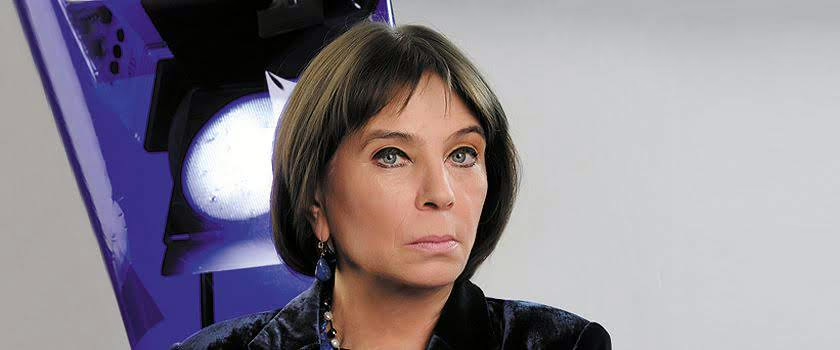
My introduction to Vera Savina was a serendipitous event, orchestrated by a mutual acquaintance. I was on a quest for answers to pivotal questions, and he suggested, “I know just the person you need to meet. Her name is Vera Savina.” This encounter marked a pivotal moment in my life—the “discovery of Vera.” If you can reach the president through seven handshakes, Vera can connect you to Vladimir Vysotsky, Andrei Mironov, and even Leo Tolstoy in just one. Vera Savina, the great-granddaughter of Vyacheslav Grushetsky, a Russian nobleman and the Tolstoy family’s physician, is more than just her lineage.
Early Life and Career
Vera Savina’s life is a treasure trove of exciting events and encounters with geniuses, akin to a precious vessel brimming with artistic essence. If we were to concoct cultural and historical elixirs for enlightenment in a future bar, Vera Savina would be the primary supplier of the secret ingredient.
Vera Savina is a multifaceted professional—a journalist, film screenwriter, and curator of art exhibitions. She has authored 30 documentary films, including significant works on Marc Chagall, Igor Langbard, Pyotr Tchaikovsky, Cheslav Nemene, Alexander Pushkin, and others. Her career has spanned across Moscow, Minsk, Kiev, and Leningrad.
She is a member of several prestigious unions, including the Union of Journalists of Moscow, the Union of Journalists of the Republic of Belarus, the Union of Cinematographers of the Republic of Belarus, and the Union of Designers of the Republic of Belarus.
International Recognition
In 1992, Vera Savina served as a jury member at the FIPA television program festival in Cannes, France, in the “Events in Society and Major Reports” section. Her work has been featured in the Paris newspaper “Russkaya Mysl” and the French publication Midi libre.
Chance and Destiny
Vera, how did you find yourself at the epicenter of the cultural community of the 1970s, alongside figures like Smoktunovsky, Vysotsky, Akhmadulina, and Rerberg? Was it your profession, destiny, or chance?
“It was a blend of profession, destiny, and chance. I was fortunate. Anatole France once said, ‘Chance is God’s pseudonym when He doesn’t want to sign His real name.’ I worked on the popular Central Television program ‘Vzglyad,’ creating plots. Before that, I wrote numerous theatrical programs for Belarusian Television. I penned an article about Nina Vladimirovna Konovalova, a Crimean artist whose home was a summer haven for musicians, artists, and writers. The article was published in ‘Literature and Art’ and caught the eye of my Moscow friend Masha Rusetskaya, married to Aygi, a renowned avant-garde poet and winner of many European awards. Her friends from Kiev, who were filming a movie about Parajanov and Gennady Aygi, saw the article and declared, ‘This is cinema. We will shoot it.’ That’s how my first documentary film, ‘My Angel,’ was born. It was immediately picked up by Central Television and won the audience sympathy prize on the ‘Ostankino’ channel. The film is deeply personal, based on my correspondence with Nina Vladimirovna.”
Inspiration and Strength
The film “My Angel” should be shown for its therapeutic value, as it evokes the most beautiful emotions. In one scene, Nina Vladimirovna, climbing to Voloshin’s grave in Koktebel, says off-camera that when she feels troubled, she comes there to seek help and protection. “Max, I feel so bad! I’ve been offended! Help me!” This is one of the most poignant moments in the film. Do you have such an “intercessor” or a place where you go when you feel troubled? A place of inspiration and strength?
“My ‘intercessors,’ my sources of strength, are Pushkin and Vysotsky. For me, they are two equally great individuals, two equally great poets. The incredible coincidences and rhymes in their lives, destinies, and creativity are astounding. They came into our world not to learn, but to teach. To share what they already know. Is this not a manifestation of the divine gift? Pushkin was said to know so much about us, and Vysotsky, who called the history of the country the ‘history of the disease,’ knew so much about each of us. The novel ‘Eugene Onegin’ is called the encyclopedia of Russian life. All of Vladimir Vysotsky’s work can be called the encyclopedia of modern life, a mirror that helps a person remain human in the most inexpressible and difficult times. In my opinion, the world is still ruled by poetry. Mine is definitely ruled by it. In the annotation to the film about Pushkin, I wrote: ‘This is not us about Pushkin. This is Pushkin about us.’ And I was fortunate to know Vysotsky personally.”
Personal Encounters with Genius
Today, any information can be found on the internet about Vysotsky, Gogol, Martians, or anyone else. But people who knew geniuses personally have a completely different understanding of them. You were closely acquainted with Vladimir Vysotsky. What was he like?
“You know, I firmly believe that audiences should not meet artists outside the stage or screen. They may experience great disappointment. Artists, poets, painters—they are, yes, like us at first glance. And completely different. So much so that it often displeases. Especially when creative people are confused with the images they create or with the lyrical hero.”
I was introduced to Vysotsky by our mutual friend, the French poet, composer, and singer Maxim le Forestier, in February 1976. In the empty hall of the Moscow Estrada Theater, Maxim introduced me to his friend. “Volodya,” he extended his hand to me. “Vera.” And that was it. I didn’t even realize who he was. At that time, a completely different life was happening in Minsk, with different cultural references, very different from Moscow and its celestial beings. The only thing I remembered was his gaze. Direct, open, penetrating. Into the eyes, into the pupils, into the soul. Vysotsky brought two chairs and placed them in the first row. We chatted easily about serious things. About how to survive. About freedom in life and creativity. About how it is much harder for men to survive and succeed, and easier for women: a new dress, shoes, a bow—and everything becomes not so hopeless.
The hall was filling with the public. People started paying attention to us, everyone looked at my interlocutor Volodya as if enchanted. A girl approached us, and he introduced her: “Lenochka, the secretary of the director of our theater. If you want to go to any performance, go to her, from me.” Then everything fell into place for me: the audience’s reaction, the theater actor, in the conversation Volodya mentioned that he wanted to meet Maxim in Paris… Could it be Vysotsky himself?
I think it’s good that everything happened this way. Had I known who was in front of me, I wouldn’t have been able to be natural. Although Volodya was very friendly and open.”