The Ultimate Guide to Perfumes and Fragrances: What You Need to Know
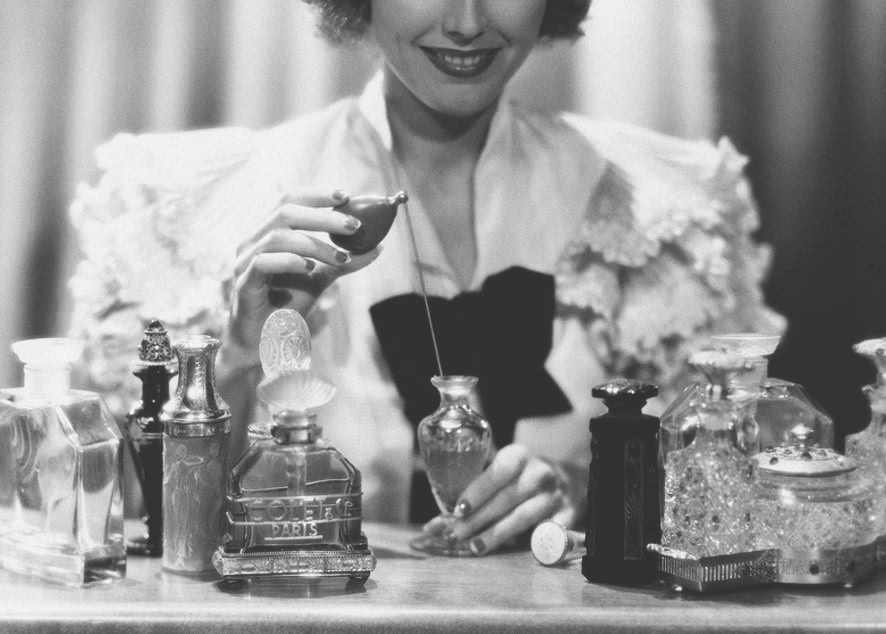
Perfume: The Invisible Accessory
Perfume is the only accessory we wear even when naked. It’s invisible, unique to each individual, and often mysterious in its composition. Industry insiders share secrets about the differences between perfume, cologne, and toilet water, how perfume is made, how to choose a fragrance, and why someone else’s perfume might not suit you.
The Natural and Synthetic Ingredients in Perfumes
Many fragrances are composed of natural ingredients. Flowers in perfume have a long history. They are beautiful, feminine, and sensual, qualities that are reflected in their scent. Flowers will always intrigue and enchant both men and women. When women wear floral scents, they often feel a special connection to nature.
However, some fragrances contain synthetic ingredients. Brands like Annick Goutal prefer natural ingredients, but it’s nearly impossible to make a perfume 100% natural due to the cost of components. Moreover, some specific scents, like peach or coconut, cannot be extracted naturally. Additionally, some natural components can have a significant environmental impact. For instance, Hanami Phlur does not use real sandalwood oil due to ecological concerns. Instead, they use a safe, lab-created material that replicates the essence of sandalwood and donate $5 from each bottle sold to the International Union for Conservation of Nature.
Understanding the Differences: Perfume, Toilet Water, and Cologne
Many of us use the term ‘perfume’ to refer to the entire sphere of fragrances. However, there are differences between perfume, toilet water, and cologne, primarily in the concentration of the scent. Pure perfume has the highest concentration, followed by toilet water, and finally, cologne.
Perfume has the strongest aroma for several reasons. Traditionally, wearing perfume was a luxury reserved for the wealthy. Perfumes are the purest recipes with a high concentration of expensive oils and minimal alcohol and water. In some cases, perfumes may contain no water at all.
Some believe that cologne is only for men. However, it is a gender-neutral format that can surprise with a scent barely different from the perfume version.
The Value of Perfume
Like clothing, you can buy fragrances for a few dollars or thousands of dollars. Good perfume is expensive due to several factors, primarily the quality of ingredients and the cost of making the bottle itself.
However, price does not always reflect quality—sometimes it’s just marketing. Often, buyers are left puzzled when an expensive fragrance does not live up to the quality of its scent. So sometimes, it’s just about market positioning.
Quality Does Not Always Mean Expensive
Often, inflated costs are due to ineffective marketing campaigns, attracting famous designers and celebrities. Fortunately, not all companies invest in such promotions, focusing more on the components. In this case, their quality will speak for itself, and no additional promotion will be needed.
Seasonal Trends in Fragrances
Trends stimulate sales but have nothing to do with consumer preferences. Sometimes it depends on the season, and sometimes it’s just about the weather outside. People wear light scents in the summer and spicy ones in the winter, but this is not a rule.
Citrus and vanilla notes remain trendy for a long time, much longer than other scents. Over the past decade, perfumery has become both harsher and sweeter, but these notes remain unchanged.
Not every manufacturer necessarily introduces new scents to stay on trend. Some focus on improving the quality of components that can be enjoyed year-round without being tied to a season.
The Most Popular Scents: Woody, Citrus, and Vanilla
If you think many fragrances smell the same regardless of the label on the bottle, it’s likely because these notes are popular worldwide.
Choosing a fragrance is a very personal process. You should not focus on trends. Perfumers say you need to fall in love with the scent—it should be love at first sniff.
Fragrances Smell Different on Different People
We have unique bodies, chemical compositions, and lifestyles, so fragrances are perceived differently. The revelation of the scent is influenced by different pH levels, food, body temperature, and the environment in which you find yourself.
A common disappointment: the fragrance smells wonderful on a paper strip in the store, but differences are noticed at home. This happens because we are not made of paper. To choose the right fragrance, you should try it on your skin.
The Higher the Quality, the Longer the Scent Lasts
There’s nothing worse than a perfume that fades by noon. If you find that your fragrance wears off quickly, you need a product with a high concentration. However, using highly concentrated perfume can also be harmful—we’ve all been in a situation where someone has overdone it with the perfume.
This dilemma is one of the most challenging that perfume manufacturers face. They have to find a balance between the duration of the scent and its strength.
Finding the Right Fragrance is Easy
There are so many different fragrances in the world that it may seem difficult to navigate them. But you should only choose what you really like. Think about yourself, who you are. A fragrance is an extension of you; it expresses your individuality. And since scents change and reveal themselves throughout the day, the best way to choose your favorite perfume is to test it on different days and in different conditions.
For more information on how to choose the right fragrance, you can visit FragranceX, a reputable source for all things perfume.