The Surprising Connection Between Easter and Globalization
The Surprising Connection Between Easter and Globalization
This article is structured so that you can start reading from any point. There is no chronological order or sequential logic. It’s not about traditional Easter narratives like kulich or Easter eggs. Instead, it’s a reflection on globalization and its unexpected links to Easter.
Religion: The Myth We Need
“Religion is the biggest myth that humanity needs now more than ever.”
— About Easter? Something that hasn’t been written about yet? — Yes. Not about kulich, not about eggs, but about something else…
I understand that a question posed in this way to a scientific employee of the Institute of Art Studies, Ethnography, and Folklore of the National Academy of Sciences should, to put it mildly, surprise. But Oksana Vorotnikova, who is waiting for me in the institute’s Museum of Ancient Belarusian Culture, is not surprised at all.
— I see. You need an “unconventional format.” And, I suppose, in “espresso” mode.
Speaking about Easter simply as a ritual is complex for me as a scientist on the territory of the Academy of Sciences. Because I see in this context not the holiday itself, but its inclusion in the system of people. That is, in my attitude towards Easter, there is not only sympathy for what happens in it from a liturgical point of view—it is very important for me that every year for centuries and millennia, people, no matter how high their civilization has reached, deliberately and consciously emphasize their primordiality—in a positive sense of this word.
My interlocutor speaks of language as an element of this primordiality—the connection with the living word and voice through the most beautiful chants and special prayers. She mentions rituals and calls religion the greatest of the myths that humanity needs especially acutely now.
Easter as a Link Between Past and Future
She talks about how Easter is given to us now as a link between the past and the future. A necessary link. And, listening to her, my mind flies into space. It turns out that being there and here at the same time is possible without Einstein, Morris, and Thorne with their theories of relativity and wormholes. This possibility has long been known to those who are now surfing the waves of the internet in search of recipes for sweet Christ’s Resurrection bread and ways to dye eggs.
Understanding Easter Traditions Across Cultures
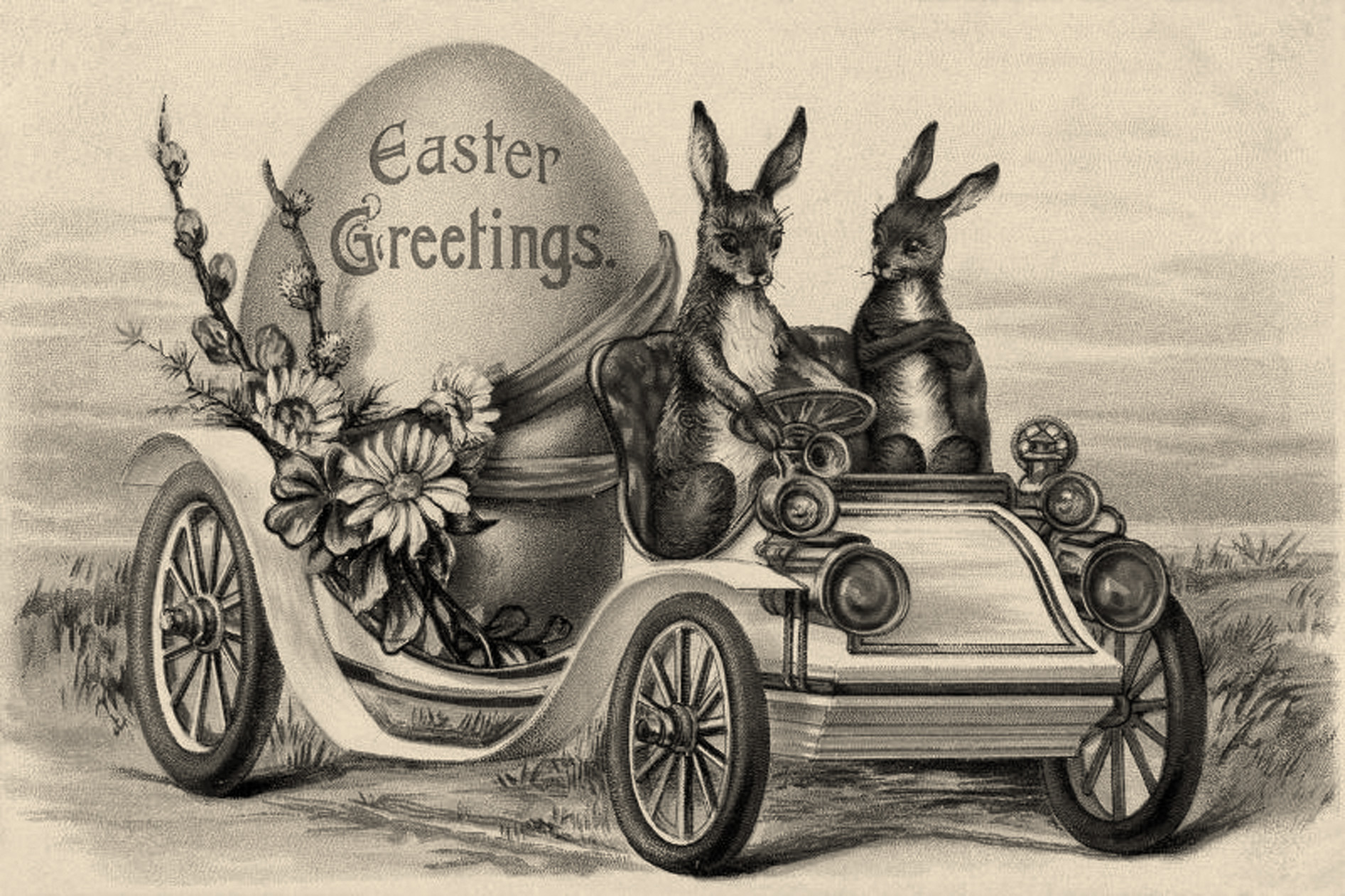
The first Easter greeting card appeared in Europe in 1874. In imperial Russia, they began printing them 22 years later. In Russia, these were pictures with images of angels, chicks and hens, children, wounded soldiers of the First World War and sisters of mercy in a hospital interior, ruddy kulich, and pyramid-shaped paskha. But from the West, compositions with painted roosters, hare-rabbits, water and wind mills were imported.
Why don’t chickens lay red eggs in the European Easter tradition? Leaving the chickens their right to lay white eggs, it was probably impossible to deny the hares their spring habit of approaching human dwellings so closely and so boldly that no other creature would think of attributing this festive red gift to them.
What do you feel, reader, when you see a large chocolate hare on a supermarket shelf in golden foil, with a bell on a red ribbon? Personally, I don’t think this hare is alien to me and shouldn’t be eaten. I want to eat this hare. What do you think this is? The fruits of globalization? Or love for all humanity expressed through love for the hare, with a desire to rejoice in every little detail of the long-awaited holiday? Or maybe just love for chocolate?
And what do you feel when the coin of your country wins in an international competition? Decorated with a Swarovski crystal, a silver-gilded commemorative coin “Easter” became the coin with the best artistic solution according to the jury of the competition organized by the American publishing house “Krause Publications”.
The artistic solution in it can be called not only the egg as a symbol of the holiday itself, but also the background: a clean, whitewashed peasant hut—a symbol of the eve of the holiday, Holy Thursday, when the house is subjected to total cleaning. It was understandable to them, the jury members, purely ours, inherently Slavic. And this is also a fruit of globalization.
Leonardo da Vinci, Religion, and Humanity
“One priest, going around his parish on Holy Saturday to distribute holy water to the houses, as is customary, entered the room of a painter and sprinkled some of his paintings with that water. And this painter, turning to him, asked with some irritation why he was soaking his paintings.
The priest replied that it was customary, and that it was his duty to do so, and that he was doing good. And whoever does good should expect good in return, as the Lord promised, and that for every good deed done on earth, a hundredfold is rewarded from above.
Then the painter, waiting for him to leave, leaned out of the window and poured a decent bucket of water on the priest’s head, saying:
— Here you are, receive a hundredfold from above, according to your word, as you told me, to reward for the good you did to me with your holy water, with which you half ruined my paintings.
This facetia—a witty anecdotal adventure with a philosophical subtext, satirical and “for edification and avoidance”—is especially worthy of reading now. As is much else written by Leonardo di ser Piero da Vinci, the “great Florentine” (treatises and allegories, aphorisms and riddles, didactic writings and prophecies, and more—more than seven thousand pages of surviving text).
A few years ago, Easter coincided with the National Art Museum exhibiting drawings and models of inventions from half a millennium ago, which “our contemporaries have not even dreamed of.”
“Madonna in the Grotto” by Leonardo da Vinci
— Look at this article by Boris Yakovlevich Ramm, a historian of religion, — says the interlocutor and hands over a collection “Questions of the History of Religion and Atheism” published in 1954 by the Academy of Sciences of the USSR, in which, among other topics, the anti-religious freethinking of Leonardo is highlighted.
Do you think, reader, that this is a dubious reference for an article that, although dedicated to globalization, tells about Easter as a bright holiday? Well, let’s see now.
Leonardo da Vinci as a person and artist was alien to religiosity, that’s true. His worldview lay in a completely different—not divine, but human—plane. He did not build rhetorical diagonals from the earthly to the heavenly, did not lower perpendiculars from the holy heights to the mortal earth, but freely, really, and truthfully showed a person.
“This angel doesn’t even have wings, he is so earthly,” writes Ramm about the painting “Madonna in the Grotto,” which represents “nothing heavenly,” but only demonstrates the ideal of human beauty.