The Maiden of Orleans: A Bold Interpretation of Tchaikovsky’s Opera at the Bolshoi Theatre
The Maiden of Orleans: A Bold Interpretation of Tchaikovsky’s Opera at the Bolshoi Theatre
The production of Tchaikovsky’s opera “The Maiden of Orleans” surprised audiences not only with its vocal performances but also with its directorial and artistic innovations.
A Premier with Anticipation
The premiere of Peter Tchaikovsky’s “The Maiden of Orleans,” marking the 185th anniversary of his birth at the Bolshoi Theatre of Opera and Ballet in Belarus, was eagerly anticipated with excitement and curiosity. It was known that the production would be directed by the invited director Georgy Isaakyan, who envisioned transferring the action of the opera, written 146 years ago about the legendary historical events of the 15th century, to modern times. Given Isaakyan’s reputation as an original and bold theater director, few expected the production to be as radical and daring as it was, with Joan of Arc appearing on stage in jeans and sneakers. The intrigue was further heightened by the fact that this opera by Tchaikovsky is unofficially considered complex and “un-audience-friendly.” Perhaps nowhere and never has it been performed with resounding success. And in the nearly century-long history of our theater, this work had never been staged on its stage… But all fears were in vain! Having attended the first premiere of “The Maiden of Orleans” at the Bolshoi Theatre, we echo the voices of the enthusiastic Minsk audience: the production was a success! Bravo!
Artem Makarov: “We Always Strive to Surprise the Audience”
“There are ‘forgotten masterpieces’ in the world of opera, and Tchaikovsky’s ‘The Maiden of Orleans’ is one of them,” says the conductor and director Artem Makarov, who came up with the idea of staging this opera at our theater. “This remarkable grand opera with beautiful music is a very rare piece in the repertoire, which not every theater can afford to stage. One of the reasons is the very high vocal demands, especially for the performer of the role of Joan of Arc. This part is very complex, designed for a voice with a wide range. As for the music, the orchestra of the Bolshoi Theatre of Belarus plays any complex scores: our repertoire includes a huge number of musically challenging performances. We have Wagner’s ‘The Flying Dutchman,’ operas and ballets by Tchaikovsky himself. It can be said that our orchestra has added another interesting and challenging score to its collection, which pushes us to develop our mastery.”
Inviting the renowned opera director Georgy Isaakyan to Minsk to stage this “forgotten masterpiece” was also the idea of the conductor Artem Makarov, who explains his choice as follows:
“Isaakyan is one of the most famous opera directors today, with whom we have been acquainted for a long time: over the past 15 years, we have often worked together and met on different stages… All our works have been risky in a certain sense. Georgy and I always strive to surprise the audience by undertaking productions of undeservedly forgotten titles and their extraordinary interpretations, as in this case. In this regard, we have complete mutual understanding! Moreover, Isaakyan is a musician by his first education. So everything came together to stage this opera with him in Belarus: the presence of excellent singers (in our production, there were also acting requirements for them, certain criteria even for appearance, since our Joan is a young girl), the capabilities of the theater, the orchestra, and the choir. This opera has very complex and lengthy choral scenes—not every choir can handle them! But ours can, if not 100%, then 99%!”
Creation of the Opera “The Maiden of Orleans”
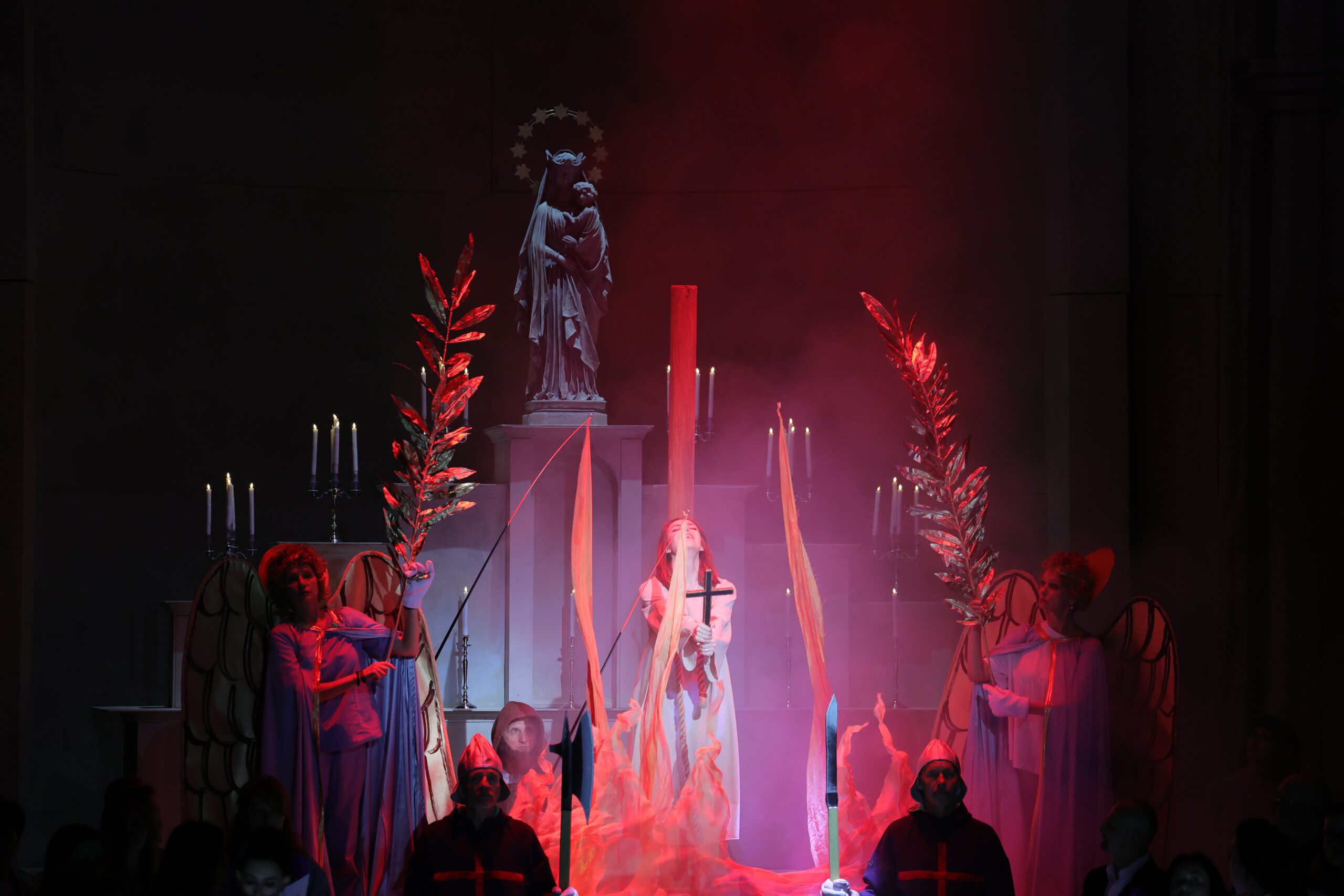
For Tchaikovsky, the creation of the opera “The Maiden of Orleans” was, one might say, a lifelong endeavor. At the age of seven, the future composer first heard from his nanny the story of the astonishing fate of Joan of Arc. While creating the libretto, Pyotr Ilyich studied all the literary works, historical sources, and research available to him. He took Schiller’s romantic drama “The Maiden of Orleans” in Vasily Zhukovsky’s translation as his basis but made changes: he could not accept the finale of the heroine’s life in battle, as the description of Joan’s execution, burned before a crowd, had once made a strong impression on him. “I felt so much pain and pity for humanity in her face that I felt completely annihilated,” wrote Tchaikovsky. Therefore, in his opera, Joan of Arc burns before the eyes of the people who condemned her to death and lost faith in the Miracle!
In Sneakers and with a Backpack
The director’s decision to move the setting from the 15th century to a conditional modernity seemed extremely risky. “Modernizing” classics rarely succeeds unless there is a deeply justified idea behind it. In Isaakyan’s production, this approach is absolutely justified and even seems to have only benefited the opera, which in its classical form is quite long and ponderous. In the Minsk production, the action takes place in our time, and historical events are shown as theatrical performances or religious mysteries, witnessed by the girl Joan.
The theater artist from Moscow, Alexey Tregubov, collaborating with our theater for the first time, brilliantly coped with his task. On the one hand, he creates large-scale decorations of the magnificent cathedral in Reims, projects the appearance of the basilica in Domrémy—the commune where Joan of Arc was born—onto the stage. With the help of animation (worked on by Arina Shlykova), he invites us to walk with Joan through the streets of French cities, where modernity is gray, like a pencil drawing. And bright spots—billboards with fragments of medieval paintings. Here Joan passes, without raising her eyes, past the portrait of King Charles VII, whom the French heroine enthroned at a key moment in the history of her country. Or she passes the equestrian statue of Joan of Arc… Time in this performance does not flow linearly; the characters exist in three realities: historical, modern, and theatrical. Joan from the present lives in the same Domrémy, but her room is adorned with posters of modern French bands and musicians, and at night, she is awakened by the conversations of sculptures of historical figures coming to life in the niches of the house. Joan is locked in this “dollhouse,” in some unreal toy life, from which she is afraid and at the same time desperately strives to escape, following the voices.
Where and how the voices that Joan hears will sound is a brilliant find by the director. According to his idea, the conversations in her head are the voices of artists singing from the orchestra pit, and the “heavenly angels and incorporeal cherubim” sound from above (the choir sings from the balcony). Just as Joan cannot see them, neither can the audience—they are only voices. But during their singing, a chandelier lights up weakly in the darkness of the hall, giving the effect of heavenly, otherworldly illumination.
The directorial innovations and the artist’s work in this production are amazing and striking! This creative duo managed to combine the parallel worlds of the production into a single action, making the events of the opera equally fictional (living statues, voices) and frighteningly real (when Joan cuts her hair right before the audience’s eyes). Timeless and out of time: everything happens “then” and “now,” “here” and “nowhere” simultaneously. And every viewer can relate to the heroine…