Sound Meditation: Healing Powers and Secrets Revealed
Sound Meditation: Healing Powers and Secrets Revealed
In the fast-paced and stressful rhythm of modern life, sound meditation is becoming an increasingly popular tool for achieving inner harmony. This practice not only helps reduce emotional tension but also aids in better understanding oneself, one’s feelings, and thoughts. We spoke with meditation guide and practitioner Anna Zinovich about why sound meditation boosts energy levels and aids in self-awareness.
What is Sound Meditation?
Sound meditation in hammocks with lullabies is a gentle and cozy practice of mindful relaxation. Like other types of meditation, sound meditation helps stop mental chatter and balance the psycho-emotional background, filling you with energy. Sound is an effective tool for restoring the body at all levels. Our practices are distinguished by their gentleness. Being in a hammock creates a sensation of a cocoon that envelops the body in weightlessness, allowing instant relaxation.
Lying in a hammock is already a pleasure. In addition, wonderful, healing sounds of high vibrations are included, and the lullaby part leaves an emotional imprint, filling you with love and trust in the world.
Instruments Used in Sound Meditation
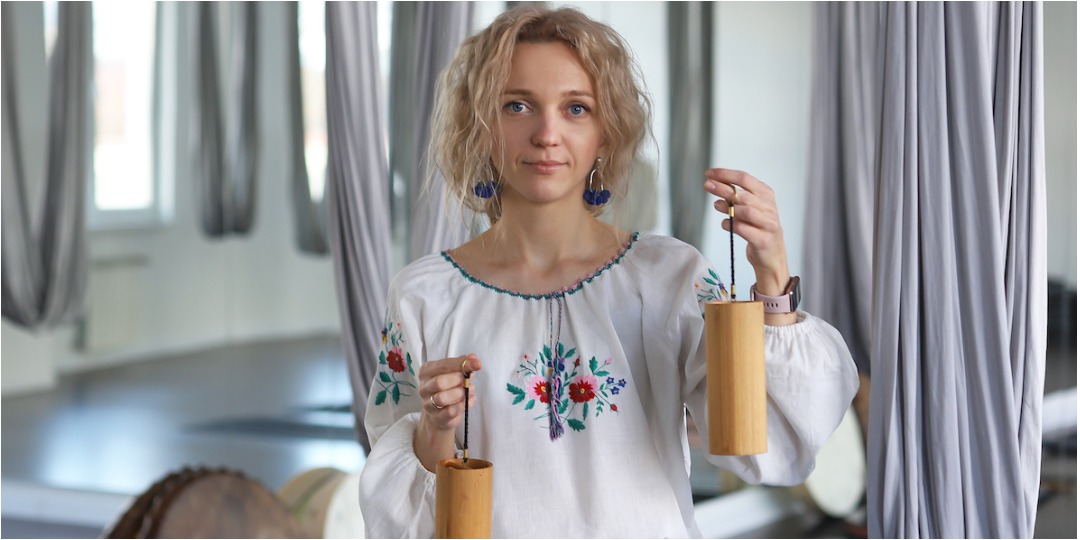
We use ethnic instruments that are handmade and cannot be bought in a regular music store. Our sessions feature various instruments such as hang drums, tambourines, Tibetan bowls, shruti, Koshi chimes, daiva, ethnic rattles, the sound of a stream, and the sound of the ocean. The sound of these instruments can heal, resonating with the physical and mental levels. The wide range of sounds allows us to engage multiple layers of the multidimensional structure of our body. Many sounds resemble natural and organic sounds, and some are even named after them: the sounds of a stream and the ocean have the same effect as being in the lap of nature.
Benefits of Sound Meditation
Immersing yourself in the practice is equivalent to 3-4 hours of full sleep! Sound meditation helps in the process of self-discovery by teaching concentration and focus on the “here and now.” During sessions, we learn to ask ourselves, “What am I feeling now? How does the sound resonate in my body, and what is happening? What emotions am I experiencing?”
The skill of “being in the moment” can be transferred to life: feeling the taste of food while eating, not planning the weekend in your head, feeling the hugs of children or a loved one fully, being present in a dialogue with a partner, touching wet grass, and truly feeling it. This is how we get to know ourselves, our true needs, and desires: “Am I really hungry now, or am I eating because it is customary to eat three times a day? Do I want to communicate with this person, or do I need to? Am I enjoying what I am doing, how I am living, or not?”
The more we live our lives with such concentration, the more we experience moments of life “here and now,” and the clearer our needs become at the level of the physical body and the soul, our destiny. This is how mindfulness develops.
Developing mindfulness changes life at the event level. Personally, over the past year, I have experienced a number of very positive internal and external changes. Some of our participants have expanded their vision and perception of the world, developing abilities such as clairvoyance and clairsentience. We call these super abilities, but they are accessible to every person by nature. By immersing ourselves, we restore the natural things of the Creator.
Changes After Sound Meditation
Undoubtedly, this is relaxation, a sense of inner silence, and balance. Immersion in the practice is equivalent to 3-4 hours of full sleep! We can talk about a restoring effect at all levels. Our clients who attend sound meditation on a regular basis not only improve their overall well-being and increase their energy levels but also develop sensitivity and mindfulness.
Through sounds, chronic diseases can be treated, but a system is important here. Sound therapy had a very positive effect on me at one time. But this is not a magic pill. For a harmonious state, many aspects are important: the purity of the physical body (nutrition, proper cleansing, physical exercises), thoughts, and space. If you add meditation to this set, you can expect results in the form of everyday ease, maximum productivity, calmness, and joy in any situation.
Tips for Beginners
Before meditation, we always discuss the main points for those who come for the first time. The most important advice is to try to engage in the process with your heart, to “put” the restless mind on the shelf, to be an outside observer of the process, to track your thoughts from the side, without analyzing and resisting, but also without engaging in them.
Imagine thoughts as clouds and watch them float by. It is not always possible to immerse yourself in a healing state of mindlessness from the first time, but sounds, hammocks, and lullabies greatly facilitate this.
Getting Started with Sound Meditation
It is important to find your guides in this direction, a person in whose hands the instrument sounds. This advice is relevant when choosing a psychologist and other specialists in helping professions with whom you will have to interact at the level of the soul. Observe the person’s lifestyle, see how similar their values are to yours, track your emotions during personal contact. This is how you will find a guide to the world of sounds.
For more information, you can visit the Unison Meditation Instagram page.