Reviving Niuean Heritage: Cora-Allan Wickliffe’s Journey with Hiapo Art
Reviving Niuean Heritage: Cora-Allan Wickliffe’s Journey with Hiapo Art
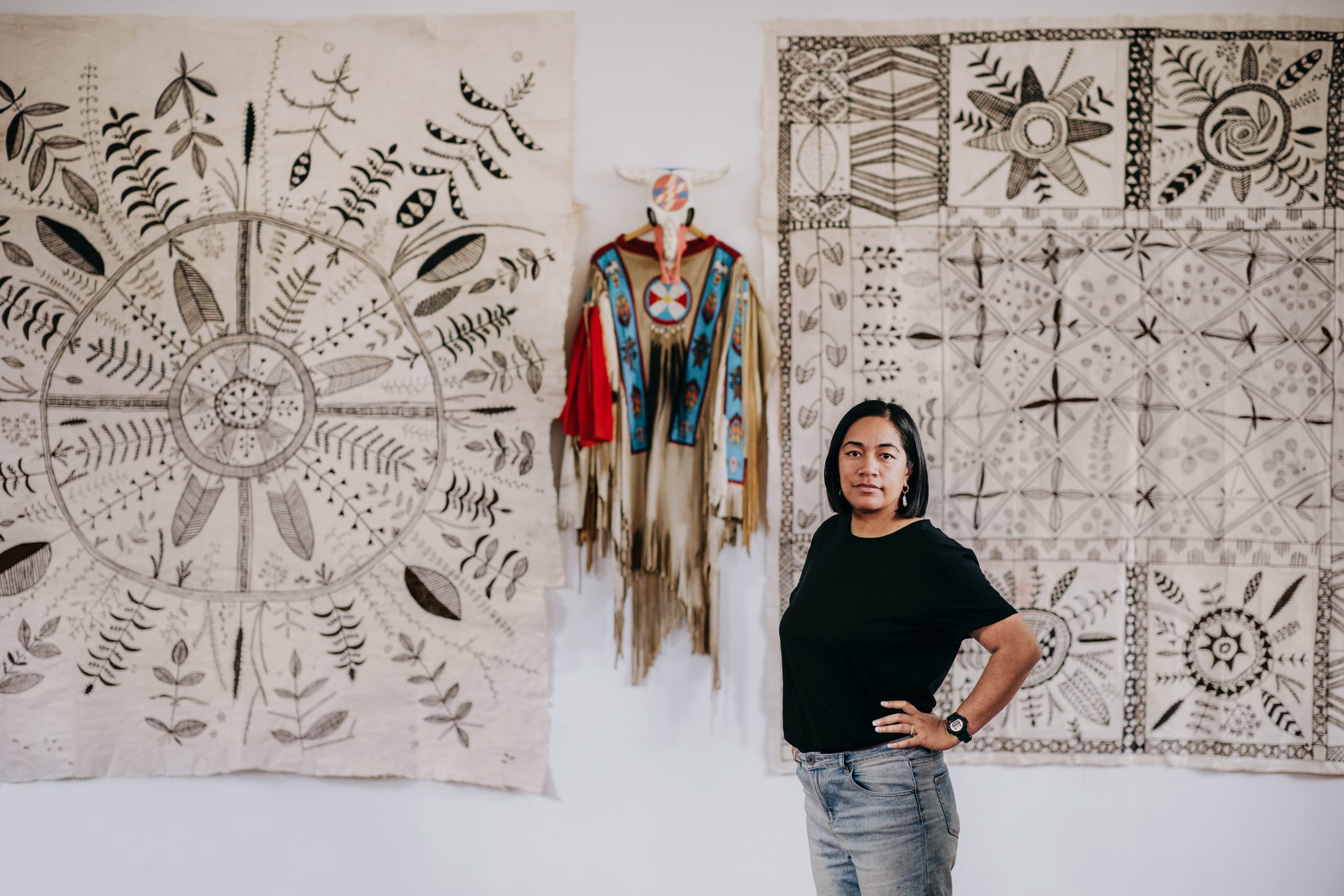
Artist Cora-Allan Wickliffe is breathing new life into the ancient Niuean art of hiapo. She shares with us why family and community are the heart and soul of her work.
The Art of Hiapo
Creating hiapo—traditional Niuean bark cloth painting—is a labor-intensive process. It begins with stripping bark from an ata tree, ensuring it’s done carefully to avoid holes. The bark is then soaked for up to a week or beaten for hours with an ike, a wooden hand tool that softens and expands the bark. A shell, often a clam shell, is used to scrape it, removing excess water before leaving it to dry for several days. Finally, the bark, now transformed into tapa cloth, is painted using Pandanus seed pods and ink made from foraged raw resources like clay and plants.
A Dramatic Statement
It’s physically demanding work that can leave the body aching. So why would someone, after putting in all that effort, stand in an art gallery and douse their creation in black paint? Cora-Allan Wickliffe, 34, remembers the reaction well. “There was a huge gasp,” she recalls. “It was dramatic, but it gave those watching a sense of what it’s like for me having to remember all this knowledge.”
The Journey of Revival
Five years ago, Cora-Allan began exploring hiapo, influenced by fellow Niuean artist John Pule. She may be the only living practitioner of hiapo using materials and methods similar to those employed on the Pacific island until the early 1900s, when colonization and the introduction of plants like cotton led to the art’s decline.
Of Māori and Niuean descent (Ngāpuhi, Tainui/Alofi, Liku) and one of five children, Cora-Allan was raised in West Auckland close to her grandparents, aunts, uncles, and numerous cousins. She has two sons with fiancé Daniel Twiss—Chaske-Waste, four, and Wakiya-Wacipi, one—who are named to acknowledge their Native American heritage from Daniel (Lakota, Sioux, Rosebud Reservation).
Family and Community
More than ever, Cora-Allan knows that reviving hiapo comes with a weight of responsibility that echoes back through generations and has ramifications for those to come. That’s partly why she painted the hiapo black in front of shocked onlookers at an Auckland art exhibition last year. Grieving the loss of her beloved Niuean grandfather, Vakaafi Lafaiki, Cora-Allan wanted to reflect on the part he played in her hiapo making and ask questions about memory—personal and collective.
“It allowed me to go beyond what hiapo is, not just in contemporary art, but how it is experienced,” she says. “I got to thinking about how I want others to create memories with it. Here’s me and my family getting all these memories, but how do others? It’s not just something to go up on a wall anymore; it’s something to decide how it’s going to be experienced.”
Recognition and Achievements
Cora-Allan’s work has been featured in numerous exhibitions in New Zealand, Vancouver, Melbourne, and Niue. It is held in private collections and by prestigious institutions like Auckland Museum and Te Papa in Wellington. She received the Pacific Heritage Artist Award at the 2020 Creative New Zealand Arts Pasifika Awards and is one of three artists who will live and work at the former Waitākere home of preeminent New Zealand painter Colin McCahon—a residency she started in September. She also obtained an annual CNZ grant that allows her to work full-time as an artist, resigning as Curator and Exhibitions Manager at the Corban Estate Arts Centre in West Auckland.
“Since I was in my mid-20s, I have always wanted to spend a whole year drawing, so for some reason, the universe has gifted me this time, and it feels like a complete blessing to be the main income earner and to have two kids!” she exclaims. “That’s not real, right? I remind myself of that every day, and I want to make my best work ever.”
The Role of an Artist
That desire to make her “best work ever” isn’t driven by ego, although she admits receiving trophies is nice—but childhood experiences explain that. “I just really like trophies. It sounds terrible, but I grew up playing sports, and everyone in my family always got awards,” she recalls. “I always got the Fair Play award, but I had sisters who got MVP and stuff like that. Maybe that should have been a first indication that I should stay with the arts. But I was head sports prefect at Massey High School and was lined up to do a sport and rec degree, then I ended up getting a Keir Trust Scholarship to study art at AUT—so that’s what I did because it could all be paid for!”
Graduating as a photographer and filmmaker, Cora-Allan later became an art teacher at Massey High before returning to AUT to complete a master’s in Visual Art and Design in 2013. She then traveled to Banff, in the Canadian Rocky Mountains, and worked as an art preparator at the renowned Walter Phillips Gallery.
These days, making her best work means fulfilling what Cora-Allan believes the role of an artist is: to serve the community. “For me, being useful is important.”
The Invitation to Hiapo
In 2016, after returning from Canada to have her first child, Cora-Allan’s grandparents introduced her to hiapo, signaling the start of a steep learning curve. Vakaafi and Fotia, who came to New Zealand in the 1960s, explained that hiapo was often made for household use and ceremonial occasions. They asked her to make hiapo large enough for them to be buried in, and when Vakaafi passed away in 2019, Cora-Allan was able to fulfill their wish.
Had she stumbled across hiapo herself, she may not have started making them, saying that as a heritage artist, one should be invited into an art form because it’s a privilege, not a right. Seeing her grandparents’ request as an invitation—and deeply touched by it—Cora-Allan agreed but soon discovered there were few examples to look at and no one in New Zealand to teach her.
Describing herself as a “go big or go home” kind of person, she headed first to Auckland Museum with Fotia to look at the few aged examples in their collection, then traveled to Niue for the first time.
Sustainable Practice
“Before I started looking at patterns, I looked at the plants because I wanted to create a sustainable practice. I didn’t want to engage with anything that I couldn’t sustain myself,” Cora-Allan explains. “I visited Niue, looked at the plants, and couldn’t locate a harvestable crop, so I went to Samoa.”
In Samoa, Cora-Allan found a mentor, Fa’apito Lesatele from the island of Savai’i, and returned to Niue with newfound knowledge and determination.