Oksana Arakcheeva: “Our Family’s Pride Lies in Our Differences”
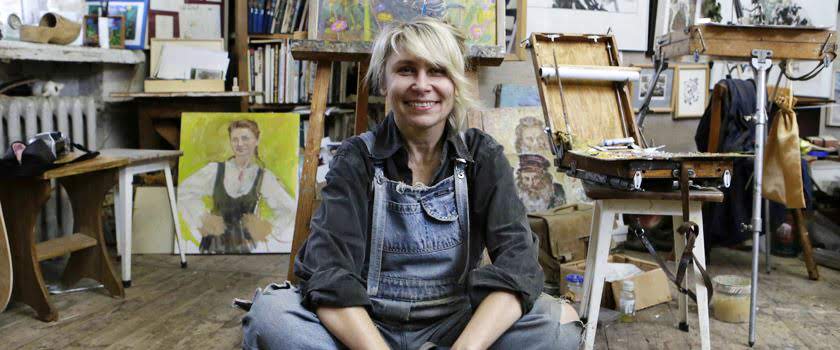
Oksana Arakcheeva: A Legacy of Art and Individuality
Oksana Arakcheeva, an accomplished artist and illustrator, is the daughter of the renowned Belarusian painter, educator, and Honored Art Worker of Belarus, Boris Arakcheev. Today, Oksana not only promotes her own creative works but also actively popularizes her father’s artistic legacy. Recently married, she now divides her time between Hamburg and her home country, where she continues to organize new conceptual projects.
Growing Up in an Artistic Family
Oksana was born into a family of a famous Belarusian artist. While she was fortunate to grow up in such a creative environment, there were also challenges associated with being the daughter of a well-known artist.
“It’s a blessing to be born into such a wonderful family,” Oksana shares. “I witnessed art come to life in my home from a young age and saw how creative processes unfolded. My father would spend days in his studio, fully immersed in his work. My sister and I learned from him how to approach art.” However, their parents did not want their daughters to become artists. They wanted them to pursue more “serious” and “sustainable” careers. But the sisters did not listen.
“Our parents were kind, so they eventually gave in to our wishes,” Oksana recalls. “All three of us daughters graduated from the Theater and Art Institute (now the Belarusian State Academy of Arts). There were challenges during admission; being the children of artists, we were often accused of being favored. My middle sister, for example, only got in on her fourth attempt, despite our father teaching at the painting department. It was a nightmare to live in a creative environment but not be given the opportunity to pursue our passion.”
Forging Her Own Path
Oksana decided to be independent. On her fifth year of study, she got married and changed her surname from Arakcheeva to Ulanskaya. After graduating, she approached a publishing house with her drawings, seeking work.
“They only knew Arakcheeva, not Ulanskaya,” she says. “I got my first commission for the book ‘Krylov’s Fables’ independently, and since then, I have been paving my own way. The surname played a significant role, but I am glad that I was accepted not just as Arakcheeva, but as an artist. I often heard opinions that my father would help me with everything, but I always ignored them.”
Family Dynasty and the Future
Oksana and her sisters hope that their children will also become artists. “There is already a wealth of knowledge and experience, and most importantly, a practical understanding,” she says. “My sisters’ sons grew up in a creative environment, drawing on everything they could find. They had an incredible passion for art. My son, however, does not have the same passion.”
“I never forced Egor to sit at the easel; I gave him the freedom to choose. Now he is into music. Although, in my opinion, he could have been a good artist as he has a developed sense of proportions. My elder nephew has a daughter who has been drawing beautifully since childhood, reminding me of her father. So, there is hope.”
Family Support and Success
Oksana’s name is well-known. She often talks about her father and presents various exhibition projects. “We have a good family,” she says. “My sisters teach. Marina has dedicated herself entirely to teaching, and Alena is also an excellent portraitist. In my opinion, her portraits are even better than our father’s. She, like a sculptor, feels the form. Such talent can only be a gift from God. Alena always fully dedicates herself to her work, and this helps her a lot in life.”
“We have a five-year age difference, and she is like a mother to me. In childhood, she was always there, and now she rejoices in all my successes and understands that, with such a temperament, I can preserve our father’s legacy and memory, so she supports my ideas.”
Unique Styles and Family Pride
Oksana and Boris Arakcheev have different styles in their creativity, despite the fact that he taught her everything he knew. “In many families of artists, children try to copy their parents’ style. But that’s wrong. Talent is either there or not. It also needs to be felt and developed,” Oksana explains.
“Artist Igor Barkhatkov, at every meeting, says that from his father he learned love and devotion to art. And in this, our situations are similar. We serve art, like in the theater. My father admired my style, and I still admire his impressionistic works.”
“Perhaps this is the pride of our family – to be different. And you know, I would not want to prove anything to anyone, because I know everything about my life myself. From childhood, my sisters and I made sketches of each other, drawings that our parents saved. We had a system in our house: you need to draw every day. As we grew older, we copied architectural objects, and then we came up with an album in which, on different holidays, for example, on March 8, we drew congratulations to our mother or to our father on February 23. It was a family tradition. That’s how each of us developed our own style.”
Choosing Subjects for Artworks
Throughout her creative journey, Oksana has created several interesting series of works, such as “Minsk Windows.” Recently, she presented a series of portraits of famous people who influenced the development of Belarusian culture. “It turns out that these people are either my friends or become them after I create their portrait. They are my contemporaries, people with whom I live in my soul,” Oksana shares.
“When I started working on portraits, I almost threw myself at everyone. While working on an exhibition at the Czech Embassy, I redrew everyone I could. Moreover, I drew not for money.”
“After that, I decided that it was time to learn how to paint portraits of friends, and orders poured in. I will tell a couple of interesting stories related to the last series. I greatly respect Gennady Buravkin. At the very beginning of our acquaintance, I was shy before him, like a schoolgirl. However, at the exhibition of Alexei Marochkin, I dared to invite him to the workshop.”
“Gennady Nikolayevich came so simple and open, with a chrysanthemum, we talked about everything and agreed that I would paint his portrait. Then I decided to photograph Gennady Nikolayevich. Probably, God led to this. Soon the writer died. Immediately after the farewell, I painted his portrait.”
“With Valery Dayneko, it happened like this. He is my idol; I have always adored his beautiful voice. We were not familiar, and I decided to offer him to paint a portrait on Facebook. He agreed with pleasure. I did not even expect it. However, the portrait was not so smooth: three times I tried to make a beautiful image, but I did not get that stateliness, gracefulness that is so inherent in him.”
“And once again, when Valera was leaving after an unsuccessful visit, he threw on a coat, and then I realized: this is what is needed. There is a reference to history in the portrait: many viewers say that Valera resembles Beethoven or Mickiewicz.”
“But the best and most successful work for me is my father’s portrait. Many photographers, when photographing my father, asked him to take a palette in his hand and put on a suit. It’s so artificial. I painted my father in a robe. Once he liked to wear it at home, and then he brought it to the workshop and worked in it.”
“I tried to accurately convey the hands of the artist who was faithful to art. These were my native hands, which I preserved forever, not only in memory. I painted the portrait in two days because I knew what it should be like.”