Mother of Dragons: Why Strong Women Are Often Portrayed as Villains
Mother of Dragons: Why Strong Women Are Often Portrayed as Villains
The final season of Game of Thrones began with a stark mass murder. To be precise, a mass murder committed by Arya Stark. The scene where the teenage girl exacts revenge planned since the second season was perhaps the most satisfying moment in the series’ history. It took place in the same hall where a massacre occurred four seasons prior. This time, instead of tragedy, it was a triumph. Our little favorite emerged from the hall filled with corpses like a rock star dropping the microphone, leaving the stage.
In Fictional Worlds
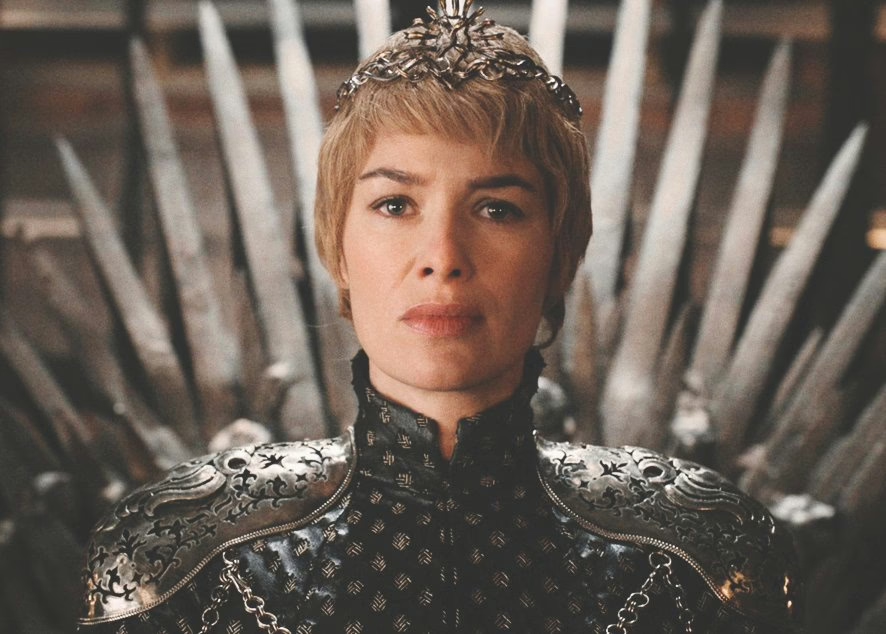
Game of Thrones has long been known as a fictional world where women are treated horribly. However, the creators invested so much in developing female characters that they ended up dominating the main storylines. Yes, the source material belonged to George R.R. Martin, but by the seventh season, the plot was driven by directors Benioff and Weiss, who focused on women rulers. Each faction fighting for the right to sit on the Iron Throne is hungry and bloodthirsty, and in one way or another, connected to a woman. This season, women are tearing down castles, conquering lands, exacting revenge, and planning wars against each other. Daenerys has swapped wisdom for belligerence, and Cersei Lannister has been dubbed the most dangerous woman in the seven kingdoms. Most of the men fighting for the throne have either died in previous seasons or are fighting under a woman’s command. Even the stubborn Jon Snow bent the knee before the Mother of Dragons.
Of course, all the heroines of the series are vastly different. Some are more human than others. Some want revenge more than they want to rule, or rule more than they want revenge. Ultimately, they do both. All have been traumatized by events and have had to commit immoral acts.
Why Not Heroines?
The fact that this rather dark story is currently so focused on women may tell us how women’s rights and opportunities are expanding, and that they can indeed be the central figures of the narrative. We prefer women villains over women heroes. Villains are often much more compelling than heroes and are often a starting point for many of us who also do not see ourselves as heroines. Villains allow us to know a person distorted by trauma, who fails repeatedly and lives unconventionally.
The origin stories of villains are usually quite dark and even much scarier than those of protagonists. Their traumas accumulate over the years so that creators can justify the character’s sadism and bloodthirstiness without revealing all the details of the dark stories.
If you are a bad character, you easily become the center of the narrative, even if your backstory is not revealed. And often, villain characters become more compelling than the main heroes because we find ourselves in antiheroes and not in heroes.
Pros and Cons
In some ways, being a villain means being strong and independent, a whole person. A villain can openly express her flaws, which we usually try to hide to make ourselves suitable for society. Perhaps we call evil the freedom, opportunities, and ability to see far ahead.
But we only need to look at the world around us to understand that this is not true. Real villains in our lives, with their money and power, prove that this is not the case. Game of Thrones is just an example of how an existing trend penetrates fictional worlds.
In Real Life
One figure that can be called a villain in real life is Elizabeth Holmes, the founder of a startup who was dubbed the new Steve Jobs. In 2004, she founded Theranos, a company to reform healthcare that would allow access to primary diagnostics, such as blood tests at home. Like Uber, which can determine if you are dying.
In 2014, she attracted $400 million to her company, and Forbes magazine named her the youngest woman to become a self-made billionaire. Magazine covers compared her to Jobs, and Holmes herself supported these comparisons by dressing in black turtlenecks. She was living proof that a girl could overcome misogyny in Silicon Valley and that women could also be technical geniuses.
But then it turned out that her entire startup was a lie. Holmes was embroiled in lawsuits related to medical errors, fake research, unscientific experiments, and more. She tried to justify herself in the press for a long time until she realized the futility of this endeavor.
Holmes is a classic American Dream fraudster; she was the truth that people wanted to believe in. She inspired people, stimulated technical growth, managed to raise billions of dollars, and literally liters of human blood. She is so allegorical that she does not seem real.
Where Do Villains Come From?
Much of the feminist struggle is aimed at empowerment. No powerful woman became a warrior out of happiness; usually, she is traumatized by a monster. And, like villains who were once traumatized by a monster, we also have such monsters. Sometimes the monster for us can be a cultural background that is not yet ready to accept feminism.
Depictions of villains in the cultural epic remind us that femininity can be frightening, sudden, and hysterical from not being sexually attractive. Letting women into power without changing all of society will only mean breeding new supervillains. To have a show for a male audience where female characters take over countries, female characters will have to be killers and psychopaths.
The Influence of Power
Of course, we have already achieved a certain progress in terms of women’s equality. We are ready for women in managerial positions but are not ready to admit that women can also be corrupt, bloodthirsty, and incompetent. This does not depend on gender—this is how power affects people.
In art, it is customary to perceive men as strong warriors, as complex figures who can fight for power without losing their heads and without striving for ruthless revenge on all living things. This means there is hope that one day women will also be seen in this light. “Strong female characters” exist in both artistic and everyday life, but for some reason, we rarely remember them.