Mastering Business Attire: Essential Rules and Taboos
Mastering Business Attire: Essential Rules and Taboos
In today’s fast-paced world, a person’s appearance plays a crucial role in career success. Why? Because the first impression forms within the initial seconds of visual contact. Our brains are wired to scan individuals based on specific traits and make judgments: successful or not, businesslike or not, someone we want to engage with or not. This first impression is extremely enduring and challenging to change.
The Importance of Business Attire
For partners, colleagues, and clients, your clothing serves as a signal system, a set of visual codes that convey your respectability, status, and competence. It’s your business card through which people perceive your public self. On the other hand, the clothes you choose, even within the framework of a business image, can reveal your personal qualities. They transmit information about your competence, reliability, stability, and other personality traits. The focus here is not just on the clothes we wear, but on what drives us to choose them.
Rules for a Flawless Business Image
Business Attire for Men
A high-status silhouette is one that resembles an elongated rectangle with emphasized angles, particularly at the shoulders. This means a straight or slightly tapered silhouette.
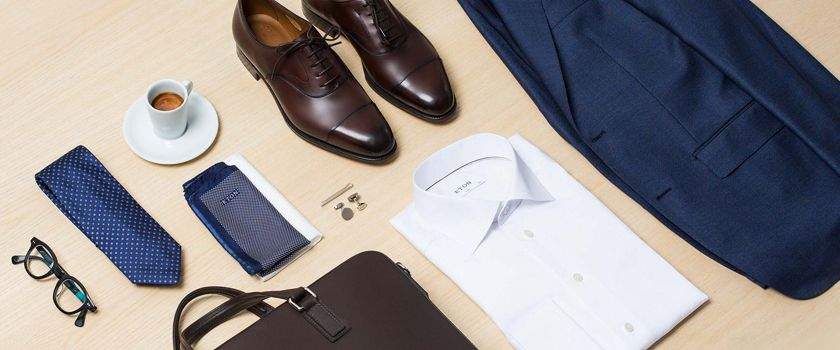
Status colors for business suits are dark blue and dark gray. From a color psychology perspective, a dark blue suit is the best choice for an authoritative leader, while a gray suit positions you as a “young expert.” Brown is also acceptable in business attire. Although not too common in the business world, it is associatively inviting and neutral. Use this quality to your advantage at first business meetings, where you need to establish contact while also making an impression as a solid, stable individual.
It’s excellent if your suit is tailored from high-quality material to your individual measurements or perfectly fitted to your figure.
The bottom button of a man’s jacket should not be fastened. The “unbuttoned rule” states: a single-breasted jacket with two buttons should never be fastened at the bottom; a single-breasted jacket with three buttons should never be fastened at the bottom, always at the middle, and optionally at the top; a double-breasted jacket should be fastened at all buttons.
A man’s shirt should have long sleeves and fit perfectly. The shirt cuffs should be visible under the jacket sleeves by about 1.5-2 cm. Choose a white shirt or one in subtle pastel shades. For a less strict dress code, a shirt with a small, calm stripe is acceptable.
From a formal standpoint, a jacket with a shirt without a tie is acceptable. However, under a strict dress code, a business suit without a tie is not worn. A double-breasted jacket is always worn with a tie. If a shirt is worn without a tie, the top button must be unbuttoned. Ideally, the tie should be darker than the shirt and lighter than the suit. When tied, the lower end should touch the belt buckle or reach the middle of the belt buckle. In the evening, the tie can be removed but should not be loosened.
Shoes should not be lighter than the pants—they should be the same color or darker. Otherwise, it creates a sense of instability. Black shoes are mandatory for a strict dress code and are reserved for the most formal events, remaining a classic. The best choices are derbies or oxfords made of smooth leather. There are rules for matching the color of shoes and suits: black pants—black shoes, brown pants—brown shoes. Dark blue pants are a more flexible option: you can wear black or brown shoes with them. However, ensure that the brown shoes are not too light. The thickness of the shoe sole also matters: the thinner, the more respectable your appearance.
The belt should be made of thick, natural leather, and the buckle should preferably be heavy and of high-quality alloy. The belt must match the color of the shoes.
Watches should be flat, with a leather strap or bracelet. The presence of hands on the watch is mandatory.
Business Attire for Women
A gray, blue, or beige pantsuit or skirt suit. When choosing a skirt, ensure that a straight skirt or pencil skirt falls just below the knee or slightly below it. A light blouse is recommended when adhering to the dress code.
Classic black pumps or shoes that match the color of the suit are a must-have accessory for a businesswoman. A suitable heel height is 4-8 cm. Shoes should be stable and made of smooth leather.
Stockings should always be flesh-colored without shine.
Choose a handbag in the A4 format made of smooth leather without logos or rhinestones, with a clear shape, such as a rectangle or trapezoid.
Makeup should be maximally restrained, with only one bright accent allowed. As for hairstyles, smoothly styled hair is preferable. Use minimal jewelry, and it should be subtle and made of precious metals.
If you desire romance, it’s best to forget about business communication. Ruffles, lace, transparent fabrics—all these elements are outside the scope of business style. Business attire is designed to create a working atmosphere, and any clothing elements or accessories that overtly emphasize your femininity distract the attention of partners, colleagues, or clients and turn off the “business communication” mode.
Accessories can emphasize your professional status and essentially complete the creation of a cohesive image. A wallet, daily planner, keychain, business card holder, pen, mobile phone, and other business style attributes should have one important unifying characteristic: a unified stylistic direction and price category.
For further reading on professional attire, you can visit GQ.