Master Jeweler Nikolai Kuzmich: A Journey of Art and Passion
Master Jeweler Nikolai Kuzmich: A Journey of Art and Passion
I believe that jewelers are wealthy and independent individuals whose craft is passed down through generations. This craft requires lifelong learning and daily practice. My love for jewelry art has grown stronger over the years, but the creative aspect must always come before the craft. The only issue is the low demand for handmade, unique jewelry in our country.
The Invisible Struggle
There are unique icons, and I have been fortunate enough to touch pure gold and work with this material. Icons represent a spiritual journey, color, line… a unique energy. They also offer an opportunity to delve into graphics and iconography. I enjoy drawing the finest lines for hands, eyes, and creating beautiful outlines to convey character.
Nikolai Petrovich showed me a fragment of an icon of Saint Nicholas the Wonderworker. The details are so miniature that I can’t imagine the patience and perseverance required to select each element by color and size. However, a piece will not be complete without soul and character. This is what attracts people and makes them stop and think, thanks to the warmth and emotions the author puts into their work.
Creating Icons
To work on an icon, one must be morally prepared and consciously strive for perfection throughout their life. Starting an icon is easy; the challenge is finishing it. An icon is a spiritual beginning, and there may be invisible forces that resist its creation. I create icons using the cloisonné enamel technique, one of the most difficult and expensive methods.
The Fate of the Cross of Euphrosyne of Polotsk
The cross is kept in the Spaso-Euphrosyne Monastery and is brought out during holidays. I periodically visit the monastery and help if needed.
This was a very responsible task…
Responsibility is not in the work itself but in the mind. To undertake such a serious task, one must be mature and a master. It would be better to live in the 12th century… That would be great! The cross was recreated in 1998, and in 2010, I redesigned the front side due to improved mastery and new artistic possibilities. By the way, the cross is entirely handmade, with no computer tricks involved. I remember when I was making the cross, Yuri Karachun, the director of the National Art Museum of the Republic of Belarus, asked, “Where is the tremor of the partitions?” I didn’t understand what he meant then. Many years have passed, and I still remember those words. Over time, I realized that “the tremor of the partitions” refers to the thin partitions that have a soul, a heartbeat, and life.
The Cloisonné Enamel Technique
How are unique jewelry pieces created using the cloisonné enamel technique? A metal plate (which can be made of precious metals) is used as the base. The outline of the future image is drawn on it, and then the thinnest metal partitions (e.g., silver) are soldered onto it. Most often, these partitions form closed cells, each of which the jeweler fills with enamel of different colors. The piece is then fired in a special furnace, ground, and polished.
Gifts and Customers
Once, during a master class for young writers (“School of Young Writers” from the PEN Center), Vladimir Orlov came in. I immediately noticed his unusual ring. At the end of the class, I asked where he got such a valuable item. It turned out to be a gift from Nikolai Kuzmich…
I have been friends with him for a long time. I also gave musician Dmitry Voytyushkevich a brooch and a ring. You need to have a warm relationship to take the initiative, create a unique piece, and give it as a gift. It’s a pleasure to make gifts for good people. All the pieces are dear to me, and each is unique.
Do people often come to you wanting to order a pendant or a ring based on their sketches?
Not really. There are other workshops for that purpose. If a customer comes, you become a captive. It’s much easier to create and sell your own pieces than to work on orders. Yes, there are customers who trust the master, consult with them, as they want a specific piece from a specific master. If the customer is very unique, you can work together. It’s possible.
Everyone “Mints” Money
While preparing for the interview, I saw works by Georgian artists using the cloisonné enamel technique. The rings by Irakli Bolgashvili, with their spirit of grand history, royal temperament, and sublimity, impressed me the most, as well as the bright and extraordinary pendants by Maya Pataridze and the restrained jewelry by Eka Abesadze. However, as it turned out, my hero does not like Georgian jewelry art (although Nikolai Petrovich appreciates it at a decent level and claims that Georgia is a unique country) because it does not match his temperament. Indeed, Georgians are sociable and open, while we are calmer, so we are closer to minor notes in music and natural, non-screaming shades, laconic forms, and lines in visual arts.
“And There Are No Cubic Zirconia, Only Diamonds, Emeralds”
What can I present abroad? Concept, design. Yes, my works occasionally appear in other countries… It’s hard to survive. Those with money survive. And you can’t just engage in author’s art. In South Korea, there is a girl – a unique master! She exhibits in a well-known American gallery. And I think: “What prevents you, Koly, from exhibiting in America?” There, they get more profit from art than from agriculture; a large part of the economy is in trade and art. And there are no cubic zirconia, only diamonds and emeralds! And all this is accessible! Abroad, not random people succeed. Mainly, narrow specialists are in demand.
I once met a girl who moved from Russia to Geneva. She graduated from the St. Petersburg State Academic Institute of Painting, Sculpture, and Architecture named after I.E. Repin at the Russian Academy of Arts. She wanted to get into the famous watch factory Patek Philippe to paint dials. And they didn’t take her. Everything is strict. Suppose 10 people work there. Even if they work poorly, they won’t take anyone “from the outside.” There is fierce competition. Not everything is so simple! Everyone protects their piece of bread.
About the Dream
I would like to see a small gallery opened in Minsk to exhibit author’s jewelry pieces by Belarusian masters. This is my dream! It would be nice if there was a national school of jewelry art… Abroad, artists with good education are supported by private galleries to help them sell their works.
I should have opened my own gallery earlier, when I was about 30 years old… I need like-minded people who could promote author’s jewelry art in Belarus. Currently, the continuers of my work are Andrei Masko, who has been working with me for 16 years, and my son Petr.
I am a happy person… I have the opportunity to work with various materials: gold, silver, enamel, iron, steel… It’s wonderful when people like my author’s pieces – it brings me great pleasure!
Interviewed by Olga Ropot
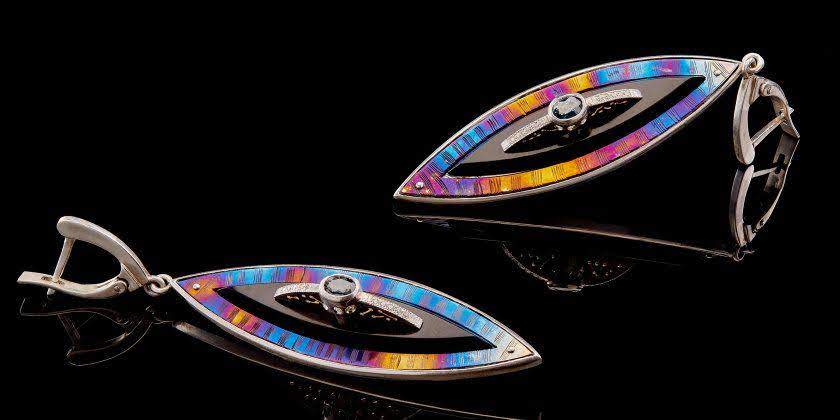
Nikolai Kuzmich is called the second Lazar Bogsha. In the 90s, he restored the cross of Venerable Euphrosyne of Polotsk, which is now kept in the Polotsk Spaso-Euphrosyne Monastery, and in the early 2000s, he created a shrine for the relics of Saint Euphrosyne of Polotsk. Nikolai Petrovich revived the technique of ancient Byzantine cloisonné enamel of the 12th century, the beauty and sophistication of which are still admired today. The jeweler from Brest is also known for his author’s jewelry – rings, bracelets, earrings, pendants, necklaces… Whose works does the master admire? What does Nikolai Kuzmich dream about?