Kim Hereu: The New Dalí of Our Time
Meeting the Artist
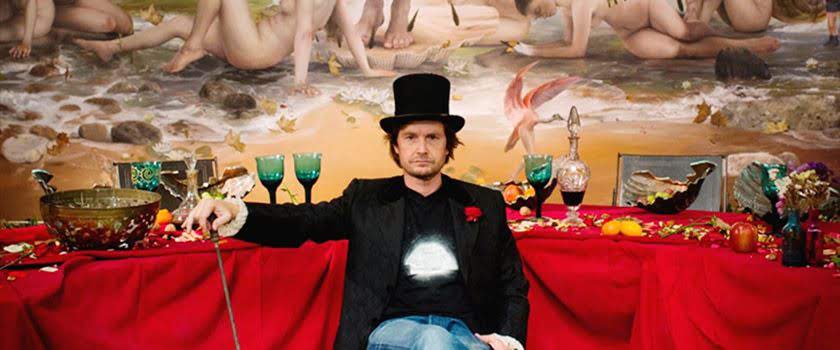
In the picturesque city of Girona, Spain, we were greeted by Tanya, a cheerful woman from Mexico. She is the wife and manager of the artist Kim Hereu. Many people ask her about her Russian name, and she shares the story of the Latin revolutionary Tania, after whom she was named. As we entered one of the hangars, we were awestruck by two massive paintings, each 12 by 6 meters, adorning the parallel walls. These are the largest paintings I have ever seen. At the base of one of them sat a small figure, a man with brushes and a palette in hand. This was Kim Hereu, the world’s only estrambotist artist. Despite our interruption, he warmly welcomed our film crew.
The Trilogy of Life
Kim’s paintings are incredibly vibrant and filled with fantastical characters. Viewers often seek the meaning behind the details in his work.
“Yes, my idea is a trilogy of the three largest paintings in the world. I want people to truly understand estrambotism, a new and largely unrecognized genre of painting. These three paintings represent the three most important values in every person’s life, regardless of their origin: Time (‘The Birth of Venus’), Strength (‘The Coronation of Ermessenda’), and Freedom (a work in progress). Because without freedom, you cannot feel time or strength. These three things are interconnected,” Kim explained.
The Coronation of Ermessenda
“The Coronation of Ermessenda” is Kim’s second massive painting. “Ermessenda was the first queen of Catalonia. The painting is almost complete, but I have been working on it for nearly two years. The preparation for this piece began much earlier, involving small sketches on paper, about three meters wide, to work out the composition, details, style, and rhythm of the figures. Every detail is crucial, and this process can take almost a year. Then, I transpose the composition from the small sheet to the large canvas,” Kim shared.
The Unique Style of Estrambotism
Kim’s paintings often remind viewers of Salvador Dalí’s surrealistic style. However, Kim represents a different direction in painting known as estrambotism.
“Estrambotism is a variant of surrealism. People often confuse the two, thinking they are the same style. The key difference lies in the process of creating the painting. Surrealism, which originated in France over 100 years ago, is the expression of the artist’s automatic thoughts. The artist has no control over their thoughts or the canvas; they are merely an instrument between the inner and outer worlds. Surrealism is like dreams that you can never control. Surrealists never know how their painting will turn out. Estrambotism, on the other hand, is easier to understand. It is a well-prepared fantasy with an enormous amount of detail. No drinks, drugs, or anything else are needed to create estrambotic paintings. The artist is an extraordinary person, a bit mad when in front of the canvas. In everyday life, they are normal people, not bohemian figures wandering through Parisian salons in search of love and inspiration,” Kim explained.
Inspiration and Muses
One of the most challenging questions for Kim is about his inspiration. “Inspiration is not necessary for the creative process. There is something much more important than inspiration: the muses. They can visit you at any moment—while you are in the studio, resting at home, driving, or showering. In these moments, ideas and thoughts come to you. I grab a piece of paper to write down what they say. For me, the most suitable moment for imagination is the time of awakening. I wake up around noon, in a state between sleep and wakefulness. These are the minutes when creative thoughts visit my imagination,” Kim shared.
The Legacy of Estrambotism
Kim is the only practicing estrambotist artist. He is the heir to the ideas of Joan Fuster, the creator of estrambotism, who passed away in 2011. “Fuster created estrambotism but never did anything to present it to the world. At the end of his life, we met, and he asked me to continue his work so that other artists could see the foundations of the genre and work with estrambotism,” Kim said.
Interestingly, Kim’s surname, Hereu, translates from Spanish as ‘heir.’ “Fuster’s relatives did not take care to preserve his paintings. Few people believed in his art, and even fewer understood it. But he accurately conveyed the ideas of estrambotism in a poem that he bequeathed to me. Now I am creating a manifesto and configuring the basics. Young artists write to me; many want to continue estrambotism. We hold conferences online or in my studio,” Kim shared.
The Secret of the Catalonians
Many famous surrealists are from Spain, including Kim and Joan Fuster. “I am from Catalonia. It is very important to note that I am a Catalan artist,” Kim emphasized.
“The secret of the Catalonians is to have a balance between madness and sanity. If these two things are combined in a person, they will always be happy. Because they harmoniously complement and restrain each other. You can imagine the craziest things, but you must have sanity to control your thoughts,” Kim explained.
The Birth of Venus: A Symbol of Time
Kim’s first painting in the trilogy, “The Birth of Venus, or The Time Factory,” symbolizes Time. “This is the estrambotic vision of time. You know ‘The Birth of Venus’ by Botticelli, William Bouguereau, and other artists? I also used this plot but made it my own,” Kim said.