Julia Aug: Embracing Adventure Every Day
Meeting the Spirits and the Secret Language of Ofen
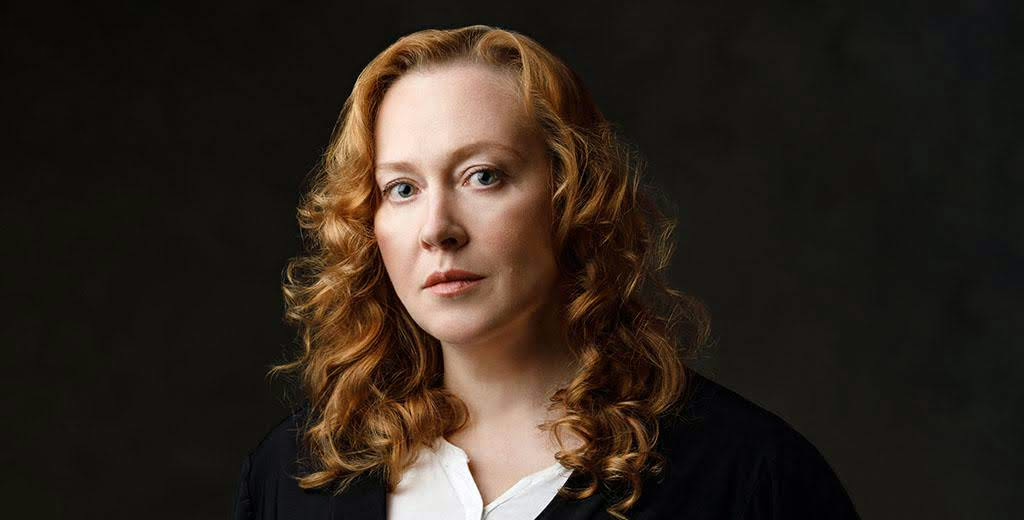
Fearful of appearing before the formidable Empress Elizabeth Petrovna, I fully understood that such figures are not to be questioned; one simply trembles and awaits their fate. However, within the first minute, Julia Aug, the actress portraying the imperial role in the acclaimed film, declared that she is not Elizabeth and there was no need for fear. Yet, as our conversation progressed, one thought echoed in my mind: “powerful, charismatic, strong-willed, steadfast, whole, stunning, and breathtaking.” In one word, an empress.
Reviving Old Love and Supernatural Encounters
Currently in production is the film “Touch of the Wind,” where Julia plays a woman journeying to Buryatia in search of a lost love. When asked if it’s possible to revive old feelings or if lost love is gone forever, Julia shared:
“Firstly, my character seeks her past love not to revive it, but to understand if she can entrust her daughter to this man as she faces death. It’s an attempt to find support in someone who was once her love and is unaware of having an adult daughter.
The film features various supernatural events, which are not surprising given that they actually occur in Buryatia, where the filming took place. When a European encounters Buddhist civilization, incredible things happen. I witnessed this firsthand. While driving, I saw a mini-tornado on the roadside—a cloud spinning close to the ground for several minutes before vanishing. What was it? It remains a mystery.”
“Touch of the Wind” is an artistic-documentary project. According to the script, Julia plays an actress traveling to Buryatia, the center of Russian Buddhism, where she meets her beloved’s younger brother and enters a world of spirits that is as natural as any everyday attribute in this region. People constantly communicate with spirits, not just in places like Ivolginsky or Barguzin Datsans. Everywhere, colorful ribbons and towels—Buddhist khadaks—are tied to bushes and trees. Living in harmony with nature, people worship rivers, trees, and mountains.
Ultimately, we don’t know if she finds her love, but at least she learns that her beloved is alive and might even be able to heal her. As for reviving love, Julia has never attempted it, neither in life nor in cinema.
Fulfilling a Mother’s Dream
Is it true that Julia fulfilled her mother’s dream of becoming an actress?
“Moreover, she even attended a theatrical studio of Stefania Stanyuta in Minsk. My mother is from Minsk. My uncle (her brother) and aunt still live there. My grandparents lived there too. I spent all my childhood in the courtyards of Minsk. As soon as school ended, I would go there for the holidays. But my mother was the eldest in a large family and had to abandon her dreams to help raise her siblings.
Not only did I fulfill my mother’s wish, but my daughter Polina also enrolled in GITIS this year, which surprised me greatly as she had planned to become a director or playwright.”
Family Endeavors in Music Video Production
Besides acting, writing scripts, and directing, Julia is involved in music video production. Who assists her in this venture?
“Music video production is a family affair. I know I can always rely on Polina and my husband. Andrei handles the technical aspects of the videos; he is the second director and on-set director. Polina takes care of casting and selecting actors. Naturally, the stars in the videos are my friends, whom I personally approach. However, many young people also participate, which is entirely Polina’s domain. I don’t even supervise this process. For example, I call her and say, ‘Pol, I need five beautiful young girls with long, slender legs.’ I don’t need to check; everything will be done perfectly.”
Family Hobbies Beyond Work
What are the family’s shared hobbies outside of work?
“Rather, my husband shares my interests, making them our common hobbies. Although it’s difficult for me to separate my interests and passions from my professional life. Cinema and theater fill my entire life, leaving no room for anything else. Moreover, when such a space appears, it feels like a catastrophe. The only salvation is the ability to travel.
When Polina was still in school and we had at least two free days, we would get in the car and go… even just to the nearest Moscow suburbs. To see something amazing, you don’t need to fly to Thailand or the Caribbean. Just look at the map—around Moscow, there are many wonderful and incredibly interesting places. Unfortunately, for the past two years, we haven’t been able to go anywhere; there’s just no time.
Our last trip was to Mstera. This town in the Vladimir region is known for the fact that almost every house was once home to miniature artists who painted boxes and wrote icons. Like many former craft towns in Russia, Mstera has incredible charm. Interestingly, these towns, despite their similarities, are all unique, each with its own soul.
It’s bitter to realize that many of them are now dying out. For example, to find masters in Mstera, we had to search for a long time. We literally drove through the streets, stopping passersby and asking where we could find lacquer miniature artists. Mostly, we were told that ‘there used to be one in every yard, but now you’re unlikely to find anyone.’ But we eventually found some…
Mstera interested me for another reason: it was home to the ‘ofeni’—peddlers, itinerant retailers who invented a secret language, ‘fenya,’ to communicate with each other. I always thought it was prison slang. But it all started with my fascination with the history of box painting, which led me to explore places where such crafts once thrived.”
The Polar Worlds of Actor and Director
Previously, the profession of director was considered male-dominated, but now those boundaries have blurred. Do you think directing doesn’t have a female face?
“The boundaries blurred long ago. It’s not that we didn’t notice; we just realized it now. Let’s recall the early 20th century when the world was truly young, aviation was developing, cinematography emerged, and cars were gaining technical advancements. Who was mastering all this? Women were among the first. We can remember the famous aviator Amelia Earhart, who was the first to fly across the Sahara. Women in the early 20th century wanted to be on par with men so much that they mastered almost any profession. Now, it’s even funny to talk about it. Among directors, there are so many women now that this question doesn’t arise for me or others.”
It’s rare for directors to transition into acting, but the reverse is quite common. What do actors and directors lack in their professions?
“Why rare? What about Andrei Smirnov, Nikita Mikhalkov, Stanislav Govorukhin, Larisa Shepitko? That’s not true. What do they lack? I think at some point, an actor may lack the ability to create their own world or may not want to be just a tool in creating that world. And sometimes a director wants to be not just a demiurge who invents and creates, but to embody a certain aspect of that world. This is all understandable: the ways of existence for a director and an actor are completely different.”
What is closer to you: being a director or an actor?
“It’s hard to say. I like both. I just don’t like being on both sides at the same time.”