Ivan Gyngazov: Mastering the Role of Otello in Opera
Ivan Gyngazov: Mastering the Role of Otello in Opera
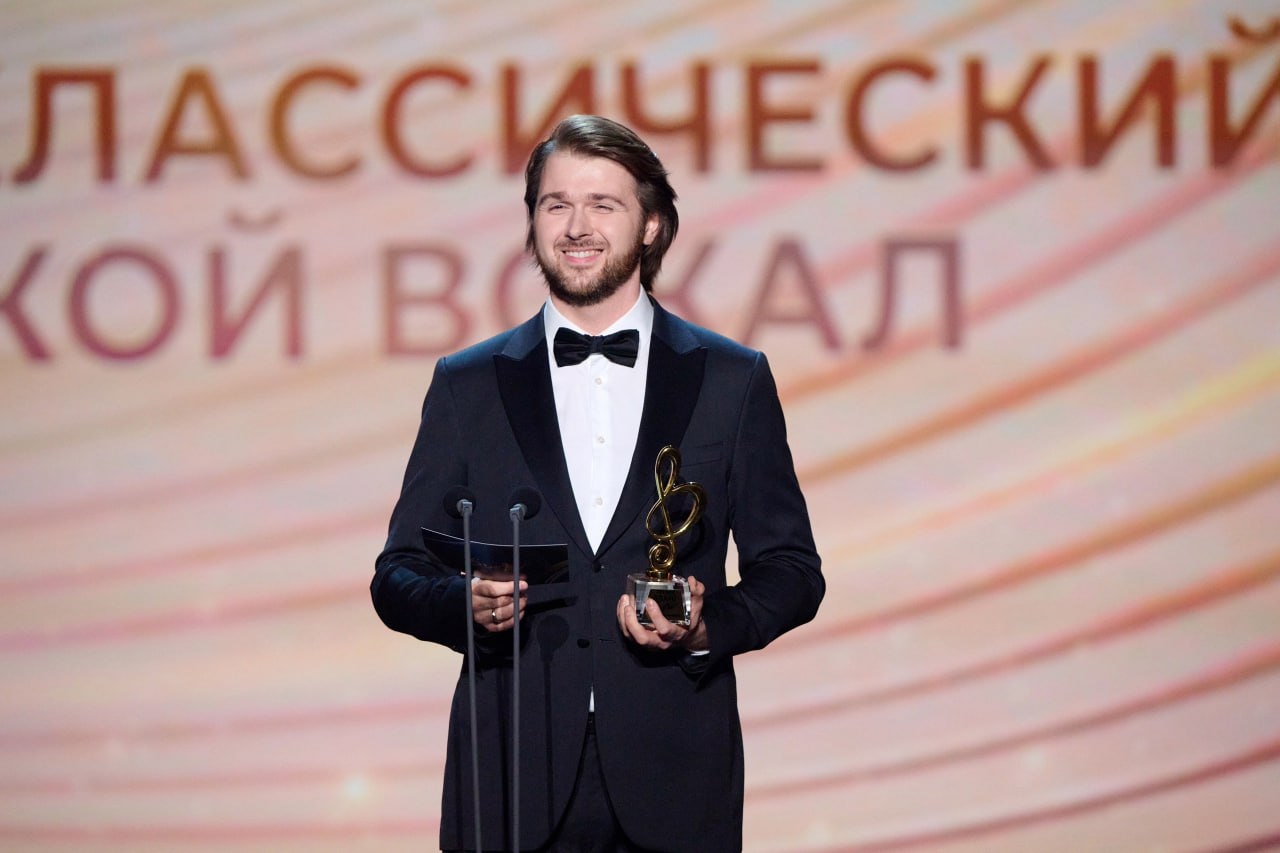
On World Voice Day, celebrated annually on April 16th, the Belarusian State Academic Bolshoi Theater of Opera and Ballet presented a magnificent gift to vocal art enthusiasts. The theater staged Camille Saint-Saëns’ opera “Samson and Delilah,” renowned for its musical beauty. The role of Delilah was performed by the Belarusian opera prima, Anastasia Malevich, known for her exceptional vocal range and richness. For the role of Samson, one of the brightest and most renowned young tenors of our time, Ivan Gyngazov, specially flew to Minsk.
The Unique Opportunity
Seven lucky winners of the “Photo with a Star” contest, initiated by the theater, had the unique chance to go on stage after the performance, take photos, and personally chat with Ivan. One of the contest questions was about Ivan Gyngazov’s biography, as the famous tenor has Belarusian roots. His grandmother was born in the village of Nemanitsa, Borisov District, Minsk Region. Although she no longer lives in Belarus, some relatives still reside there, and the future opera singer often visited them during his childhood.
A Man of the World
Today, Gyngazov is a man of the world: one evening he performs in Minsk, the next day he sings at the Mariinsky Theater, and in the summer, he is expected at the Vienna Opera. At just 36 years old, Ivan is considered young for an opera singer, and he is often referred to as a “rising star of world opera,” suggesting that the outstanding tenor has much more to achieve. A graduate of the Novosibirsk State Conservatory named after Glinka, Gyngazov is now a soloist at the Moscow Musical Theater “Helikon-Opera,” as well as a guest soloist at the Mariinsky and Bolshoi Theaters of Russia, and a laureate of the Russian opera “Oscar” – the “Onegin” award.
Global Collaborations
Gyngazov collaborates with numerous theaters worldwide and regularly receives invitations from prestigious venues such as the Rome Opera, Vienna Opera, Sydney Opera, Berlin Opera, Dresden Opera, Alexandrinsky and Mikhailovsky Theaters, Vienna and Moscow Philharmonics, Opéra Bastille in Paris, and the National Theater of São Carlos in Lisbon. He has worked with renowned conductors like Valery Gergiev, Vladimir Fedoseyev, Plácido Domingo, and Antonio Piroli.
Belarusian Roots and Career Beginnings
Ivan, did your Belarusian roots influence your collaboration with the Belarusian State Academic Bolshoi Theater of Opera and Ballet?
“Of course, I dreamed of singing in this beautiful theater on the land of my grandmother’s birth. But I think this invitation is more related to my growing popularity and my competence as an opera performer. After the first invitation, others followed, and now it has become a tradition for me to regularly come to Minsk and perform on the stage of the Belarusian State Academic Bolshoi Theater of Opera and Ballet. At first, it happened once a year, but now more often. And every time I am happy to accept the invitation.”
Family and Performances
Do your Belarusian relatives attend your performances in Minsk?
“My relatives still live in Belarus. However, since all my relatives are in Gomel, unfortunately, they cannot always come to Minsk for every performance.”
Novosibirsk and Career Choices
How often do you get to perform in your native Novosibirsk, where your vocal career began?
“This year I have already performed there twice! I am invited regularly, but I often have to decline because sometimes I receive three or four invitations from different theaters around the world for the same day. I have to choose. If there was a concert at noon in Novosibirsk and another in Moscow in the evening, I could fly and perform twice a day due to the time difference. But that’s not how it happens. Although I have a lot of energy, I can’t be in two places at once.”
Dreams and Aspirations
When you were a singing boy in Novosibirsk, which opera role did you dream of performing on a big stage?
“Probably, the role of Herman in “The Queen of Spades.” Later, I often heard even bass singers say, ‘I want to be a tenor to sing the role of Herman at least once!'”
Future Roles and Ambitions
Is there a role you dream of but is meant for a different voice type?
“For example, the role of Delilah in Saint-Saëns’ opera “Samson and Delilah” is such beauty! Thankfully, I always have such wonderful partners on stage in this opera that I can enjoy this beautiful role.”
Speaking of plans rather than dreams, I soon plan to return to the works of Giuseppe Verdi, a significant composer for me. Essentially, my big career began with Verdi’s opera “Il Trovatore.” I first performed the role of Manrico in 2017 when I debuted with it at “Helikon-Opera.” Then I sang it on the stages of the Mariinsky and Bolshoi Theaters of Russia. In the near future, I am to learn and perform the role of Don Carlos in Verdi’s opera of the same name at the Primorsky Stage of the Mariinsky Theater in Vladivostok. I am also interested in the tenor roles in Verdi’s operas “Simon Boccanegra” and “La Forza del Destino.”
Career Decisions and Growth
New offers come constantly, but I do not accept all of them. Not long ago, I turned down a contract with the Rome Opera, which invited me to perform the title role in Verdi’s opera “Otello.” The contract was already signed, and the dates were announced… But I still feel that to perform Otello, one must either be born for it or grow into the role. I feel that it is still too early for me: I am still growing…
Overall, my Western career is going well now. I receive many invitations and travel a lot. In the near future, I plan to perform in Vienna: in early June, I will perform the role of Calaf in Puccini’s opera “Turandot” at the Vienna Opera. Then I will go to Hong Kong, also with “Turandot.” After that, Berlin – “Carmen,” the role of José.
Stage Costumes and Language Skills
Do you bring your stage costumes with you around the world, or does each theater have its own wardrobe for you?
“For example, in Minsk, the costume of Samson was tailored for me because I participated in the production of this opera by Oksana Volkova. Although, I must admit, I do not like this stage wig! (Laughs) I even wanted to bring mine from the Mariinsky Theater, but first, I consulted with my wife. And she rightly noted that the wig from another production would not fit the style of this particular performance. So I left everything as it was.”
You perform operas not only in Russian but also in Italian, French, and German. Essentially, an opera singer must also be a polyglot?
“Yes, that’s why I study languages separately, and I have tutors for each language. I think I am already quite good at French. It sounds immodest, but I had good teachers who taught me correctly. Italian is simpler; the phonetics are not as complex. I am still working on German, but I will catch up. Although I understand perfectly that we will never be equal to native speakers. Our Slavic voices of Russian, Belarusian, and Ukrainian opera singers are so good, they are loved and appreciated all over the world, so much is forgiven to us because of our voices. But we still strive to be closer to the ideal.”
The Fragility of a Tenor’s Voice
The voice, especially a tenor’s, is a very fragile and vulnerable instrument. Do you have to give up something in life for the sake of your voice?
“I do not give up anything! The worst thing for a singer is infections, all these colds, and covid. Today, I had such a cough backstage that while singing, I thought: if I were perfectly healthy, what divine sounds I would produce! Vocalists are constantly ill; to be honest, a singer is never completely healthy – that’s life. But live performances are interesting precisely because of their imperfection. You never know how it will go.”