Hatha Yoga: A Journey to the Present Moment
Hatha Yoga: A Journey to the Present Moment
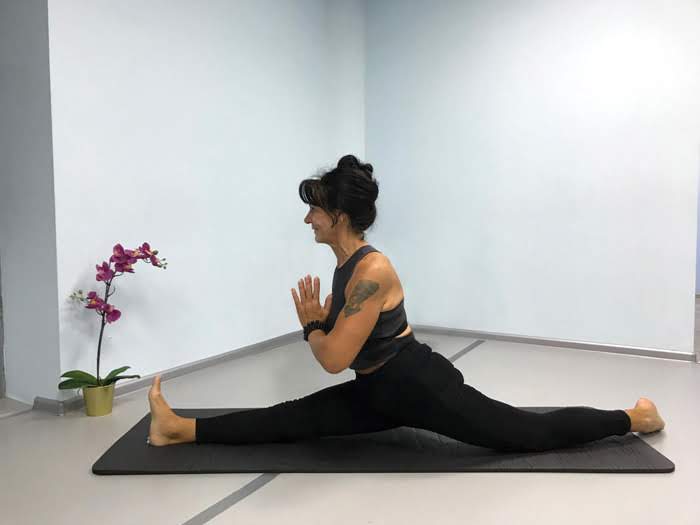
Our interlocutor, Tamara Zhukevich, is a Hatha Yoga instructor at the women’s club “Samaya.” At 57, she began practicing yoga and became a teacher within a year. A few years later, Tamara started dancing flamenco and performing ballet moves at the barre in the same club. During our conversation (I find it hard to call it an interview as questions were asked of me too), she said, “Every day is a celebration for me. There’s a saying, ‘The grass is always greener on the other side.’ But I can say, ‘It’s great where I am.’ And you should enjoy life every second.” After several hours of talking with Tamara, I understood a lot, but some of her words still need to be comprehended as every answer she gave was a seed for thought.
Tamara Zhukevich, Hatha Yoga Instructor
What is unique about Hatha Yoga, and what can it offer?
I believe that all yoga styles originate from Hatha Yoga. Its uniqueness lies in its comprehensiveness. Hatha Yoga practices include Shatkarmas, Asanas, Bandhas, Mudras, and Pranayamas, as well as elements of Pratyahara, Dharana, and Dhyana.
When I started practicing yoga, nothing worked for the first three months. Then I thought, “Why can the teacher do it, but I can’t?” I began observing him and asking questions. Eventually, I realized that breathing plays a crucial role in yoga. When you breathe correctly, performing Asanas becomes easier. It’s also essential to direct your attention inward. Where your mind is, there your energy is. People don’t understand why they come to yoga agitated and leave calm, happy, and full of energy. When you perform Asanas and focus your attention inward, your mind’s agitation ceases.
- Shatkarma: Cleansing practices for the body.
- Asana: A yoga pose (a body position that is comfortable and stable).
- Bandhas: Internal locks or contractions in yoga.
- Mudras: Symbolic finger combinations, a ritual gesture language.
- Pranayama: Breathing techniques.
- Pratyahara: Withdrawal of the senses from external objects.
- Dharana: Concentration of the mind.
- Dhyana: Meditation.
Let me give you an example from my practice. One of my yoga students said, “My director upset me. I went to another room where no one could see me and stood in the ‘Tree Pose.’ After a few minutes, I calmed down.” Why did she calm down? The ‘Tree Pose’ is a balancing Asana that requires focusing on your breath and looking at one point. Concentrating on your breath helps stop the mind’s agitation and control your emotions.
It’s important to understand that yoga is not a sport. And the final form is not external but internal, invisible to everyone. In yoga, energy accumulates. Many also think that yoga is meditation. That’s not correct. To meditate, you need to go through several stages, starting with the basics. You must follow moral principles (Yama and Niyama), prepare your body with Asanas and Shatkarmas (yogic cleanses), and learn to breathe correctly (Pranayamas).
You can’t skip a stage (although anything is possible in this life). A beginner might experience back pain or fall asleep after five minutes. You need to start small and progress gradually.
Regular Hatha Yoga practice leads to the improvement of physical form, mental state, emotional background, and psychological balance. As a result, you will gain health, increase your energy potential, learn to control your emotions, and your life will become harmonious with a clear mind.
For me, yoga is:
- The 8 limbs of Patanjali;
- Quality of life. It’s a path (Dao);
- Self-realization;
- Health;
- A path to harmony and freedom;
- Cessation of the mind’s agitation;
- Expansion of consciousness;
- Love.
How can one choose their path in yoga?
You need to try and gain experience. Eventually, you will find your direction and your teacher. When the student is ready, the teacher will appear. The human factor is the most important. You should be on the same wavelength as your teacher. I hated 90% of Asanas. It was difficult for me; I had excess weight and some health problems, but I intuitively continued practicing yoga. Now I understand that if I, as a teacher, don’t give energy to the student, then I am not a teacher.
How to restore energy?
It’s not my energy. A flow passes through me. Imagine that your body is a vessel. This “vessel” has been filled with something since early childhood (kindergarten, school, university, friends, society). Everyone has their own experience of good and bad. You have a family, money, and a job. Nothing else bothers you – you are in your comfort zone. That’s where it all begins. The past is your acquired experience. But if you don’t fill the “vessel” with something new, the contents will turn into a “swamp.” Why do people suffer? Because they “live” in the past. In the present moment, you don’t suffer. Regular yoga practice leads to the realization of this.
I teach clients to be aware, that is, to “direct” attention inward. Why do people have problems? Because they always blame someone or something. “I’m in a bad mood because of the rain, my husband yelled at me in the morning, my boss is bad…” But resentment and anxiety are within you. And the events that happen to you are given for a reason. There’s a famous saying: “Want to be happy – be happy.” It’s true! But people are not used to working on themselves; they are afraid to leave their comfort zone. They like to complain and suffer, blaming others for their failures. Take this away from people, and they will have nothing to live for.
Tamara asks me, “Are you doing well at the moment?”
“Yes, I am. It’s cozy,” I reply.
“So, you will always be well because you are ‘here and now.’ As soon as a bad mood appears, ask yourself, ‘Where are my thoughts?’ They are either in the past or in the future. But you need to be in the present.”
People also spoil their lives with fear of the future. But you don’t know what will happen in five minutes! Nothing has happened yet, and the person is already suffering. Can you change the situation?
“I can change my attitude towards it,” I answer.
“Correct! People talk about problems. But they don’t exist! I tell my students the same: ‘Don’t say the word ‘problem’ in front of me!”
“There is a situation. And it needs to be resolved,” I continue.
“You are speaking my words,” she smiles. “Let’s imagine a situation: I spilled juice on you. Do you want to suffer? Get angry, yell at me, hold a grudge for a long time, for example. Or accept it, blot the spilled juice, and forget about it in five minutes. You need to realize that a person lives in society, and everyone gets lessons to change themselves, not others. Learn to live in the present moment and solve issues as they arise. Learn to take responsibility for yourself. No one owes you anything. Learn to love. But not physical love, but unconditional love. In other words, learn to love people. Do you love people?”
“I love finding beauty in everything and everyone,” I answer my interlocutor’s question.
“That’s how it is. But people always look for flaws in others. We are given two eyes: one eye should look at our own flaws, and the other at others’ virtues. You need to understand: it’s not that this person irritates you, but that a lesson was given to realize something.”
What breathing practices can beginners do at home to restore energy and remove emotional tension?
To calm down, you can do 6-12 full yogic breaths: a deep inhale through the nose and exhale through the mouth. Next, close your right nostril and breathe through the left, and vice versa. You need to “return” your attention from the outside to the inside – focus on your breath.
How to calm down? For example, you can do a concentration practice on a candle, the horizon, a fire, the sea… You can take a shower. Shavasana for 10 minutes (a yoga pose for deep relaxation).