Flowers and Colors: Expert Tips from a Landscape Designer
Flowers and Colors: Expert Tips from a Landscape Designer
As spring approaches, we all crave more color and, of course, more flowers! While your garden is still waking up from its winter slumber, there are a few tricks to add vibrant hues to your surroundings. Today, we’ll draw inspiration from the compositions of Danish designer Claus Dalby and discuss the rules for planting flowers in containers and pots.
The Garden’s Skeleton
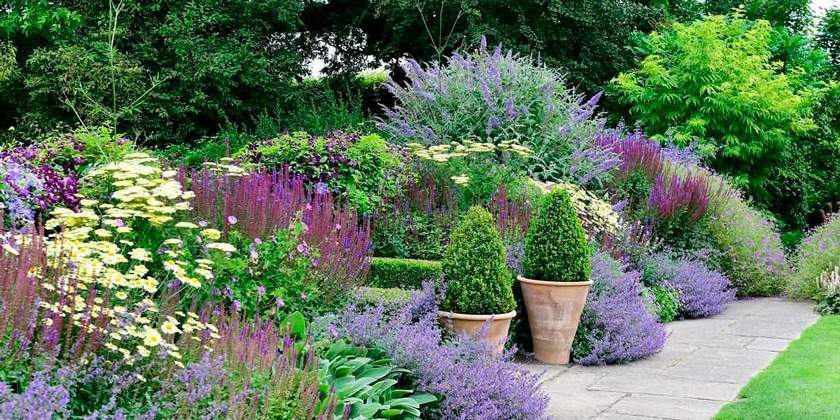
Every garden has its own skeleton of green plantings that work throughout the season. This includes evergreen and deciduous plants, as well as a layer of perennial flowering plants, some of which create effects that last the entire season in landscape design.
Bulb Plants: The Jewelry of the Garden
Bulb plants are like the jewelry of the garden—temporary, bright, and beautiful. They inspire awe and, along with spring, bring hope for better things to come. I would like to focus on these decorative elements. Container gardening, in the context of the entire garden, is like a brooch on a coat. We wear the coat for a long time, but we can change the brooch. However, these are temporary compositions that require a lot of care. It’s also important to remember that any container gardening is not as long-lasting as we would like. The reason is that a container holds a limited amount of soil, and as the plants grow, there’s a chance that the roots will eventually consume all the soil. Containers last for 2-3 years, after which everything needs to be removed and replanted. This applies to both bulb plants and perennial flowers.
Rules for Planting in Containers and Pots
If we agree to all the care required, let’s talk about the rules for planting in containers and pots.
Choosing Pots and Bulbs
To create a good spring mood, we need various types of bulb plants and a dozen pots (or fewer). Pots can be of different heights. For bulbs, a depth of 20-30 cm is sufficient. You can plant tulips, crocuses, daffodils, irises, anemones, snowdrops, and fritillaries. The choice depends on your budget and time.
Substrate and Planting
Use universal garden soil as a substrate. Plant the bulbs a couple of weeks later than those planted directly in the ground outside. It’s better for them to bloom later than to be caught by frost. These planting conditions are tied to the soil’s temperature regime, as the soil in pots is warmer. It’s better to overfill the pot with plants and place them close to each other, about 1-2 cm apart. To avoid mistakes with the flowering time of the bulbs, it’s better to plant one variety and type in each pot. Outdoors, the flowering will last longer than indoors. Keep this in mind. Also, don’t forget about drainage in the containers with a layer of about 5 cm.
Care and Maintenance
Place our pots in a cool place with a temperature of 8-9 degrees Celsius. A balcony, basement, or garage will do. Otherwise, the pots will need to be wrapped in paper or fabric and uncovered when it gets warmer.
Water the pots and keep the substrate moist. Just because a plant is in the soil doesn’t mean it’s like a stone and doesn’t need care.
Color Combinations
Don’t forget about the color combinations in our compositions. It’s better to use one color and its shades or pay attention to neat combinations: yellow and orange, red and burgundy, blue with white or yellow. These color games will be a sure win and, in large quantities, will create a wow effect. Remember that plants bloom with a difference of weeks.
From perennial flowering plants, you can plant sedges and woodrushes, primroses, violets, and anemones.
After Flowering
When the plants stop vegetating (the last flowers have bloomed and the leaves begin to turn yellow), the pots can be moved to an inconspicuous place if possible. You can dig up the bulbs and send them for storage until autumn and the next planting, and fill the pots themselves with annual flowering plants.
A Quick and Less Troublesome Option
Another quick and less troublesome option for container gardening is to buy ready-made cultures that have already been forced for the season in the nursery and are now on sale. You can find these in covered garden stores. It turns out to be quite inexpensive. In the spring, we buy what we like, plant it in a container, put it on the balcony or terrace, and enjoy the beauty and spring rays. After that, we calmly put it away for storage and plant it on the site in the autumn, forgetting about it until spring. The only downside is that the number of bulb plants on the site will increase every year, and every spring you will have to buy new forced plants for containers.
Everything requires care and our attention, but beauty is definitely worth a little effort to enjoy it later!
For more information on landscape design, you can visit The American Society of Landscape Architects.