Feminism: The Challenging Journey Towards Gender Equality
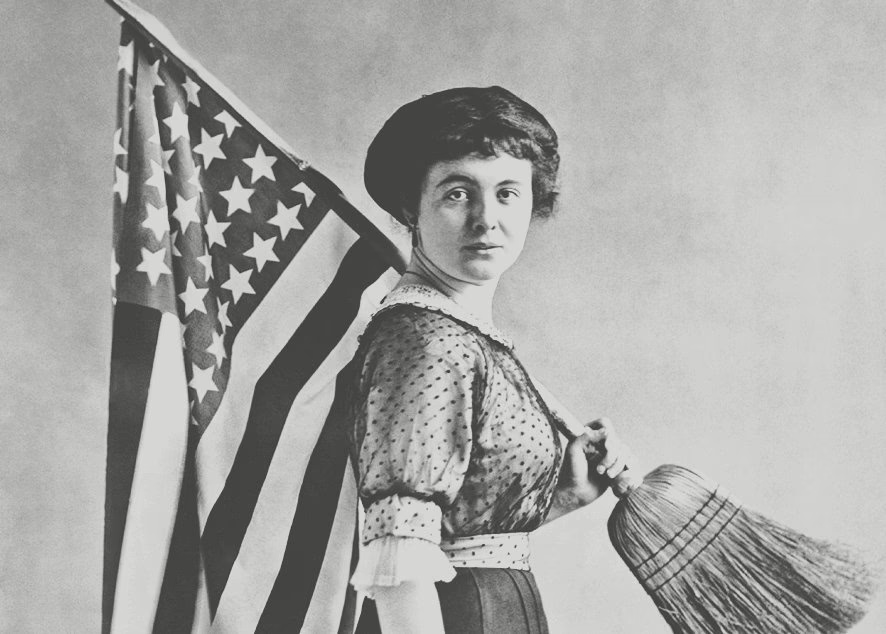
Understanding Feminism
Feminism, a term often surrounded by confusion and misconceptions, is primarily associated with the struggle for women’s rights. However, its evolution over time has led to a diverse range of interpretations and goals. To truly grasp the essence of feminism, it’s essential to delve into its historical context and developmental milestones.
The Roots of Feminism
Feminist ideas have been present since the dawn of culture, with traces found in the teachings of Plato and Buddhism. However, these ideas were often isolated, lacking widespread support or dissemination. The late 18th and early 19th centuries marked the emergence of the first true feminist activists, coinciding with the American War of Independence and the European reform movement. These pioneering women, though charismatic and strong-willed, were limited in their impact due to their solitary efforts.
The First Wave
The latter half of the 19th century witnessed the birth of organized feminism, with thousands of individuals advocating for women’s rights. This era saw the rise of the suffragettes, who fought for specific rights such as voting, education, and property ownership within marriage. Their protests, often dramatic and attention-grabbing, eventually led to gradual changes, although many countries, particularly in the Arab world, still deny women these basic rights.
The Second Wave
The 1960s brought the second wave of feminism, focusing on social inequality, oppression, and discrimination against women. Despite having secured basic rights, women faced barriers in employment, often confined to traditional female roles. This period also saw the development of a robust theoretical and philosophical foundation for feminism, addressing issues of female sexuality and introducing the concept of gender as distinct from biological sex.
The Third Wave and Beyond
The current wave of feminism, beginning in the 1990s, is characterized by its all-encompassing nature, permeating all aspects of life. It has branched into various factions, each with unique goals and ideologies. Modern feminism advocates for complete gender equality, addressing issues such as male conscription, equal pay, and protection from violence. It also emphasizes equal opportunities, challenging societal norms and biases.
Feminism in Russia
Russia’s feminist movement has followed a distinct path. Prior to 1917, it mirrored global trends, but the Soviet era brought a unique form of feminism. Women gained equal rights, including the right to vote, and were integrated into the workforce, often in physically demanding roles. However, this was largely a formal equality, driven by necessity rather than a genuine belief in gender equality. Post-Soviet Russia saw a resurgence of sexist attitudes, but the feminist movement has gradually gained traction, driven by individual efforts and increasing awareness.
Opposition to Feminism
Feminism has always faced opposition, but organized anti-feminist movements emerged during the second wave. These groups, often passive-aggressive, rarely engage in direct action or advocacy. Active anti-feminists, or masculists, emerged during the third wave, typically opposing radical feminist factions. In Russia, these groups often conflate all feminist movements, perceiving them as a threat to their rights.