Facial Rejuvenation: The Magic of Kinesio Tape and How It Works
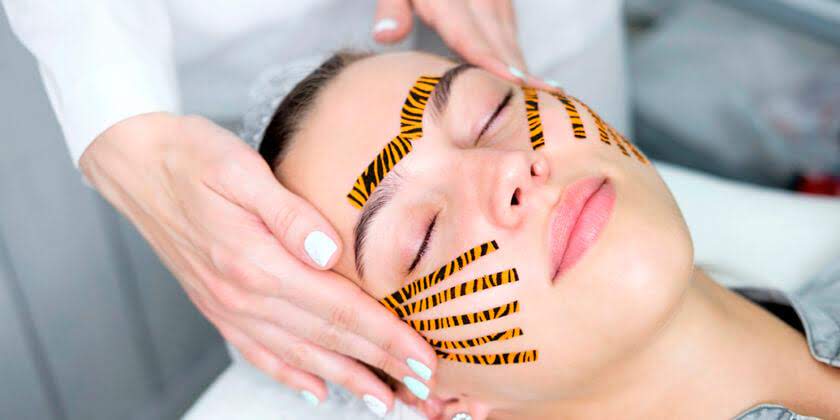
Facial Rejuvenation: The Magic of Kinesio Tape and How It Works
Instead of Botox and plastic surgery! In cosmetology, taping has become in demand not so long ago, but its popularity is growing every day. All thanks to the impressive lifting effect of this method! So what is taping and why has the use of tapes become so relevant and fashionable lately?
Anna Shabalovskaya, an osteopath and kinesiotherapist, @osteopat_anna
Taping was first used by Kenzo Kase in 1983 in sports medicine, and at the 1988 Seoul Olympics, the first athletes with tapes (from the English tape – tape) appeared. They needed them to fix or support joints, ligaments, and tendons. Then tapes began to be actively used in other areas, including cosmetology – as an alternative to surgical operations. Tapes came to the CIS countries in 2000: first in sports medicine and rehabilitation, and then in cosmetology.
What is Kinesio Tape and How Does It Work?
A kinesiology tape is an elastic tape made of natural cotton that is applied to the skin for a certain time. One side of it is covered with a layer of hypoallergenic glue for good and safe adhesion to the skin. The main “trick” of the tape is that its elasticity is similar to the elasticity of the skin. Because of this, the skin does not perceive the tape as something foreign and does not resist its effects.
How does the tape work? It lifts the skin, enhancing lymph flow and blood flow, relaxes muscles, and removes excess fluid. At the same time, it does not restrict movement or stretch the skin, is completely breathable and moisture-permeable. Therefore, it does not harm the skin, but on the contrary, allows reducing the severity of age-related defects.
Tapes come in different types: cotton, silk, and silicone. However, the latter are not yet available in Belarus. The most popular in the CIS are cotton tapes. Silk tapes are used less often due to their higher cost.
Facial Taping
With the help of taping different zones on the face, you can easily tighten the skin without injections. This method allows you to relax the muscles, improve lymph flow and blood flow, and stimulate metabolic and recovery processes in the tissues. It is thanks to this that a rejuvenating effect is observed.
Facial taping is performed with lightweight tapes (BB tape). They are glued along the massage lines. The tape should be applied with the transverse side so that its long side goes along the wrinkles. All edges of the tape must be rounded before application so that no folds form on the skin from the sharp corners.
The tapes are usually left on the face from 30 minutes to 8 hours (can be overnight). The effect is visible after the first application. But it is not long-lasting! Taping is a systematic procedure that should be carried out in sessions. It is after several procedures that you can see the wonderful effect of this method. Thus, even a very sagging upper eyelid can be lifted with the correct taping technique in 3-7 procedures.
Important! Before applying the tapes, be sure to cleanse your face in the way you are used to. Then moisturize with cream or serum. And to warm up the muscles, you can put a warm towel on your face or gently massage it so that the moisturizing product is absorbed faster.
With the help of taping, you can:
- Smooth nasolabial folds, wrinkles on the forehead, around the eyes and mouth;
- Tighten the oval of the face;
- Lift the upper eyelid;
- Remove swelling and bags under the eyes;
- Improve complexion;
- Get rid of asymmetry;
- Remove double chin;
- Smooth the neck.
Taping has some minor but still contraindications. You cannot apply tapes to the face for skin diseases, allergies to cotton or components of the glue used in the composition of the tapes.
Techniques for Applying Tapes to Different Areas of the Face
As you know, the muscles of the face are divided into mimetic and chewing muscles. And depending on this, taping of different zones on the face has its own characteristics.
Chewing muscles are covered with fascia – a membrane that gives them shape, such as the nasolabial fold. Such muscles need to be stretched during taping to achieve a lifting effect. Mimetic muscles are located on the forehead and near the eyes. To smooth them, you do not need to stretch the muscles, as they are not covered with fascia. Therefore, wrinkles in such areas are well smoothed with ordinary point or local exposure.
Important! For the correct application of tapes, it is worth using a muscle atlas that will help you understand in which direction to glue the tapes.
After applying the tape in any area, it is recommended to gently massage it with your finger to enhance the adhesion of the glue to the skin. And also work the muscles through mimicry: frown, smile, frown, etc.
Below we provide a couple of simple examples of taping that you can do at home. In case of more complex types of taping, it is better to contact a specialist (at least for consultation and training) rather than experimenting with your skin.
Forehead Taping for Wrinkles
The scheme for applying tape to the forehead is quite simple.
- Take a piece of tape 5 cm wide and long.
- Round the ends of the tape.
- Glue the tape to the middle of the forehead, taking into account the following recommendations:
- Start gluing the tape above the bridge of the nose, first gluing its end 1 cm long;
- Place your palm on your hair and gently pull the skin;
- Pull the backing paper and glue the tape completely (without stretching it!).
How to understand if you have glued the tape correctly? The tape always has a marked backing. If the glued tape and the backing are the same in width and length, then you have done everything correctly.
After applying the tape, it is recommended to “play” with the muscles of the forehead using mimicry, in simple terms, to frown. To achieve a lifting effect, it is necessary to wear the patch for at least two hours.
Nasolabial Fold Taping
Tapes can be successfully used to eliminate the nasolabial fold. The procedure for applying them to the skin is quite simple.
- Measure the tape along the length of the nasolabial fold.
- Round the ends of the tape.
- Inflate the cheek on the side to be taped.
- Peel off the backing.
- Apply the tape to the wrinkle (fold), smoothing it out.
- Deflate the cheek and smooth out the tape.
- Smile several times.
It is recommended to wear the tape for 1 to 8 hours to achieve a rejuvenating effect.
Taping is an excellent method for rejuvenating and improving the skin, which is quite budget-friendly and simple to implement. Therefore, perhaps in the future, instead of a million care products, Botox, and surgeries, women will massively use this particular method, appreciating all its possibilities!
Text: Irina Ivlieva