Experience the Enchantment: Cinderella’s Ballet Magic Unveiled!
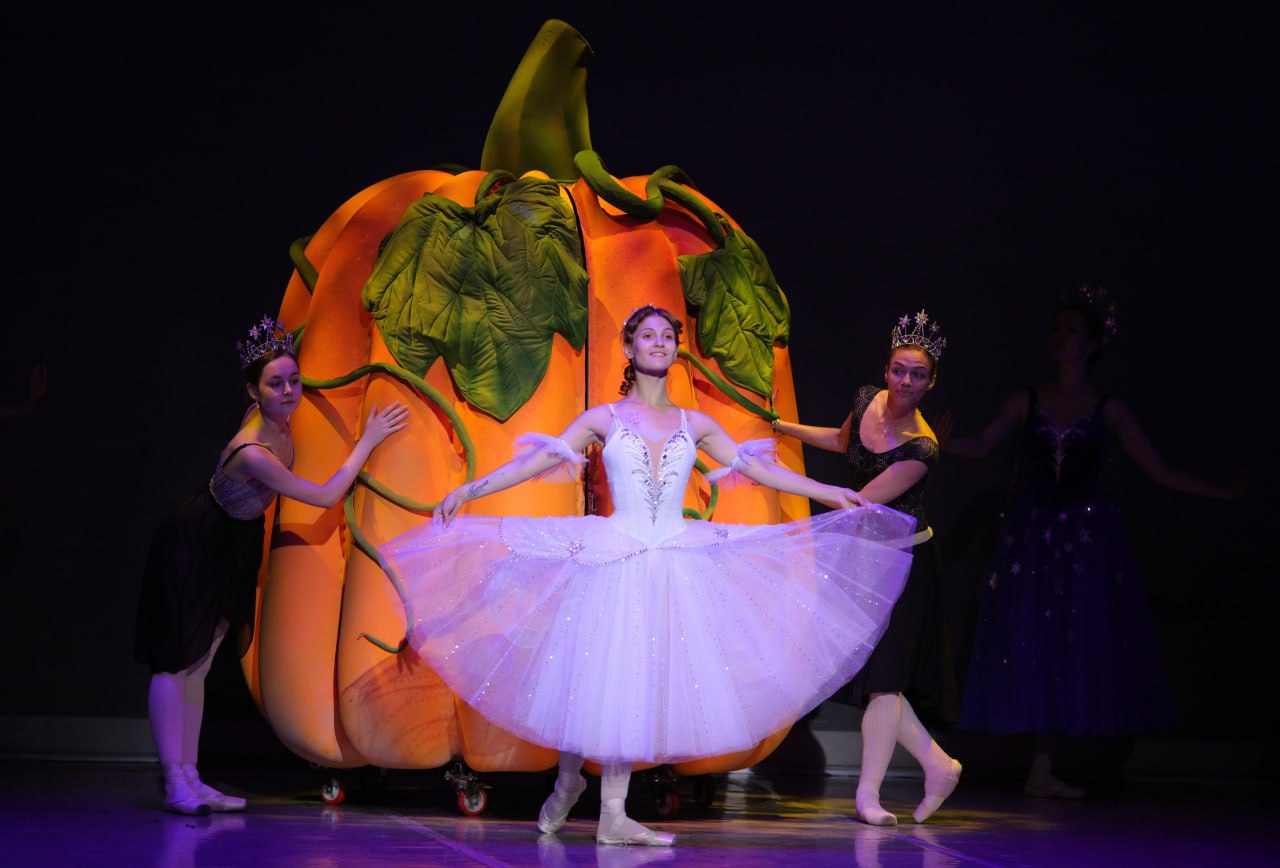
The Belarusian State Academic Bolshoi Ballet Theatre is set to conclude its 91st season with a dazzling premiere of “Cinderella,” a timeless tale that shows how a lost glass slipper can lead to everlasting love. Picture yourself at a royal ball, dancing with a prince to the enchanting music of Sergei Prokofiev, and discovering that fairy tales can become reality with a bit of effort and a sprinkle of magic!
Beyond the Fairy Tale
When the Bolshoi Theatre of Belarus decided to revive one of its most beloved ballets, “Cinderella,” set to Sergei Prokofiev’s iconic score, they faced unexpected challenges. “Cinderella” had been staged twice before at the Bolshoi, in 1965 and 2009. This time, renowned choreographer Valentin Yelizariev planned to offer his unique interpretation of Charles Perrault’s classic tale. However, in May 2024, Maestro Yelizariev left the theater, leaving the production in limbo.
Determined to bring the fairy tale to life, the theater entrusted the production to a dynamic husband-and-wife duo: People’s Artist Konstantin Kuznetsov and Honored Artist Yulia Dyatko. This decision proved to be a stroke of genius.
A Miracle in the Making
“I believe a miracle has happened—one that was meant to occur at the Bolshoi Theatre with this fairy tale production,” shared the theater’s chief choreographer, Igor Kolb. “We all believe in miracles! Even though we know that luck accounts for only 1% of success, we still hope for it. In our story, everything fell into place when we chose this duo—Yulia Dyatko and Konstantin Kuznetsov—to lead the production. We’ve known each other since childhood, having studied together at the Belarusian Choreographic College. This year, their eldest daughter, Anna Kuznetsova, joined the theater as a ballet dancer! It’s a real-life story of a ballet family where children grow up in the theater, and parents, who were once ballet dancers, have become choreographers with the opportunity to bring their artistic visions to life in their home theater.”
Generational Continuity
For the theater, maintaining generational continuity is crucial, connecting the present with the future, the school with the theater. In the new version of the ballet “Cinderella,” choreographed by the Kuznetsov-Dyatko duo, an important idea was embedded from the start: a grandmother, now an older Cinderella, shares her memories and tells her fairy tale story to her grandchildren in a cozy home setting. “Cinderella” is not just a children’s fairy tale; it is a story for the whole family, where parents can reminisce about the beginnings of their own romantic relationships.
Taking a Risk with Contemporary Choreographers
Did the theater take a risk by choosing choreographers known for their work in contemporary dance to create a large-scale classical ballet?
“The main risk was actually the tight timeframe,” explains Igor Kolb. “Additionally, the sets and costumes were already prepared when the new choreographers were selected. We had to reassemble all the musical material, which was handled by conductor Yuri Karavaev, as the new choreographers conceptually altered the original vision of the performance. I would say that triple the work was done! At the end of the season, everyone gave their last bit of strength to make the miracle happen and bring the fairy tale to life.”
A Happy Ending Guaranteed
“Any new work for a theater troupe and a choreographer is a gift, an opportunity to gain new experiences, try a new genre, and glimpse into the future,” admits Konstantin Kuznetsov, the librettist and choreographer of the ballet “Cinderella” and a People’s Artist of Belarus. “It’s no secret that Yulia and I primarily work with contemporary choreography. But here we had to stage a classical ballet! It wasn’t easy… We are used to working ad libitum (Lat. “at will”), where nothing holds us back. We wanted that familiar freedom, but the ready-made sets and costumes dictated a different working style. The main challenge was to fit into the given framework and work within a specific style.”
While preparing their version of the ballet, did they refer to previous productions of “Cinderella” by masters such as Frederick Ashton, Oleg Vinogradov, Rudolf Nureyev, and Vladimir Vasiliev?
Konstantin Kuznetsov: “Much had already been conceived before us. So, approaching the new production, we usually turn everything off and forget everything we’ve seen and known. We are both ballet dancers ourselves, so the habit of adopting the plasticity that you not only saw…”
Yulia Dyatko: “…but also danced yourself! We were both involved in the previous version of the ballet: I was one of Cinderella’s sisters, the Ugly Stepsister.”
Konstantin Kuznetsov: “And I was the dancing master! We performed this ballet for quite a long time, so we had to abstract ourselves as much as possible from the previous version to create our own. For some reason, in all previous productions of ‘Cinderella,’ no one tried to imagine how this story could end. But we did! And ours is a 100% happy ending!”
A Family Affair
The story of Cinderella is a fairy tale known to everyone since childhood. With two daughters growing up in their family, did Yulia and Konstantin discuss with them what their production would be like?
Yulia Dyatko: “Since the work on the performance did not stop even at home, our daughters were involved in everything from the very first day—in our discussions and ideas. The youngest will soon be six years old, and she spent the entire production period with us in the theater. As for the eldest, she often joined in the discussions and expressed her ideas. I remember there was one contentious moment when we couldn’t figure out why our approach wasn’t working? Then Anya shared her vision: ‘You could do it like this…’ We listened to her and even used some of her ideas in the end.”
Konstantin Kuznetsov: “We tried to approach this production with humor. We kept telling the artists that we intended to use all the ballet clichés possible in our performance. As for the narrative style, we tried to move into our favorite direction—timeless and beyond any era. We attempted to use the simplest choreographic vocabulary, without overloading it with complexity. We wanted the story to be presented as simply as possible so that even the most inexperienced viewer could understand what was happening on stage without needing a program.”
Poof! And the Pumpkin Turns Into…
If the ballet is a fairy tale, then magic must happen on stage: a pumpkin must turn into a carriage…