Dali’s Living Ruby and Frida Kahlo’s Pain: 5 Fascinating Facts About the Heart in Art
Dali’s Living Ruby and Frida Kahlo’s Pain: 5 Fascinating Facts About the Heart in Art
The heart is one of the most recognizable and replicated symbols worldwide. Various artists have drawn inspiration from this emblem, whose history dates back to ancient times. As the heart is considered the vessel of human emotions, passions, and feelings, its depiction is associated with a wide range of experiences, from suffering and pain to love and joy.
The Flaming Heart: From Christianity to Pop Culture
In Christian art, the image of a heart with fire burning above it is a significant symbol in Catholicism, representing the Sacred Heart of Jesus Christ. The fire next to the heart symbolizes the transforming power of divine love. Often, this image is accompanied by a crown of thorns, embodying the physical and spiritual sufferings endured by Jesus for the redemption of human sins.
The Christian symbol of the Sacred Heart gradually became part of secular pop culture and acquired new meanings. It began to appear in tattoos as a symbol of courage and selfless love. Thanks to Dolce & Gabbana’s Sacred Heart collection, the image of the flaming heart became a part of high fashion.
Salvador Dali’s Ruby Heart
In the world of jewelry art, the most famous heart is perhaps the luxurious ruby ornament designed by Salvador Dali. The renowned surrealist artist first ventured into jewelry design in 1941. Dali created sketches and provided detailed comments, while jeweler Carlos Alemany brought his unusual ideas to life.
Today, many of these pieces are exhibited in the Salvador Dali Theatre-Museum in Figueres, including his famous “Heart.” This piece attracts attention not only for its luxurious execution, which includes 46 rubies, 42 diamonds, and 4 emeralds, but also for its unique feature. The jewelry composition is designed with a special mechanism that makes the movable center pulsate rhythmically, just like a real heartbeat. Dali dedicated this work to the coronation of Elizabeth II, which took place in 1953.
Frida Kahlo: The Heart as a Symbol of Suffering
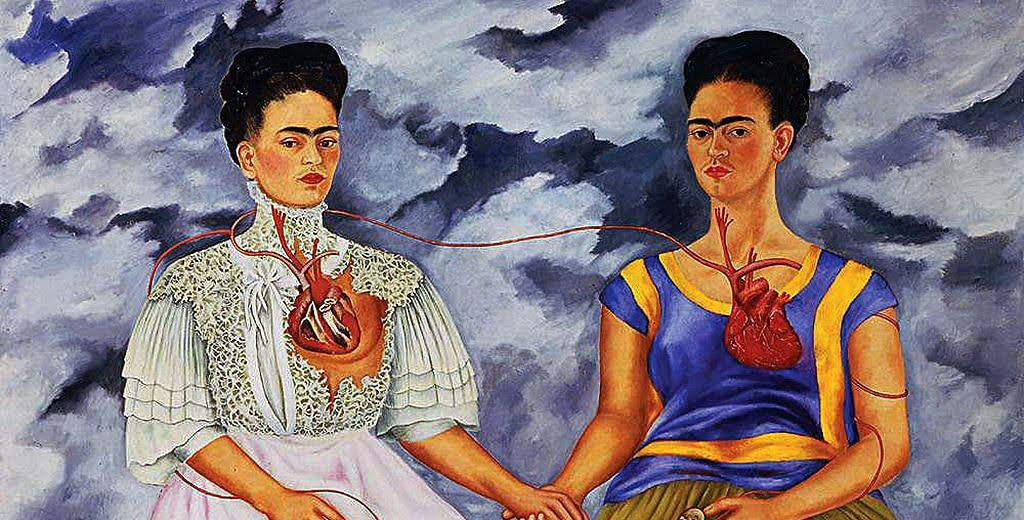
Mexican artist Frida Kahlo, in her self-portrait “The Two Fridas,” aimed for a naturalistic depiction of the heart muscle. In this painting, Kahlo portrayed herself twice. The Frida dressed in a traditional Mexican Tehuana outfit has her heart shown externally, while the one in a white European dress has her heart depicted internally, with all the details of its structure. The hearts of the two Fridas are connected by a blood vessel, which art critics interpret as a symbol of Kahlo’s dual heritage: German from her father and Spanish-Indian from her mother.
The exposed heart of Frida speaks volumes about her vulnerability and sensitivity. During this period of her life, she was going through a painful breakup with her husband, artist Diego Rivera. The severed blood vessel, bleeding onto Frida’s white dress, symbolizes this pain, which is not only related to her personal life but also to the constant surgeries she endured as a result of a car accident in her youth.
Werner Panton’s Heart-Shaped Chair
The legendary Danish designer of the 20th century, Werner Panton, experimented extensively with furniture design. His chairs were considered the most unusual in the world due to their materials and forms. One of his chairs was designed in the shape of a heart and named the Heart Cone Chair.
Unlike his contemporaries, who designed traditional wooden furniture, Panton focused on futuristic design and bold color solutions. He wanted to awaken people’s imagination and make their surroundings exciting. The heart-shaped chair is not only a bright accent in any interior but also a comfortable piece of furniture. These chairs are still produced today by the company Vitra, based on Panton’s original design from the mid-20th century.
Jeff Koons and the Festive Heart
Jeff Koons is one of the most expensive contemporary artists, often referred to as the “king of kitsch” due to his fondness for bright, glossy sculptures of seemingly banal forms. One of his works is shaped like a heart and resembles a giant balloon, but it is actually made of stainless steel. Koons’ “Heart” is part of his “Celebration” series and resembles either a pendant or a Christmas ornament—something that delights both children and adults and creates a festive atmosphere.
For further reading on contemporary art, you can visit The Museum of Modern Art.