Creating a Bully-Free Environment: How Kids Foster Friendship in Schools
Creating a Bully-Free Environment: How Kids Foster Friendship in Schools
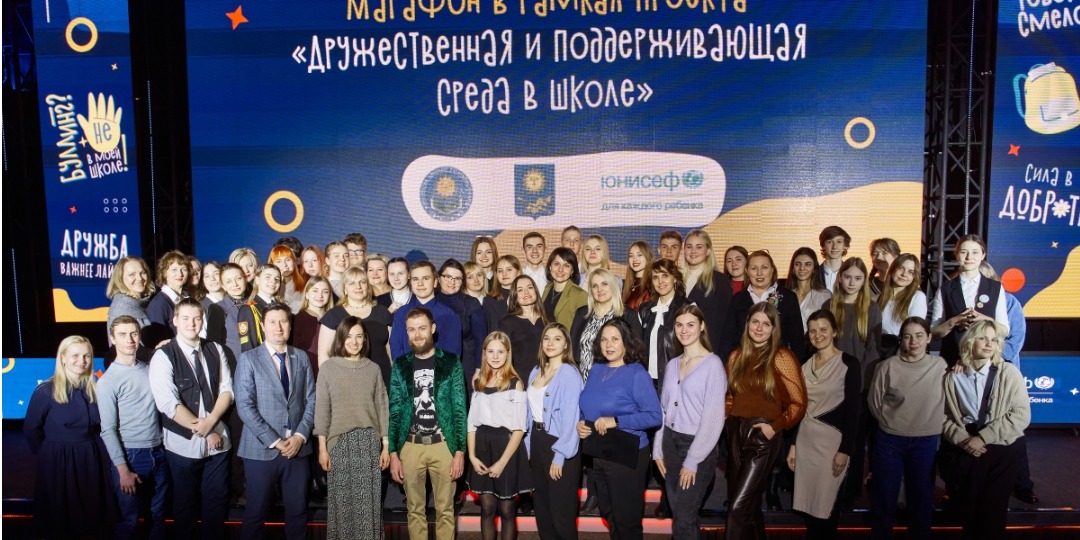
In Minsk, an online marathon took place where teenagers from pilot schools involved in the project “Friendly and Supportive School Environment Free from Bullying” shared their experiences and solutions on how to prevent bullying. Students from Minsk and the Minsk region presented their projects, including those from secondary school No. 125 in the Frunzensky district, gymnasium No. 146 in the Moskovsky district, secondary schools No. 66 and No. 45 in the Pervomaisky district, and Borovlyanskaya secondary school No. 2.
Understanding Bullying
Bullying is repeated aggressive behavior intended to cause physical or emotional harm to another person. It can take various forms, including physical or verbal abuse, and can occur online (cyberbullying) or offline. Violence against children is a global issue, including in Belarus. According to the PISA 2019 study, 19% of Belarusian schoolchildren experienced bullying several times a month.
A study conducted by UNICEF in Belarus in 2018 revealed that 11.6% of students in grades 5-7 and 11.3% of students in grades 8-11 consider the school atmosphere unfriendly, primarily due to bullying by peers, older students, or other members of the school community.
How Schoolchildren Combat Bullying
To address bullying and create a friendly and supportive school environment, the Ministry of Education of the Republic of Belarus, with the support of UNICEF in Belarus, launched an experimental project in 2020. The project, “Adaptation of the Model for Creating a Friendly and Supportive Environment in General Secondary Education Institutions,” initially involved 26 schools and expanded to 30 schools in 2022.
The model includes seven key steps aimed at:
- Extensive media coverage of conflict issues among teenagers;
- Promoting mutual respect among students and establishing a system to monitor compliance;
- Involving a wide range of stakeholders in violence prevention, including parents, teachers, and local authorities.
This model has already proven effective in Croatia, Serbia, and Montenegro, where it reduced school violence by 50% and bullying by 75%.
“UNICEF aims to protect children from all forms of violence, including bullying. The project focuses on protection and violence prevention. We strive for schools and communities to work together to create a culture of respect and understanding, where all children feel valued and safe. We recognize that children are crucial in combating and preventing bullying, so they should be involved in developing measures to prevent harassment,” said Dmitry Shilin, Senior Coordinator of UNICEF in Belarus for Child Protection.
Thanks to the project, schools have implemented violence prevention mechanisms, many of which were devised by the students themselves and presented at the marathon.
For example, students showcased the most effective solutions created during training on the social design methodology APShIFT. During the training, ten prototypes were developed, five of which received financial support for implementation from UNICEF in Belarus and the Institute of Psychology of BSPU. These projects include quests, board games, tutors for new students, workbooks for teenagers, sticker packs, chatbots, and comics.
“It wasn’t without challenges,” said Nastya from Minsk, who worked with other students on comics about bullying. “For example, we had to establish communication between different schools with different schedules. We spent a long time looking for an illustrator and working on tasks to make them effective and interesting. But we are glad we chose such a modern approach and are very happy that everything worked out.”
During the online marathon, participants also learned about the experiences of those who attended the communication training and the anti-bullying festival at the “Zubrenok” children’s camp last year. The main outcome of the work at “Zubrenok” was the project of the Constitution of a bullying-free school, where the students themselves formulated the main rights and responsibilities of the participants in the educational process for violence prevention. Several schools have already adopted this document and shared their experiences.
“At the communication training, after the lessons, we could ask questions to the experts. And that was the coolest part. We discussed all the problems that concerned us. It was also very interesting to listen to examples from the experts’ personal experiences,” the teenagers shared.
“We also acquired skills in communicating with peers and younger students about bullying: it is very important to know how to properly convey the idea of preventing harassment to the interlocutor, support the victim, and tell them where to seek help.”
The second part of the event was dedicated to a mini-forum for adults, without whom the project would have been impossible. These included project implementers, teachers, psychologists, mentors, and parents. They discussed important issues: what the project has achieved in 2.5 years and what needs to be adjusted to move forward more effectively. For example, parents noted significant positive changes in their children’s behavior, psychological well-being, and the overall school atmosphere.
“Teenagers have become more open to talking about this problem and are not afraid to seek help, including from teachers or psychologists,” said the mother of one of the students.
“Today, we have indeed reached the midpoint of our journey. We have not only adopted the project’s rules but also lived by and approved these rules, which we convey to others: ‘Speak boldly.’ Today, we are talking about the difficulties and problems that are our points of growth. We need to enhance our diagnostic and methodological tools to make our work easier and simpler,” said the project leader, Head of the Department of Psychology of Education and Personality Development at BSPU, Alla Viktorovna Muzychenko.
The implementation of the pilot project in Belarus is designed for 5 years. Now that half the distance has been covered, it was important to make an interim assessment and receive feedback from students, teachers, and parents.
Follow us on Telegram.