Building Your Personal Brand: A Blueprint for Success

Building Your Personal Brand: A Blueprint for Success
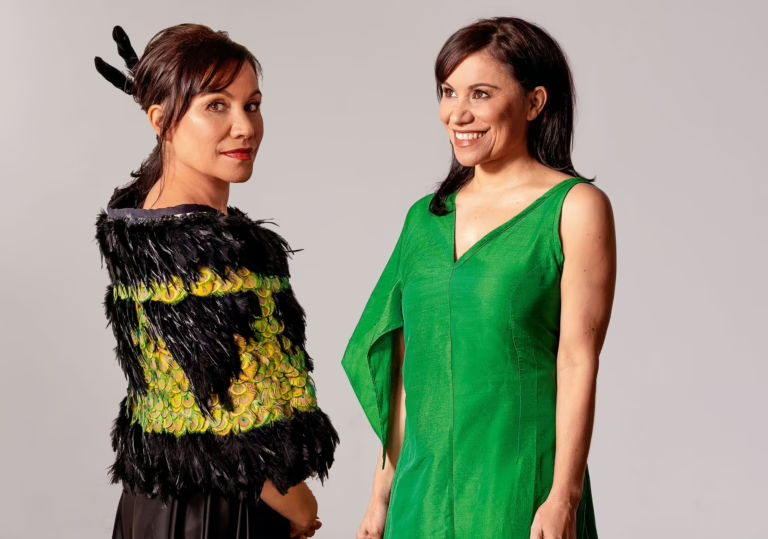
Our September cover features not professional models, but individuals whose work is intrinsically linked to publicity. Tatyana Kurbat and Daria Lyskovets have been managing PR and personal branding for over a decade. Both have held leadership positions in public relations departments at major international companies. Today, they are part of the same team and are ready to share their insights on creating a personal brand.
Why is Personal Branding Important?
Personal brands are more successful and in demand. They receive better job offers, easily implement bold ideas, enjoy popularity, earn well, appear in the media as experts, and feel a sense of stability.
Moreover, brands and corporations have found that traditional promotion tools are no longer effective because people have stopped trusting advertisements, especially those made by companies about themselves.
However, as trust in advertisements declines, trust in other people, personalities, opinion leaders, and experts increases. This era in communications is often referred to as the “heart-to-heart” or “person-to-person” era.
The Difference Between a Personal Brand and a Popular Personality
Popularity means frequently appearing in the information field, often referred to as “face shining” in PR. While this makes a person recognizable, without expertise, it remains just a story about the packaging.
A personal brand, on the other hand, is primarily an expert whom people trust and whose opinions they value. People follow them, are inspired by their actions, listen to them, are loyal to them, and follow their choices and recommendations. Additionally, they are known in their professional field.
Therefore, building a personal brand is not just about self-promotion, being in trendy circles, dressing stylishly (though that is important), or gathering hundreds of likes on Instagram. It’s about creating a smart package for a good and quality product, which is the person themselves. It’s about establishing warm, trusting, and long-term relationships with people.
At the core of a personal brand is always a mission, a key idea. What do they want to tell the world? What are they ready to give to people? How do they change the space around them? Can this idea unite other people? And all this should stem from sincere motivations.
The First Stage: Laying the Foundation
Creating a personal brand is not much different from building a house: first, you need an idea and a project (in the case of personal branding, a strategy). Next comes the foundation, which will support the structure (in our case, an existing business, a new project, a hobby, or some activity where the person is an undisputed expert). After that, you can start building, designing, and then promoting and introducing the finished project to the audience.
It is essential to determine the path, the direction of movement, and to get to know yourself well. This will help avoid internal conflict, contradictions, and the eternal question: “Am I doing the right thing?” Therefore, it is necessary to define your values and goals, knowledge, and skills.
There are many ways to do this: you can delve into your personality independently, with the help of coaches and experts, through special tests and literature, or by communicating with your surroundings and asking what they think about you and how they perceive you. Then compare it with how you see yourself.
The Second Stage: Dressing the Brand
“Dressing” the brand involves coming up with a name and pseudonym, logo and other visual attributes, style and color solutions, determining the most advantageous and appropriate appearance, working on gestures, gait, voice, and the ability to behave in public. It may also involve creating a website and organizing social media profiles.
The design of the brand is important because it helps people immediately understand “what you are about,” who you are, what idea you convey, and what you want to say to the world. The “clothing” of the brand is already communication.
Only when the project called “your brand” is ready and packaged can you move on to its promotion among the target audiences.
In personal branding, it is crucial to follow the stages. Skipping any step risks not meeting the audience’s expectations (a brand is the opinions about you and the associations people have with you or your product, not what you think and say about yourself).
Who Needs a Personal Brand?
We are often told that personal branding is only needed by those who work in the public sphere. This is not true. A personal brand is needed by anyone who wants to achieve success, surround themselves with the best people, and independently choose who to collaborate with.
For example, many psychologists, coaches, and business consultants work in Russian-speaking countries. Among them, of course, there are many professionals. However, they all have audiences of different sizes, and as a result, their income levels also vary. Those who quietly and modestly sit in their offices and conduct personal appointments likely feel different from those who have worked on their brand and started promoting themselves.
Professionals who have created a name for themselves live more comfortably. They are quoted by the media, their posts are shared on Facebook by hundreds of people, and thousands attend their webinars. As a result, these psychologists realize themselves and do not experience financial difficulties. Financial freedom often helps to realize one’s potential to the fullest, without being distracted by monetary issues.
However, there is a trap: if guided solely by mercantile motives, it is unlikely to achieve success. Only a sincere desire to benefit people, share knowledge and skills, and a willingness to help will yield the expected results. All components of the brand must be genuinely close and understandable to you.
They must be sincere and real. They should inspire you first and foremost! Therefore, the task of those who build their brand is to be themselves. There is a wonderful phrase, “Be, not seem.” This applies to personal branding as well.
When we work on creating a personal brand, we start with an audit of the person themselves. Who are they, what are their true values, what do they like, what colors do they prefer, what do they prefer in clothing, what literature do they read, and so on. All this is the raw material, a kind of “given,” with which we will work further to improve. But not to remake beyond recognition.
You can turn to professionals for creating a “me-brand,” or you can work on it yourself. However, there is a risk of engaging in non-core activities to the detriment of the main occupation.
First, you need to determine your vector. Next, you need to work through all points of contact (how the audience will interact with you): appearance, social networks and website, interviews, and photos. All this should be done in the same style and not contradict each other.
The Third Stage: Tools for the Brand
The most difficult stage is usually promotion. It’s one thing if you are familiar with the laws of marketing and PR. It’s quite another if all this is a dense forest for you.
Remember the key idea: connections and people decide everything.
We recommend starting with building warm and long-term relationships with those people who depend on promotion to success. Building relationships does not mean using people for your purposes. It is a collaboration beneficial to both parties. Warm and trusting.
Let the website be a single-page with a concise landing. It simply serves as a showcase where you can place the best exhibits of your work.
For further reading, consider exploring Forbes, a renowned source for business and marketing insights.