Bread and Circuses: 5 Peaceful Revolutions That Changed History
Bread and Circuses: 5 Peaceful Revolutions That Changed History
History is often marked by violence and images of pain, suffering, and loss. It seems that not a day goes by without news of another bloodshed, suppressed revolt, or act of terrorism. However, modern society faces numerous problems and conflicts that require resolution and radical changes. Let’s remember some historical movements that fought for rights, freedom, and humanism without resorting to violence. These movements were more successful than anyone could have expected, promoting justice, strength of spirit, hope, and beauty. They may not have been loud, but they showed that violence is not the answer and that salvation lies in unity.
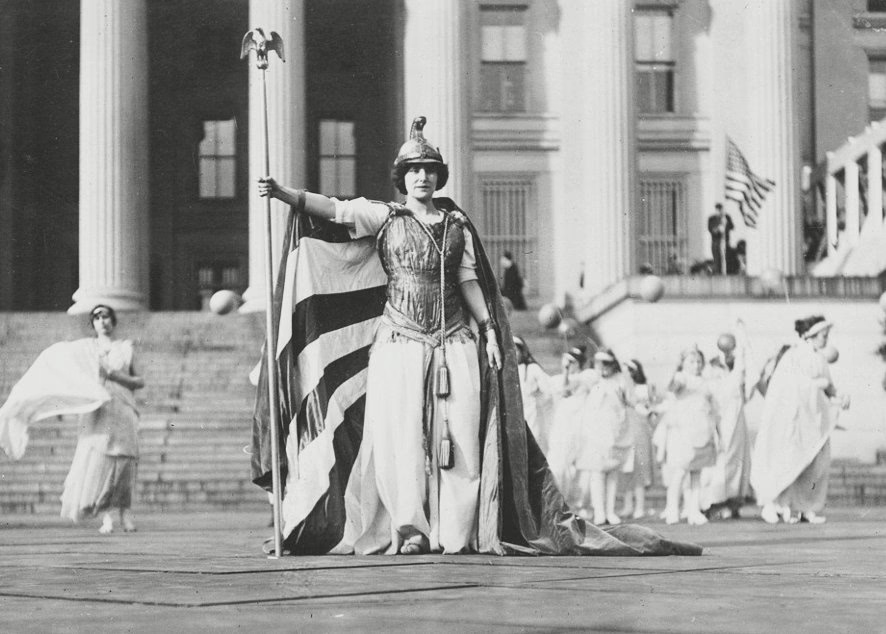
The Suffragette Parade, 1913
Why should you participate? Because it was the most significant demonstration ever organized by the suffragettes. This parade would highlight the importance of the suffragette movement, as it would be witnessed by the press and thousands of people gathered in Washington for the Inauguration. This was the call to women preparing to organize the largest suffragette parade in America. Together, they planned to participate in a demonstration aimed at drawing attention to issues concerning women’s rights.
Indeed, on March 3, 1913, women gathered for a parade along Pennsylvania Avenue, led by speaker and lawyer Inez Milholland, who was dressed in white and rode a white horse. Behind her were 5,000 women from different countries. In addition to them, the parade included musicians, cavalrymen, heralds, and 24 decorated platforms. Despite the fact that the main part of the audience, which included men, did not receive the demonstration very kindly, shouting insults and behaving indecently to distract the women marching in a straight line, the press described the event as the most beautiful, magnificently organized, and spectacular parade ever held in the United States.
The Olympic Games, 1968
At the medal awarding ceremony during the 1968 Summer Olympics, two African American runners stepped onto the podium not to bask in the glory of their victory but to draw public attention to the existing problem of racism and inequality that no one wanted to discuss. Athletes Tommie Smith and John Carlos, who were awarded medals for their victory, publicly raised their hands, clad in black gloves, during the national anthem as a protest against racial discrimination.
Later, the athletes explained that with this performance, they wanted to show their respect for the country in which they were born—the United States. “We are just people who saw the need to discuss the issue of inequality in our country. It is unpleasant that people look at us with negativity. We only showed our palms and bowed our heads to emphasize that the American flag symbolizes the unity of people, not hatred.” Their peaceful protest inspired many viewers from different countries, and the performance itself showed that success can be an excellent platform for addressing important social issues.
The Singing Revolution, 1986-1991
In 1939, Estonia was the first country occupied by the Soviet Union and then by the Nazis. Terror and dictatorship exhausted the nation, especially considering that a quarter of the population was deported to Siberia by the end of World War II. During the war, songs helped people remember their culture, language, and dignity. This is why, in 1987, a series of demonstrations were held on the streets of Estonia. The demonstrators were unarmed and had no aggressive intentions; all they did was use their voices. Thousands of Estonians gathered together, risking their lives to sing national songs about their country and unity.
The participants were filled with patriotism and passion for their homeland, so the movement quickly gained new participants and was repeated many times. This revolution helped Estonia soften the Soviet government and gain freedom. Thus, historical events prove that the power of song should not be underestimated.
The Ford Factory Strike, 2007
In 2007, the Ford factory in Vsevolzhsk held the first Russian strike, which had a European character and was organized according to Western standards. Considering that revolutions and protests in Russia and the Russian Empire were quite memorable and heroic but not at all peacekeeping, this strike can be considered a great achievement for the Russian people and government. The protest was pre-planned and well thought out, and by the end, the Ford workers achieved their goal, gaining the opportunity for civilized negotiations with the management. The factory’s work was suspended from November 23 to December 17, during which the conveyor was stopped, and 271 cars were not produced, resulting in losses of $5 million. As a result, the workers achieved a 16-20% wage increase, and public movements in Russia acquired a more modern character.
Martin Luther King’s March
The brightest example of peaceful activism in U.S. history is the March on Washington for Jobs and Freedom, which took place on August 26, 1963. More than 200,000 Americans participated in the protest, calling on the government and people to pay attention to the problem of racial discrimination and injustice. The movement was led by Martin Luther King, who accompanied the march with his famous public speech “I Have a Dream.” This day was a peaceful and joyful culmination of his speech, songs, prayers, and other activities undertaken by clergy, speakers, civil rights activists, and politicians. The march itself inspired hope for a new future and the strength to bring it closer.
King’s speech about his dream that one day his own children would live in a country where they would not be judged by the color of their skin gave Americans faith that they too could dream. For further reading on peaceful protests and their impact, you can visit this Nobel Peace Prize page.