A Talk with Anita Gademann | Founder of Edu Smart Technologies and Member of the Board & Head of Innovation, Institut auf dem Rosenberg
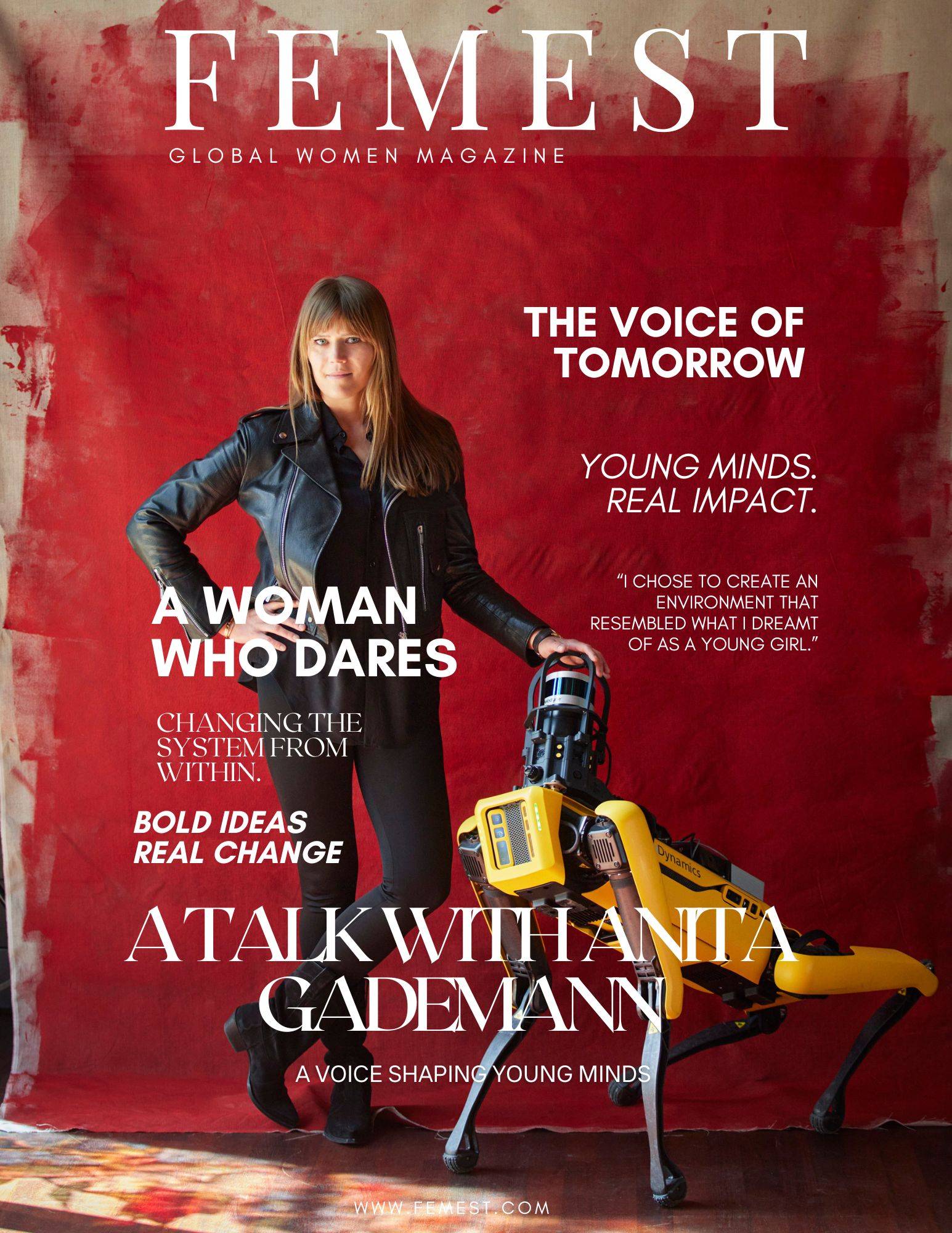
Transforming Education: A Visionary’s Journey
This interview delves into the story of a pioneer in education who is revolutionizing the way schools operate today. She shares her journey, the challenges of molding learning environments, and how she empowers students with a genuine voice and responsibility. Discover how students learn through innovation, technology, and student-led projects to grow and prepare for the future.
From Personal Passion to Educational Innovation
Could you briefly tell us about yourself and what led you into the field of education?
I am deeply passionate about education and learning, whether it’s learning for myself, developing new technologies, creating an educational environment for our students, or mentoring our team of leaders. I’ve always been a contrarian and very academic. While I was a good student, I was unhappy with the education system during my youth.
This dissatisfaction drove me to create an environment that resembled what I dreamt of as a young girl. One of my favorite quotes, often attributed to Einstein, is: “Insanity is doing the same thing over and over again and expecting different results.” I am committed to doing things differently to achieve transformative results.
From Media to Education: A Necessary Transition
You have worked in media, business, and innovation. What pushed you to move from writing about the world to shaping it through education?
As often happens in business and entrepreneurship, my transition to education occurred out of necessity. I am a mom of two wonderful children, and this role brought me into the field of education. I needed to create a school environment in which my children would thrive because I couldn’t find a school that I thought would enable and inspire them.
The Birth of Edu Smart Technologies
What inspired you to create Edu Smart Technologies, and what gap did you see in schools at the time?
Edu Smart Technologies emerged from a deep necessity for technology that was lacking in the market. This technology helps us deliver on our promise to our clients, families, and students. Accountability, which we deeply believe in, can only be achieved if there is transparency towards all stakeholders—students, teachers, and parents—something most school systems lack.
Our vision for the ideal school required a live system with powerful generators to create individual timetables, update information to students and teachers multiple times per day, and connect accurate information in real-time to deliver the diverse and abundant offerings we create.
Innovation at Institut auf dem Rosenberg
In simple words, how would you describe your role as Head of Innovation at Institut auf dem Rosenberg?
I am fortunate to work at a school where innovation happens every day, bridging academic knowledge and the real world, and giving young people what they deserve: agency and a voice.
I listen to my clients, who are all highly successful entrepreneurs. I try to understand what they want for their children, what they struggle with, and what they hope for. I break this down to the smallest units of learning to find what we can offer our students. For instance, if parents talk about the lack of collaboration and teamwork in the workplace, we ensure that all courses provide opportunities for teamwork, whether through debates, band concerts, or problem-solving in a team.
I am also highly aware of my privilege to work at a school like Rosenberg and applaud everyone else trying to innovate in a rigid and archaic world of education. In the simplest terms, the role of a Head of Innovation in the context of institutional education is to question everything. If a dean or headteacher says, “This is how it’s done,” a Head of Innovation must ask why and analyze the answer in detail.
The likelihood that the answer is “because it’s always been done this way” or “the best schools in the world do this” or “in my previous school we did this” is very high. I wish the Head of Innovation position at schools would be as exciting as it is in the tech industry. Unfortunately, Heads of Innovation in schools innovate paradigms and ecosystems that are two hundred years old without access to technology. Can you imagine innovating a newly built factory during the Industrial Revolution without new technology? That’s what schools struggle with today—their own resistance to innovation.
The Rosenberg Difference
Rosenberg is known for doing things differently. What makes its education model stand out today?
We have created our own educational ecosystem, an environment in which all stakeholders participate with agency, accountability, and success. I did not undergo typical training for leadership in education, which is why my working philosophy is entrepreneurial and service-driven: the pivotal moment for me daily is to deliver on my promise.
When the student is at the forefront of an operation, we cannot talk about a system of education or educational model because they all fail students. We offer the exact opposite: we hope to inspire students, discover their passions, and hold them accountable for what they are good at. If aviation is a student’s passion, we expect them to thrive in physics and mathematics. If aviation design is what they are after, that’s fine; they can pursue visual arts.
At the same time, if a student spends hours every day on mathematics problems or practicing the piano and yet they are not progressing successfully, we let them know very openly and honestly that this is not their field of excellence. We treat our students with great respect and believe they can handle this feedback and use it constructively.
At Rosenberg, we choose not to follow any educational model because we found educational models, whether national school models or international external exam models, so outdated that we would have failed our clients by offering one or two models. The educational systems or models have been in existence for two hundred years and have created a society that struggles with mental health, dislikes their jobs, and looks for inspiration outside of their workplace, yet spends the most time working. The educational systems have not served our society successfully.
We run our proprietary Rosenberg International Curriculum, which offers external examination systems of value to universities such as the IB, the American Advanced Placements, or the International A levels alongside language examinations following the CEFR model, performing arts and public speaking exams from the London Academy of Dramatic Arts, Trinity music exams, among others.
Empowering Students at the World Economic Forum
Being the first school to host at the World Economic Forum is a big step. What does this moment mean for students?
I am thrilled about this wonderful opportunity and everyone who is joining our students at the Rosenberg House Davos. I believe it will be the first time a large group of young people will be given the voice they deserve. You will be able to see students as young as twelve years old interview leading voices, and I am sure our students will surprise and inspire the ruling generation.
President Obama recently said, “It’s fair to say that 80 percent of the world’s problems involve old men hanging on who are afraid of death and insignificance, and they won’t let go,” and I wholeheartedly agree with this statement.
I am sure that everyone is trying to do their best, but we must reflect and understand that the world of today is not as great as we would have hoped for it to be. It’s time to change something; it’s time to give the power and voice to younger generations to look for solutions to the world’s problems instead of talking and holding on to power.
Lessons from Student-Led Conversations
Rosenberg House is fully student-led. What have you learned from watching teenagers lead global conversations?
Teenage conversations are almost always solution-led, which is so refreshing and inspiring! Teenagers have a heightened reward responsiveness as a result of their maturing prefrontal cortex, which makes them more prone to take risks. They are much more willing to put their head on the line and say something that may seem risky.
For further insights into innovative educational practices, visit the World Economic Forum.