Kate Newby’s Artistic Sanctuary: A Journey Through Te Henga
Kate Newby’s Artistic Sanctuary: A Journey Through Te Henga
Contemporary artist Kate Newby has discovered a peaceful retreat and a wellspring of inspiration at her family’s property in Te Henga, marking a tranquil yet fruitful homecoming.
The Creative Roots
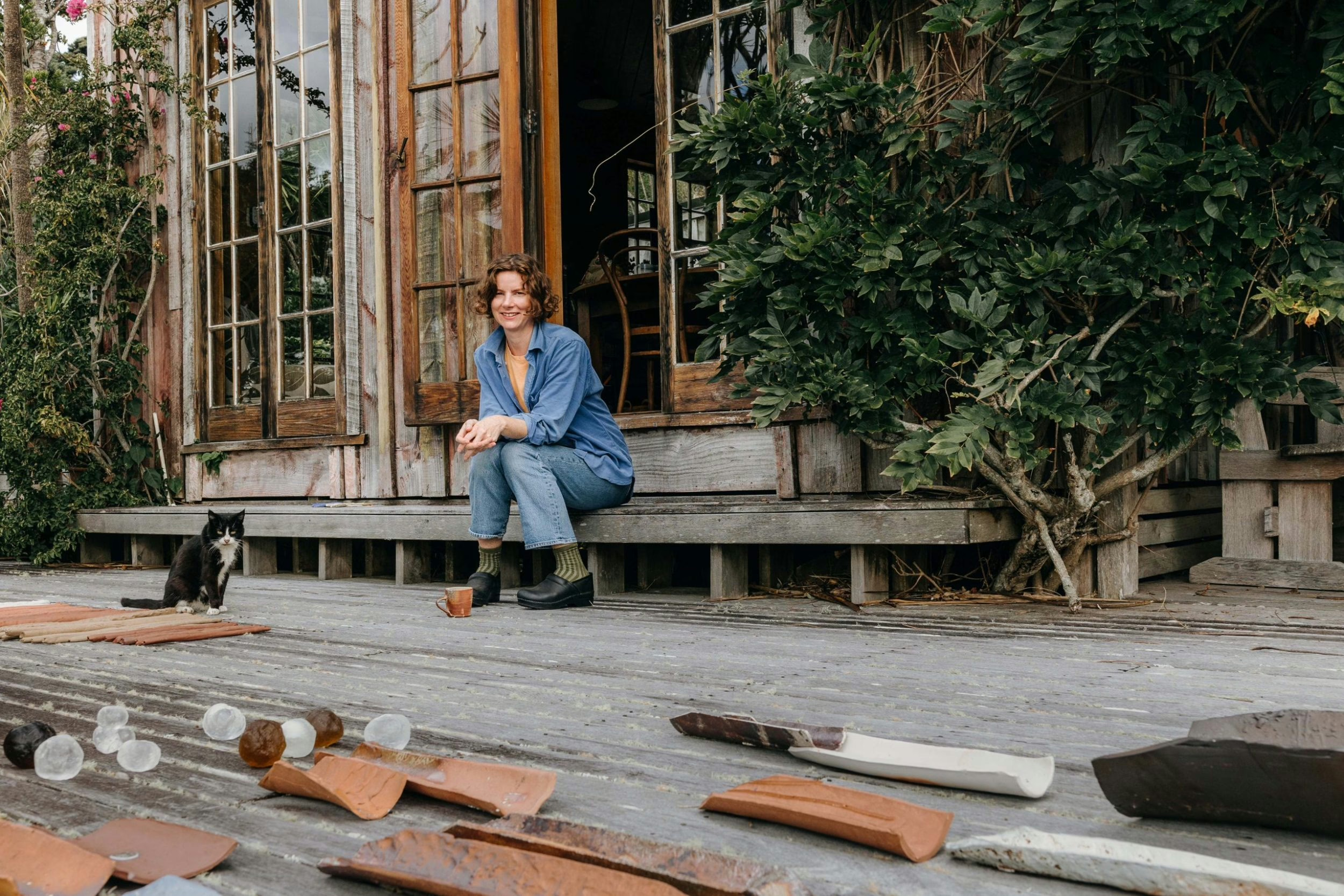
In the 1970s, Kate Newby’s childhood home was transformed into a pottery studio by her parents. Accessible only via gravel roads, they revamped the space using repurposed materials, including windows salvaged from central Auckland’s High Street. Nestled in the Te Henga (Bethells Beach) bush, the home’s surroundings seem to foster creativity.
Kate grew up in a lively creative community, with filmmaker Briar March and her mentor, artist Allie Eagle, as neighbors. “I grew up in a creative community, and both my parents have a huge interest in art,” says Kate. Her home became a hub for artistic inspiration, with a wood kiln on the property where the whole valley would gather to fire pots.
The Artistic Journey
After years of success as an artist in the US, Kate has returned to her Te Henga roots, preparing for some of her most exciting exhibitions yet. The home now houses her mum, Margaret, and cat, Wendy, along with her old artworks scattered throughout the space.
Kate’s interest in art developed gradually. She took art classes at Massey High School before transferring to ACG Senior College for her final year. Although she was accepted into the prestigious Elam School of Fine Arts at the University of Auckland, she didn’t consciously set out to become an artist. “I just kept going. I didn’t even think about it,” she reflects.
Artistic Influences and Process
Reflecting on her art school days in the 1990s, Kate valued the time spent in Elam’s library, away from the internet’s overwhelming influx of information. “I appreciated that protection from the current art situation, because it helped me foster curiosity quite slowly and intuitively,” she says.
Back home, Kate has been sorting through old notes from art school, rediscovering her early influences. “It’s so interesting to see what I was looking at back then and what I was drawn to. And I think about how that still really affects my work now,” she muses.
Artistic Vision and Exhibitions
Kate’s art responds to locations, translating observations into installations using locally sourced materials. She works with everyday textures—from textiles to ceramics and glass—to render lived experiences into art. For her doctorate in fine arts, completed at Elam in 2015, she explored ideas around interiors and how we operate in different spaces.
Her work often challenges expectations of how art can be experienced, using windows and windowsills as display spaces. “I really like the idea that my work can be lived with quite casually. The work could just be sprinkled along a windowsill, or it could be put outside in the garden,” she explains.
Kate’s accolades include the 2012 Walters Prize, New Zealand’s most prestigious contemporary art award, and a grant from the New York and New Orleans-based Joan Mitchell Foundation in 2019. Her most substantial exhibition to date, Yes Tomorrow, was held at Adam Art Gallery Te Pātaka Toi in Wellington, featuring found objects and collaborative pieces.
International Recognition and Future Plans
Kate’s international exhibitions include a notable show at the Kunsthalle Wien in Vienna, where she installed 6000 bricks embedded with local objects. Another career highlight was a residency at The Chinati Foundation in Marfa, Texas, where she enjoyed biking through the desert past sculptures by the foundation’s founder, artist Donald Judd.
“I think the importance of art is it uses all sorts of things to make sense of the world around us,” she says. “It opens up spaces—it doesn’t close them down.”
The past year in America was challenging due to the pandemic, but Kate found a silver lining in the slower pace of living. “I wasn’t sad that heaps of my shows got pushed or cancelled or changed,” she says. “There’s a momentum around contemporary art that I’m really unsure about. I wasn’t really expected to do anything in the same way. And that was actually—now I’m thinking about it—quite a relief.”
Day-to-day life was still nerve-racking, and returning to New Zealand at the end of 2020 provided a welcome respite for Kate and her partner, Rob. They have enjoyed walks along the clifftops and on the beach, and swims in Lake Wainamu over the summer. “Being here calms me in a way I’m not calm anywhere else,” says Kate. “My body remembers it all in a way it doesn’t know any other space.”
Making the most of her time reconnecting to New Zealand, Kate is working on a September show for the Govett-Brewster Art Gallery in New Plymouth. She is collaborating with local potteries and tile makers, relearning about the New Zealand art ecosystem. “I love that people are curious and they want to see you do your work, and they want to help you do your work. I’m having such a nice time working here. I’m not going to rush away,” she says.
Once her work in New Zealand is finished, Kate will return to the US. She and Rob have relocated to South Texas and will spend the summer in a small farmhouse on an old ranch, providing her with the tranquility she craves.