From Graveyard to Glory: The Unconventional Life of Charlotte Brontë, Author of Jane Eyre
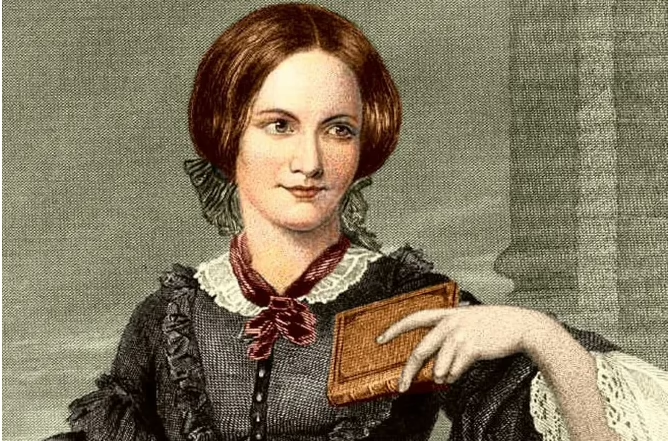
From Graveyard to Glory: The Unconventional Life of Charlotte Brontë
On October 16, 1847, 175 years ago, the first edition of “Jane Eyre” was published. Charlotte Brontë wrote to her publishers, “Messrs. Smith and Elder,” three days later, saying, “You have done everything to make the book look attractive. Excellent paper, clear type, and a wonderful cover. If it sells poorly, the fault will lie with the author.” The book continues to sell to this day. The anniversary of this classic novel is a perfect opportunity to delve into the life of its author, Charlotte Brontë, in alphabetical order.
English Upbringing
The harsh realities of English upbringing in the 19th century are vividly depicted in the semi-autobiographical novel “Jane Eyre.” The Lowood Institution, where the protagonist resides, mirrors the Cowan Bridge School, where Reverend Patrick Brontë sent his elder children after their mother’s death. Tragically, two of his daughters died at the school, and the other two were withdrawn due to the dire conditions. The school was notorious for its poor conditions, with oatmeal made from rainwater collected from the roof, and epidemics raging through the premises.
Upon their return home, the children were cared for by their maternal aunt, Elizabeth Branwell. Although she loved the children dearly, their father’s stern demeanor and frugality meant that there were no luxuries, not even children’s books. Young Charlotte read newspapers, which reported on farmers’ bankruptcies and weavers’ strikes. Despite the grim tales of child-rearing in 19th-century England, the Brontë household was free from the ghostly tales that some parents used to discipline their children.
Pregnancy
The most fateful event in Charlotte Brontë’s life was her pregnancy, which ultimately led to her demise at the age of 38. She likely suffered from hyperemesis gravidarum, a severe form of morning sickness that causes irreversible damage to the body. Before this tragic turn, Charlotte experienced a brief period of happiness. After her marriage, observers noted that “God had wiped the tears from her eyes,” as she seemed to blossom.
Indeed, her life before this had been marked by sorrow, as she mourned the loss of her sisters, brother, and aunt Elizabeth. She wrote to a friend, “My life is now completely different from before. No one in the world has such a good husband as mine.” However, her happiness was short-lived, lasting less than a year.
Heather
The heather moors of Yorkshire, where Charlotte Brontë lived, were and still are a significant landmark. She would wander through these moors, contemplating the chapters of her novels. The moors also served as a refuge when her fame as the author of “Jane Eyre” became overwhelming. She once said that hiding away was like an ostrich burying its head in the sand. Eventually, she realized that she could not escape her fame, writing, “Hiding like this is deceiving oneself.”
The heather moors of Yorkshire attract tourists worldwide, but their stark beauty often evokes melancholy rather than joy. Heather is frequently mentioned in literature, but the contexts are usually somber or mystical.
Marriage
Charlotte Brontë received several marriage proposals but initially refused them all. At 23, she rejected her first suitor because she did not feel a deep enough attachment to him. She believed her chances of marriage were slim, but she was wrong. Her second suitor, Mr. B., a Dublin University graduate, was also turned down. She felt happier at home, cleaning and cooking, than she would have as a lady at social gatherings.
Years later, Arthur Bell Nicholls, a young colleague of her father and a curate, confessed his love for her. She initially refused him as well, citing her father’s need for her care. Eventually, she married Arthur Bell Nicholls, who adored her, but their happiness was brief.
Sincerity
Growing up in a rural parsonage in a remote area, Charlotte Brontë was unacquainted with the ways of high society. She was frank and outspoken, unable to hide her true feelings. Her straightforwardness extended to her opinions on literature and her contemporaries. She was particularly critical of William Thackeray, a renowned author she admired. She praised his surgical precision in dissecting societal ills but also criticized his harshness and lack of faith in human goodness.
Despite her sharp critiques, she acknowledged his literary prowess, stating, “Critics call him the second writer of our time. He should not be second. God made him first in everything.” She also noted his laziness, saying, “Mr. Thackeray is too yielding and lazy and rarely tries to reach the limits of the possible.”
Graveyard
The Brontë Parsonage, now a museum, is situated on a graveyard, with graves dating back over 700 years surrounding it on three sides. Reverend Brontë managed to halt further burials on the site due to the health risks posed by the hilltop cemetery, especially during rainy seasons and epidemics.
A stone plaque now marks the spot where the Brontë family entered the church, and nearby lies the family vault, close to where they once sat during sermons.
Mosaic Writing Style
Charlotte Brontë’s writing style was meticulous and deliberate. She would not begin a sentence until she knew precisely what she wanted to say. Her careful selection and arrangement of words led critics to describe her manner as mosaic-like. She patiently waited for the perfect word to express her thoughts accurately.