Valeria Lisitskaya: ‘Art is the Heartbeat of My Existence’
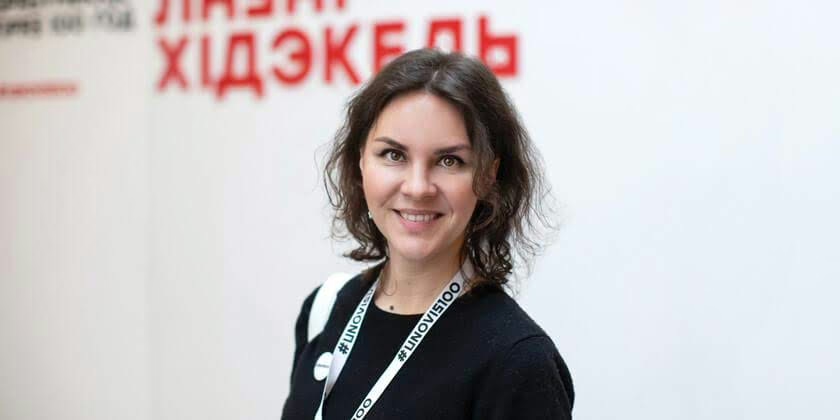
Valeria Lisitskaya: ‘Art is the Heartbeat of My Existence’
Suprematism, “Tale of Two Squares,” prouns, “Beat the Whites with the Red Wedge!” – these phrases echo through history as vivid reminders of the legendary artist, inventor, and architect El Lissitzky. His work in Vitebsk, as one of the “affirmers of new art” (UNOVIS group), has left an indelible mark on the world. Today, his masterpieces grace museums and exhibitions not only in Belarus but also in Russia, Germany, France, the USA, and the Netherlands. In an exclusive interview with “City of Women,” Valeria Lisitskaya, the great-granddaughter of the renowned artist, shares her insights on art, creativity, and the enduring legacy of her great-grandfather.
Meeting Valeria
Our encounter with Valeria took place at the Lazar Khidekel exhibition, “They Will Understand Us in 100 Years,” which opened in February in Minsk. This exhibition is part of the large-scale project #UNOVIS100, implemented by the Center for Belarusian-Jewish Cultural Heritage, the Museum of the History of the Vitebsk People’s Art School, and the company A1.
Valeria traveled from Novosibirsk, visiting Minsk and Vitebsk for the first time. Vitebsk, the city where, 100 years ago, Kazimir Malevich initiated the creative association UNOVIS (“Affirmers of New Art”), transforming the city into a global capital of the avant-garde. It was here that her great-grandfather, Lazar Lisitsky (known as El Lissitzky), one of the greatest masters of European and Russian avant-garde, worked. Valeria’s journey to Belarus was not only as the great-granddaughter of a famous creator and a member of the advisory board of the Lazar Lisitsky Foundation but also as a passionate admirer of avant-gardism and art in all its forms.
Valeria’s Journey
– Valeria, you are experiencing Belarus for the first time. Could you tell us about your origins and your current endeavors?
– I hail from Novosibirsk, my hometown. My great-grandmother, Sophie Küppers-Lissitzky, El Lissitzky’s wife, was exiled to Novosibirsk after his death in 1944 due to her German heritage. I have a diverse range of interests. For over a decade, I have been involved in charity work, focusing on projects for children with disabilities and special health needs. It is heartening to see the progress we have made towards inclusion and eliminating these limitations.
Another significant aspect of my life is psychology. I am a body-oriented psychotherapist, a field that is both modern and innovative. The human body is like a memory card, storing vast amounts of information about our lives, past, and present. My role is to guide individuals in exploring these “folders,” helping them to see, feel, and understand themselves better. It is incredibly rewarding to witness the transformation in people as they gain new insights and energy.
Art in Valeria’s Life
– Does creativity and art play a significant role in your life?
– Art is the essence of my life! While my heritage certainly plays a part, I believe that even if I were not Valeria Lisitskaya, I would still be drawn to Lissitzky, Malevich, abstraction, and constructivism. Music is another passion of mine; I sing and have a musical education. I am also drawn to movement and dance, which is perhaps why I chose body psychotherapy. Visual art has always captivated me.
Visiting Vitebsk
– Besides Minsk, you also visited Vitebsk and the Museum of the History of the Vitebsk People’s Art School, where UNOVIS was created. Your great-grandfather, El Lissitzky, lived and worked there. What were your impressions?
– Belarus has a special place in my heart. From the moment I arrived at the Vitebsk railway station, I felt a connection. The architecture reminded me of my hometown, and the cleanliness and order were striking. In the museum, I found myself in the very place where Lissitzky’s workshop once stood. It was an overwhelming experience, filled with a sense of his presence and energy. It was as if he was guarding me, a feeling that is difficult to explain but deeply moving.
This place is truly a “dormitory of geniuses.” So many brilliant minds gathered here to create something magical, something that would be discussed even after 100 years. The impact of El Lissitzky’s work is timeless; his genius will continue to inspire for generations to come.
Discovering Lissitzky’s Work
– Can you recall the moment when you first consciously encountered your great-grandfather’s work?
– My love for Lissitzky’s work began in childhood. My grandmother introduced me to his art, and I was captivated by the magic of his paintings. As I grew older, my appreciation for his style deepened. Minimalism and geometry in jewelry, clothes, and interior design have always resonated with me.
In 2001, as a student in Cologne, Germany, I visited a gallery where Lissitzky’s works were exhibited. His abstract cabinet, a 3D space that immerses you in the painting, left a lasting impression on me. I also have a deep affection for Lissitzky’s figurine “New,” which has always been close to my heart.
Studying Lissitzky’s Creativity
– Did you study your great-grandfather’s work purposefully?
– My exploration of Lissitzky’s work has been more intuitive. I am grateful that there was no family pressure; I studied the aspects that attracted me the most. In life, we excel at what truly inspires us and fulfills an inner need.
Memories of Lissitzky
– Were you told about Lissitzky? What was he like?
– I heard many stories about his boundless energy. Lissitzky was like a battery, constantly recharging those around him. Despite his untimely death at the age of 51, he accomplished so much in his short life. His energy and character traits were truly remarkable, leaving a legacy that continues to inspire.